
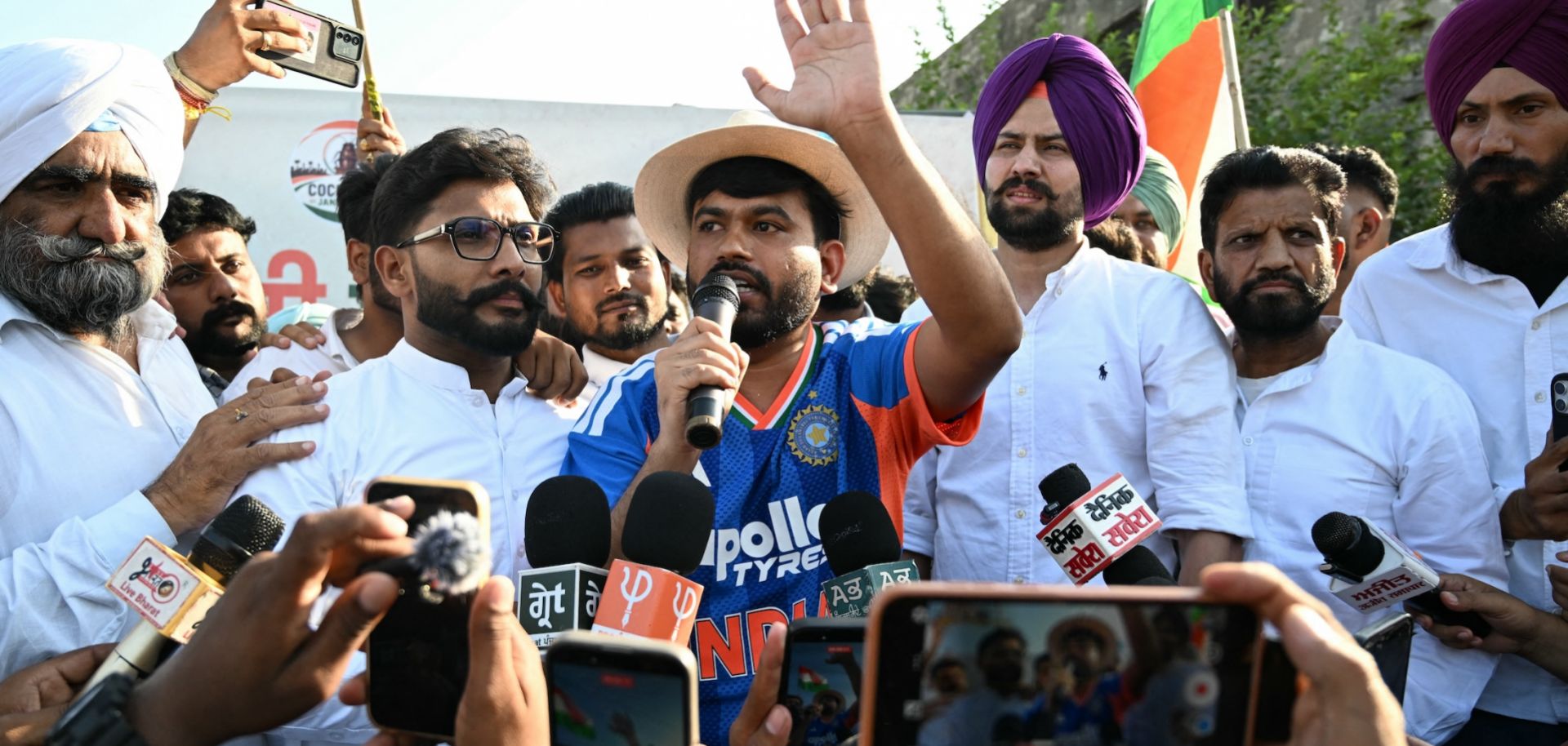
Cockroach Janta Party founder Abhijeet Dipke (center) participates in a protest in Amritsar, India, on June 13, 2026.
(Narinder NANU / AFP via Getty Images)
Cockroach Janta Party founder Abhijeet Dipke (center) participates in a protest in Amritsar, India, on June 13, 2026.

In India, the Cockroach Janta Party (CJP) youth group will face challenges in translating its online popularity into an influential and sustained political movement, but worsening economic grievances may facilitate the movement's growth. Since its formation in mid-May, the Cockroach Janta Party (CJP) has amassed over 20 million social media followers and is now attempting to convert this growing online presence into street-level youth mobilization. Founder Abhijeet Dipke returned from Boston, the United States, to India on June 6 to organize protests demanding the education minister's resignation over recent scandals involving school entrance exams. The group has since staged protests in New Delhi (June 6), Pune (June 11), Lucknow (June 12), Amritsar (June 13), Hyderabad (June 14) and Jaipur (June 15). However, reported turnout at these events reached only the hundreds to low thousands at most, highlighting the movement's struggle to garner broader political support. In particular, the CJP has failed to secure outright backing from India's largest opposition party, the Indian National Congress. It has also faced criticism from the popular ruling Bharatiya Janata Party, which has painted the group as driven by foreign powers and anti-India forces.

  • The CJP's popularity has been fueled in part by grievances over school entrance exam scandals that have emerged in recent weeks. One scandal involved leaks of an exam required for admission to undergraduate medical school, resulting in authorities nullifying the test results of more than two million students. Another involved the introduction of a new digital grading system that botched results for a different major exam. 
  • The CJP protests have so far been overwhelmingly peaceful. However, an isolated violent incident occurred at the June 15 protest in Jaipur, where at least two unidentified men slapped the founder, Dipke, several times. Dipke responded by proclaiming in a video posted on CJP's social media accounts that "we will continue to speak out" despite efforts to scare and threaten "us."
  • Some critics have alleged links between CJP and the regional Aam Aadmi Party, in part because of Dipke's prior work with the party. While Dipke has acknowledged this past involvement, he has maintained that the CJP is independent.
  • The CJP's name is a satirical reference to comments made by India's chief justice, in which he compared some of the country's unemployed youths to cockroaches. Although its title also includes the word "party," the organization has yet to register as a formal political party in India. 

The CJP has gained significant online traction by channeling the economic frustrations of young Indians, who face persistently high unemployment rates, which have periodically triggered protests and occasional violent unrest. India has experienced higher youth unemployment than the global average in recent decades, especially among recent graduates. The vast majority of young Indians are also informally employed, often working without written contracts or legal protections in unregistered sectors that typically pay low wages. Against this backdrop, scandals linked to school exams and policies perceived as worsening job prospects have periodically triggered youth-led unrest. In June 2022, for example, young Indians staged roughly a week of violent protests across several states after the military announced a new recruitment scheme that limited most new recruits' service to four years and rendered many ineligible for pensions, which was largely viewed as undermining the traditional benefits and job security of a military career. More recently, in late December 2024, thousands of aspirants for Bihar state government jobs staged days-long protests demanding the opportunity to take new exams after prior exam papers were reportedly leaked. While such backlash has occasionally compelled authorities to grant modest concessions (such as regarding the aforementioned military recruitment scheme), young Indians have so far failed to mobilize sustained, widespread protests capable of bringing about greater change. The new CJP youth movement has thus stood out by quickly building a massive online following and attracting supporters likely inspired by recent youth-led uprisings in neighboring Bangladesh and Nepal.

  • World Bank data indicates that between 1991 and 2020, India's youth unemployment rate fluctuated between 20.1% and 26%, consistently exceeding the global average of 11.5% to 17.1%. From 2021 to 2024, India continued to face higher youth unemployment rates of between 15.6%-20.8% compared to the rest of the world, whose rates fluctuated between 13.3% and 15.7%, even as global trends improved. According to a 2026 report by Azim Premji University, these challenges have been particularly acute for recent Indian graduates, whose unemployment rate remained between 35% and 40% from 1983 to 2023. This has only worsened as more Indians have pursued higher education, with 67% of unemployed 20- to 29-year-olds in 2023 having recently graduated.
  • Several factors have undermined youth unity and national mobilization in India, despite shared economic concerns among young people. This includes the country's ethnic and religious diversity and quotas for government jobs based on caste, tribe and other classifications. Furthermore, India's decentralized administrative structure often directs anti-government grievances toward local and state authorities rather than the central government.

Despite this socioeconomic context, the CJP will face numerous constraints in translating its online popularity into a sustained protest movement, which will very likely limit turnout and heighten associated safety and operational risks at its demonstrations, at least over the coming weeks. The CJP's most prominent upcoming demonstration is scheduled for June 20, when the group has threatened to stage a mass, indefinite sit-in at New Delhi's Jantar Mantar protest site to intensify pressure on the country's education minister to resign. Beyond this, the CJP will probably continue organizing smaller demonstrations in various Indian cities as part of its effort to transition into a longer-term protest movement. However, the movement will face a range of constraints in achieving its aspirations, including its fledgling mobilization infrastructure and current, narrower focus on pressuring the country's education minister to resign. There are also questions surrounding the CJP's massive online following, including what percentage of its followers are humans versus bots, where most are based, and how many are willing to risk protesting in person. Additionally, the CJP will face challenges in broadening its support base, as the ruling Bharatiya Janata Party remains widely popular, while established opposition parties like the Aam Aadmi Party offer alternative platforms for dissatisfied voters. Furthermore, Indian authorities have a history of effectively neutralizing political threats, often in part by utilizing advanced cyber capabilities to surveil and combat government critics. These constraints will very likely limit turnout at most CJP protests in the coming weeks to hundreds or a few thousand participants, and keep rallies localized to their announced locations, which have so far included universities and prominent demonstration sites in major urban areas. While events like the scheduled June 20 protest in New Delhi may draw larger crowds, the relatively limited size of the group's recent rallies suggests any increase will likely be modest. However, even limited demonstrations could still cause localized travel and business disruptions in the urban areas where they occur. Personal safety risks will also be elevated in these areas, especially if authorities crack down on protests, which is more likely to happen at those held without formal permission.

  • Some Indian law enforcement agencies have reportedly already considered how they would deal with a mass popular mobilization resembling Bangladesh and Nepal's recent youth-led uprisings. Weeks after Nepal's September 2025 unrest, which ultimately helped topple the country's then-government, the Delhi Police Commissioner reportedly directed the agency's intelligence, operations and armed police units to draft a "contingency action plan" to address such a possibility.
  • Beyond the challenge authorities will pose, probable ideological divisions within the CJP, alongside protest fatigue, will also constrain the group's efforts to become a widespread protest movement.

Over the coming months, economic grievances fueled by lingering disruptions from the Iran conflict, along with authorities' potentially assertive crackdowns on CJP and its demonstrations, could fuel greater support for the group and exacerbate its associated tactical and political threats. While the CJP currently appears narrowly focused on pressuring the resignation of India's education minister, the group has also published a broader five-point "manifesto," which includes barring India's chief justices from being granted a seat in the upper house of parliament after retirement, arresting the country's chief election commissioner "if any legit vote is deleted," and barring lawmakers who defect from one party to another from contesting elections and holding public office for 20 years. The existence of this manifesto and the fact that broader youth economic anxieties account for much of CJP's support suggest the group will remain intent on organizing demonstrations, regardless of whether it succeeds in pressuring the education minister to step down. Over the coming months, there will remain an underlying potential for the CJP — or some successor group — to foster a more popular, politically influential and possibly enduring street movement fueled by youth economic anxieties, which will risk worsening as the lingering impacts from the recent Middle East conflict threaten to sustain heightened inflation, temper economic growth and disrupt India's energy supplies. Aggressive security crackdowns on young demonstrators or Dipke's arrest could also give the CJP additional momentum by garnering sympathy and broader popular support. Any such expansion of support would exacerbate the safety and logistical threats posed by the group and its future demonstrations, and increase political pressure on Prime Minister Narendra Modi and his ruling Bharatiya Janata Party.

RANE
SUBSCRIBERS ONLY

Expert analysis when it matters most.

Get access to RANE's decision-grade geopolitical intelligence.