
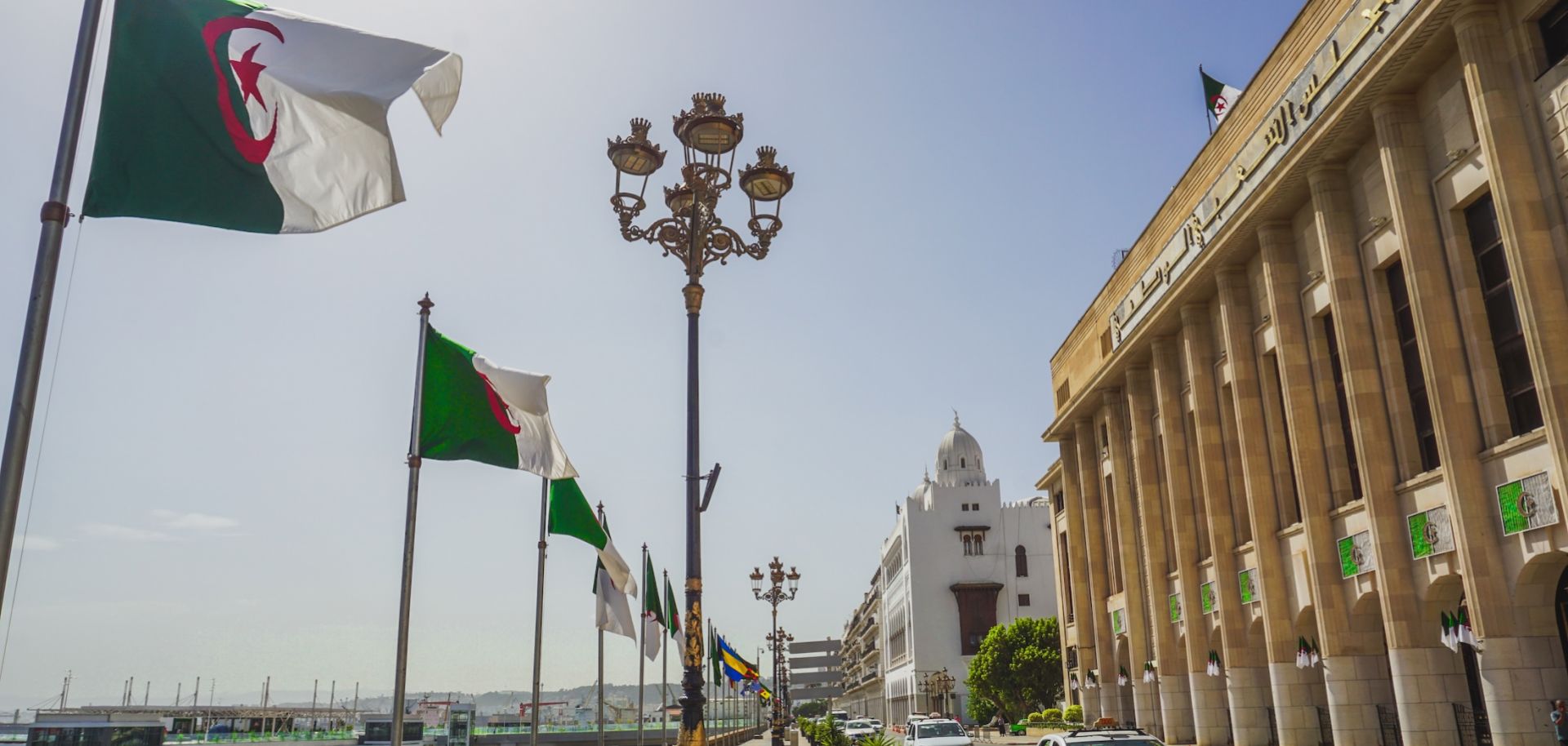
The Council of the National Assembly, Algeria's primary legislative body, is seen in Algiers.
(Getty Images)
The Council of the National Assembly, Algeria's primary legislative body, is seen in Algiers.

Algeria's parliamentary elections will very likely yield an assembly that supports the president's policies, signaling continuity in foreign and domestic affairs, alongside limited reforms aimed at mitigating domestic unrest. On July 2, Algeria will elect lawmakers to fill the 407 seats in the National People's Assembly, the lower house of Parliament, for a five-year term. The National People's Assembly — in combination with the Parliament's upper house, the National Council — is responsible for drafting and voting on laws, approving the state budget and providing nominal oversight over Algeria's executive branch. Both legislative chambers are currently dominated by Algerian President Abdelmadjid Tebboune's pro-government bloc and have done little more than rubber-stamp his agenda. Tebboune has recently moved to further increase his power over Parliament by supporting March constitutional reforms that expanded the role of the upper house, to which the president appoints one-third of the members, in resolving parliamentary deadlocks. The reforms also transferred several duties from the National Independent Election Authority back to the Ministry of the Interior, including ballot organization and polling site staffing.

  • Voter turnout dropped from 35.4% in Algeria's 2017 elections to 23% in the 2021 elections. The 2021 vote was the first after the 2019-21 Hirak protest movements, which demanded pro-democratic reforms and led to the ousting of former President Abdelaziz Bouteflika. While the movement eventually dissolved due to COVID-19 restrictions and government crackdowns, the establishment of the National Independent Election Authority served as a political concession to protesters intended to reduce government interference in elections. However, the recent constitutional reforms have eroded the body's independence, and the military still exerts influence over it.
  • Tebboune was initially elected in December 2019 in the first presidential election since the Hirak protests forced Bouteflika to resign in April of that year. Tebboune was reelected for a second term in September 2024, securing around 95% of the vote with a voter turnout rate of 46%. 

The military exerts significant influence over the electoral process, and the disqualification of reformist candidates — alongside crackdowns on the opposition — will limit competition ahead of the July vote. While Parliament is responsible for legislation and executive oversight, political authority remains concentrated within the presidency and the military. The military, Algeria's primary powerbroker, exerts substantial influence over elections and the National Independent Election Authority, despite the latter's nominal impartiality. Historically, the security apparatus has leveraged the judiciary to embroil opponents in "anti-corruption" charges, a tactic that intensified after the 2019-21 Hirak protests. Ahead of the upcoming elections, the electoral authority banned former Hirak activists from running on both pro-government and opposition lists, often citing vague "suspicious activities." Consequently, several opposition parties plan to boycott this vote as they have in previous elections due to government interference. Additionally, Algerian authorities have quashed efforts to resurrect broad protest movements, including the #GenZ213 campaign, which denounced the poor economic conditions Algerian youth face, including high unemployment, as well as restricted free speech, and the 2024-25 online grassroots movement "Manich Radi" (meaning "I am not satisfied"). Furthermore, there are longstanding grievances regarding systemic corruption, low salaries and poor working conditions, the latter of which have fueled sporadic labor protests, including the February 2025 nationwide teachers' strike for better pay and conditions.

  • Since the Hirak protests, Algerian authorities have cracked down on protest movements such as 2025 efforts by young Algerian activists to lead a #GenZ213 protest movement calling for economic improvements for young Algerians, inspired in part by the September 2025 #GenZ212 protests in Morocco. However, the protests never gained traction in Algeria and quickly fizzled out, especially after calls for nationwide protests led to significant deployment of Algerian security services in major cities. 
  • Broad skepticism toward political parties means that, in every parliamentary election, numerous independent candidates win seats. Still, many align themselves with the president, further increasing the pro-government bloc in Parliament. 

The elections will likely yield a similar, pro-Tebboune lower house, precluding any significant changes in the overall power dynamics of Algeria's political system. The Tebboune government will likely encourage Algerians to vote in the election to strengthen its legitimacy, but turnout will likely remain low amid broad political disengagement and boycotts over government interference. In the end, the pro-government bloc, which comprises the nationalist National Liberation Front and the center-right Democratic National Rally, will likely dominate the elections. While the two parties might not secure a clear majority on their own, nominal opposition parties — such as the centrist Future Front and the Islamist National Construction Movement, also known as Binaa — are expected to generally support President Tebboune's goals, giving the pro-government bloc an effective majority in the lower house. As a result, the election will not change the overall power dynamics of Algeria's political system, and Algeria's Parliament is very likely to continue rubber-stamping Tebboune's policies. 

As such, Algeria's domestic and foreign policy will likely remain relatively unchanged, though limited reforms are possible. Parliament's narrow political powers and likely compliant composition indicate that the elections will not change Algeria's domestic policies, preventing broad political and economic reforms from gaining significant traction. However, the government will still likely implement more limited reforms to reduce the risk of domestic unrest. For instance, Algeria will likely attempt to appease its large youth population by increasing housing and education spending, as well as taking nominal steps to raise wages and boost youth participation in government. Additionally, a decrease in global oil prices would likely increase pressure on Algiers to pursue at least some economic reforms to boost foreign investment and, by extension, job creation, though bureaucratic red tape and persistent corruption would still make companies vulnerable to operational and reputational risk. On the foreign policy side, which is largely driven by the presidency, Algeria will very likely continue to uphold its long-held positions of nonalignment and nonintervention, and will maintain elevated defense spending amid its ongoing regional rivalry with Morocco. Moreover, Algeria will continue seeking to expand its regional influence through economic partnerships, increased trade and transnational infrastructure projects, such as the Trans-Saharan Gas Pipeline, which began construction in early June despite financial and logistical challenges. 

  • Algeria's defense spending comprises around 25% of its public expenditure in its 2026 budget.
  • Government repression will likely prevent major domestic unrest from emerging during the elections. However, localized protests are possible, and there remains a persistent, albeit low, risk of broader protest movements calling for systemic reform, motivated by longstanding economic grievances and fueled by the legacy of the reformist Hirak movement.
RANE
SUBSCRIBERS ONLY

Expert analysis when it matters most.

Get access to RANE's decision-grade geopolitical intelligence.