
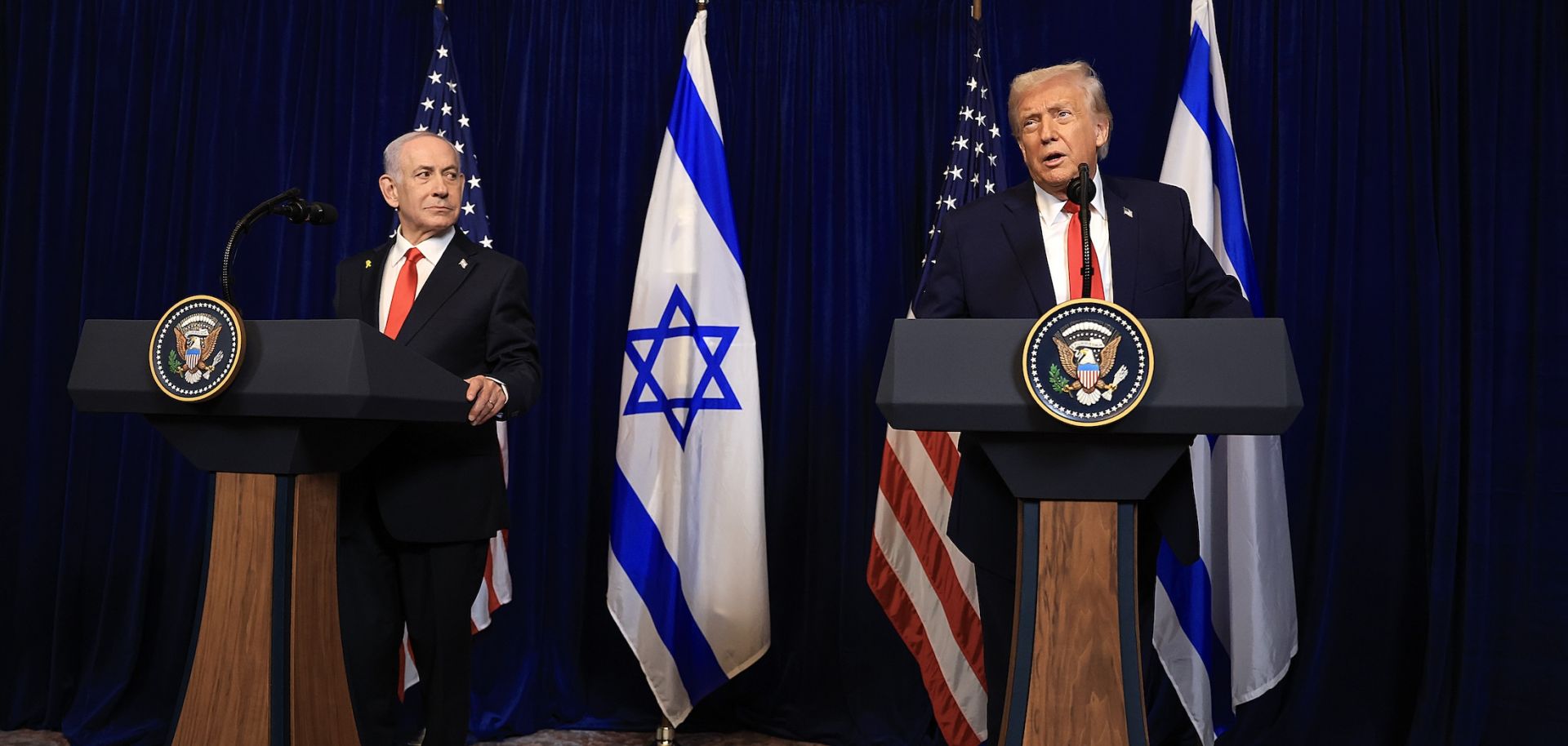
U.S. President Donald Trump holds a press conference with Israeli Prime Minister Benjamin Netanyahu at his Mar-a-Lago club on Dec. 29, 2025, in Palm Beach, Florida.
(Joe Raedle/Getty Images)
U.S. President Donald Trump holds a press conference with Israeli Prime Minister Benjamin Netanyahu at his Mar-a-Lago club on Dec. 29, 2025, in Palm Beach, Florida.

The U.S.-Israeli relationship is straining as their policies in the Middle East diverge, but for now, relations will largely be managed through the White House. Even the likely election of a more critical Congress in this year's midterms will shape Israel's appetite for risk rather than its overall regional strategy. In the early hours of June 8, Israel carried out airstrikes against multiple targets in Iran despite intense American pressure not to respond to Iran's initial missile barrage late on June 7. It was the latest example of divergences between Israel and the United States in recent days, with U.S. President Donald Trump on June 1 reportedly telling Israeli Prime Minister Benjamin Netanyahu to hold off on an assault on Beirut against Iran's proxy, Hezbollah. According to Axios, Trump said in an expletive-laced phone call that Israel's actions were destabilizing and were further isolating Israel. These and other fissures between the two come against the backdrop of declining U.S. congressional and popular support for Israel, which has increasingly isolated the Netanyahu government from its otherwise closest ally. A Pew Research Center study published in April found that a record-high 60% of Americans now held an unfavorable view of Israel, up from 53% a year prior. Meanwhile, several members of Congress seen as close to Israel have suffered defeats in their recent primary elections to opponents more critical of Israel.

  • The June 1 call was supposedly very harsh, with Trump telling Netanyahu that he was "crazy" for continuing an assault on Beirut despite the international pushback and threats to the overall U.S.-Iranian ceasefire. The White House denied the wording of the Axios report, but Trump did subsequently confirm that there was a heated exchange.
  • Trump was also critical of Israel at the end of the 12-Day war against Iran in June 2025, when he demanded Israel adhere to the ceasefire after Iran and Israel continued to exchange fire. He also pressured Netanyahu into accepting the October 2025 Gaza ceasefire with Hamas after Israel attacked Doha in an attempt to assassinate Hamas leaders.
  • Until this year, Gallup had recorded that the majority of Americans sympathized more with Israel than with the Palestinians. This began to sharply diverge after the Gaza war began and Israel was accused of significant humanitarian violations by both right- and left-wing politicians and commentators in the United States. Palestinians now have Americans' greater sympathy in this poll, whose data goes back to 2003. Anti-Israel sentiment has increased across the board, most significantly among young people and self-described Democrats, but also among traditionally more pro-Israel constituencies like older people and self-described Republicans.

The most recent split emerged as Israel ramped up pressure on Hezbollah in Lebanon, imperiling the United States' push for a ceasefire with Iran, which has pushed for comprehensive de-escalation across multiple fronts. When Trump announced the ceasefire with Iran on April 8, Israeli media reported that the Netanyahu government was concerned that the ceasefire and potential U.S.-Iran negotiations would fail to weaken Iran enough to destabilize the Islamic Republic. But given Netanyahu and Trump's close personal relationship and the prime minister's reliance on positive American opinion ahead of Knesset elections due in the fall, the Netanyahu government was unwilling to go public with its disquiet. Instead, the Israeli government shifted its military center of gravity away from Iran and toward Lebanon once more, increasing its pace of airstrikes and ground raids to take and hold territory, assassinate key leadership and destabilize Iran's most prominent proxy after over two years of war with the group. However, because Iran has tied negotiations with the United States to the situation in Lebanon, the Israeli offensive undermined Trump's own goal of reaching an agreement to normalize the Strait of Hormuz, rein in Iran's nuclear program and extricate the United States from an unpopular conflict that has driven up gas prices and threatens a new cost-of-living shock that might destabilize the Republicans in November's midterms. Lebanon has been a secondary theater to the United States, given Hezbollah's inability to directly threaten the trade routes and energy interests that are core concerns for the United States in the Middle East, but the conflict between Israel and Hezbollah has now taken on greater importance because of its direct link to the conflict between the United States and Iran.

  • On June 1, Israeli Defense Minister Israel Katz announced a major offensive against southern Beirut, a Hezbollah stronghold. This prompted a threat from the Iranians to intervene directly to prevent the attack and spurred Trump to call Netanyahu to demand that the offensive be called off, which Israel partially agreed to.
  • On June 7, Hezbollah launched rocket attacks on northern Israel, prompting Israeli counterattacks on Beirut and then the Iranian counter-strike on Israel in enforcement of its red lines.
  • The same day, American media reported that the U.S. Defense Intelligence Agency had upgraded Israel to the highest classification of espionage threat due to Israel's intense interest in America's diplomatic process with Iran.

At least for the remainder of the year, there is sufficient U.S. congressional backing for Israel to sustain current levels of U.S. support, meaning there is no formal institutional check on otherwise close Israeli-American relations besides Trump himself. Although pro-Israel members of Congress are steadily losing races, Congress remains dominated by a bipartisan, pro-Israel majority that supports Israel's defense and supplying it with arms necessary for its security. This is particularly true in the Senate, where fewer senators have been primaried out of their positions by critics of Israel. At least until the new Congress starts its term in early January 2027, this leaves the institutional check with the White House and Trump's own perceptions of how Israel fits into his wider strategy in the Middle East. While the president has the unilateral ability to hold up crucial weapons sales, intelligence sharing and other cooperation to pressure the Israelis, few presidents have been willing to do so out of concern about a significant domestic backlash. In 2024, former President Joe Biden withheld 2,000-lb. bombs to try to spur the Israelis into a more restrained Gaza campaign, while in the 1980s, Ronald Reagan limited arms deliveries to Israel multiple times to shape its regional behavior.

  • Israel's military remains highly reliant on U.S. arms, especially for its air force, which is entirely U.S.-made, and its air defenses, where its munitions depend on U.S. supply chains.
  • President Reagan withheld deliveries of warplanes to Israel in protest at its airstrikes on Iraq's Osirak nuclear reactor, attacks against Beirut and eventual full-scale siege of Beirut during the 1982 invasion of Lebanon. The tactics were ultimately successful in helping to convince the Israelis to abandon the siege and withdraw to a southern buffer zone that they withdrew from in 2000.
  • Of the two parties, the Democratic Party has emerged as the more critical of Israel, although the party is split between those who favor blocking all aid and those who favor switching over to conditional aid. The "Block the Bombs Act" has 73 co-sponsors and is the most prominent example of the growth of the conditional aid faction; the sponsors are almost uniformly Democratic, with a single Republican joining. But Republican Speaker of the House Mike Johnson has shown little indication of allowing the legislation to be voted on.
  • The Iran war remains highly unpopular in the United States. The House passed a bipartisan but entirely symbolic War Powers Act to end the conflict on June 3.

Trump is more likely to continue to use his bully pulpit to shape Israeli behavior rather than impose arms holdups, but repeated Israeli actions that undermine his goal to achieve a deal with Iran open the door to the White House threatening or even imposing restrictions on some Israeli arms transfers. Trump prefers to use his personal relationship with Netanyahu to shape Israel's behavior and the media perceptions around their relationship and Israel's own role in the U.S.-Iran negotiations. His occasionally aggressive rhetoric deflects from having to commit to concrete U.S. policy shifts toward Israel. But there may be an upper limit to this approach. Netanyahu remains under intense domestic pressure to degrade Iran and its proxies, incentivizing him to adapt to this pressure rather than abandon the anti-Iranian campaign by embracing lower-risk tactics. The United States can be relatively tolerant of intermittent Israeli violations of various ceasefires — particularly in Gaza and to some extent Lebanon — provided they do not provoke Tehran back into a regional war that would pull U.S. forces back into high-intensity conflict, further shock energy markets and risk more global economic disruption. But with Iran now more hawkish than it was before the Feb. 28 U.S.-Israeli attack, Iran is likely to respond more quickly to provocations, deepen instability and undermine the already weak ceasefire. As a result, should repeated Israeli actions more seriously threaten a return to regional war that drags in the United States, Trump will be increasingly incentivized to consider more assertive pressure to end Israeli provocations against Iran and Hezbollah to preserve some progress toward a diplomatic deal. This could include threatening arms deliveries or other coercive measures.

  • The United States has been trying to distance the Hezbollah conflict from the Iran diplomatic track, seeing them as separate issues. However, Iran sees Hezbollah as its last outpost of influence in the Levant after the fall of Syrian President Bashar al Assad in December 2024. Tehran is concerned that Israeli military operations against the group will further weaken Iran's already battered deterrence and proxy network. Israeli violations of the Lebanon ceasefire thereby risk regional escalation.

If U.S.-Iran negotiations drag out or Iranian provocations result in significant U.S. casualties, Trump is likely to drop his criticism of Israeli behavior and back new Israeli attacks against Iran. With the ceasefire uncertain and unstable, small provocations may undermine the ceasefire to the point where the United States begins large-scale operations against Iran, or the Iranians conduct a provocation that results in significant loss of life of American soldiers or civilians in the Gulf Arab states. In that case, Trump is likely to close the gaps with the Israelis and once more back their assaults on Iran. For that matter, if negotiations continue to drag out for weeks and the United States begins to feel the economic effects of the Hormuz energy shock, the White House may also consider greenlighting a resumed Israeli military campaign against Iran in an attempt to weaken Iran's resolve. Approving an Israeli military operation without actively participating in it would be one way for the United States to limit the risks to its own forces and shape the narrative around the conflict by framing it as an Israeli-Iranian conflict rather than a resumption of the Iran war.

  • Trump has framed U.S. intervention at the end of the 12-Day war with Operation Midnight Hammer as highly successful, noting that the operation helped cap off nearly two weeks of fighting between the Israelis and the Iranians and allowed him to declare a decisive victory. Future rounds of Israeli-Iranian escalations may attempt to repeat this pattern, with the United States backing Israeli action and eventually intervening to end the escalation.

Regardless of how Trump approaches Israel over the coming months, public sentiment in the United States will continue to shift against Israel. The election of a more critical Congress in November would increase the chances of congressional coercion to restrain but not necessarily shift Israel's actions. The election of strong critics of Israel would shape overall sentiment and norms in American political discourse. Even incumbent members of Congress, particularly within the Democratic Party but also on the margins of the Republican Party, will likely become more critical of Israel and more supportive of conditioning aid to the country. This would be particularly likely in the event of future rounds of Iranian-Israeli escalation that affect energy markets and global supply chains and therefore Americans' standard of living. This more critical Congress will likely push for deliveries of offensive and heavy weapons systems to be conditioned. However, it is unlikely to have the supermajority necessary to overcome a likely presidential veto, limiting how far it can impose conditions on Israel and channeling aid restrictions into parliamentary battles over funding through budget items like the National Defense Authorization Act (NDAA). Meanwhile, the White House and some pro-Israel hawks in Congress are more likely to try to channel this sentiment toward a deliberate separation between Israeli and U.S. military aid and supply chains, encouraging Israel to develop a more independent defense sector and be less reliant on American aid on a more predictable timeline. Still, given the slow pace of this progress on this front, Israel will still have to contend with more congressional criticism of its foreign policies. This would likely weaken but not fundamentally reverse Israel's freedom of action in the region, including by creating new political risks in the event of aggressive strikes against its rivals, risking political backlash for its covert operations and spurring more internal debates within Israel over its current hawkish approach to the region.

  • Netanyahu has said that he wants Israel to be independent of American aid in the next 10 years, in part as a reaction to changing U.S. sentiment toward Israel that suggests the era of open-ended aid is coming to a close. America's current $38 billion aid package runs through 2028.
  • Israel's aid runs through multiple vectors in Congress, including the must-pass NDAA and the State, Foreign Operations and Related Programs, all of which create opportunities for amendments or changes but still face an uphill battle for Israeli critics to act within.
  • Several states, like Texas and Florida, have passed laws that limit the ability of private companies to divest from Israel in so-called anti-BDS (Boycott, Divestment and Sanctions) laws, which will complicate attempts to limit U.S.-Israeli economic relations.
  • Israel's persistent military operations in the Gaza Strip — where, despite an ostensible ceasefire, Israeli attacks occur frequently and humanitarian conditions remain dire — and worsening violence in the West Bank — where Israeli settlers, backed by the Netanyahu government, are steadily expanding their territorial control — also remain potential future flashpoints in the U.S.-Israel relationship.
  • Israelis will also go to the polls later this year in elections due by late October, with polling suggesting a close race. Even if Netanyahu's far-right coalition loses to an opposition coalition, the most likely new government would still be hawkish toward Iran, Hezbollah, Hamas and other regional threats, meaning a new government would still likely result in friction with a U.S. government seeking to keep regional calm.
RANE
SUBSCRIBERS ONLY

Expert analysis when it matters most.

Get access to RANE's decision-grade geopolitical intelligence.