
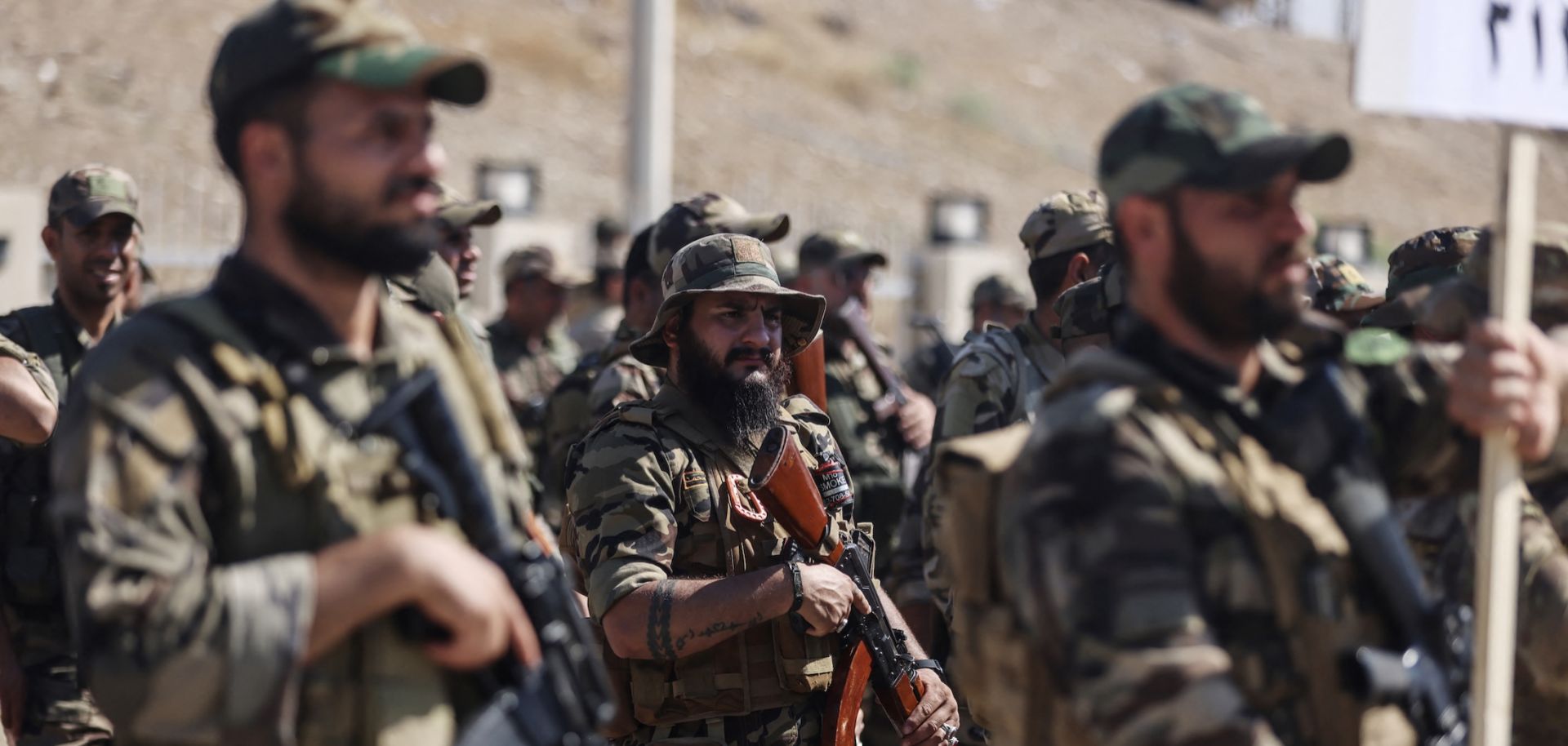
Members of Saraya al-Salam gather during a ceremony in the city of Samarra on June 4, 2026, marking their separation from the Sadrist movement and their integration into the Iraqi security forces.
(AHMAD AL-RUBAYE / AFP via Getty Images)
Members of Saraya al-Salam gather during a ceremony in the city of Samarra on June 4, 2026, marking their separation from the Sadrist movement and their integration into the Iraqi security forces.

Iraq will likely achieve only partial militia integration, as the most powerful Iranian-aligned groups are unlikely to relinquish their core military capabilities, leaving Baghdad unable to fully resolve the militia challenge and keeping the state vulnerable to continued U.S. pressure and intra-Shiite tensions. On June 3, Iraqi Prime Minister Ali al-Zaidi agreed with delegations from Iranian-backed political and militant factions Asaib Ahl al-Haq and Kataib al-Imam Ali to form a joint committee tasked with implementing measures to place militia weapons under state control. The meeting followed a series of recent announcements by Iraqi armed factions signaling at least partial willingness to comply with Baghdad's long-standing effort to bring militias under state authority. On May 29, Asaib Ahl al-Haq and the Imam Ali Brigades announced they would begin handing over weapons to Iraqi authorities, two days after prominent Shiite cleric Muqtada al-Sadr pledged on May 27 to disband his affiliated militia, Saraya al-Salam, and called on other armed groups to surrender their weapons to the state. However, other, more prominent and hard-line militant groups such as Harakat Hezbollah al-Nujaba and Kataib Hezbollah renewed their rejection of disarmament and reaffirmed their commitment to "resistance," describing their weapons as "sacred" and used to defend Iraq, its holy sites and its people. 

  • Asaib Ahl al-Haq has reportedly formed a committee to inventory fighters, weapons and equipment and coordinate the process with the commander in chief. Separately, Sadr's office reportedly directed Saraya al-Salam to detach from the Sadrist political movement and integrate into state security structures, with a joint government-Sadrist committee beginning implementation.

The announcements come as newly appointed Prime Minister al-Zaidi attempts to rein in Iranian-backed militias amid increased U.S. pressure. Following al-Zaidi's swearing-in as prime minister on May 14, Washington renewed pressure on Baghdad to bring the Iranian-backed paramilitary umbrella group Popular Mobilization Forces, or PMF, under firmer state control. The push to integrate or disarm these groups has become one of the earliest and most sensitive tests for al-Zaidi's new government, particularly as he balances U.S. demands for stronger state control with the political and security influence of Iranian-aligned factions and their demands and refusal to disarm. U.S. President Donald Trump has also called on Baghdad to prevent militia leaders from assuming senior roles in Iraq's government. Since the start of the U.S.-Israeli war with Iran in February, Washington has repeatedly struck Iraqi militia and PMF-linked bases inside Iraq, underscoring its willingness to use direct military pressure against Iranian-aligned factions. Similarly, in February, the United States reportedly threatened punitive measures against Iraqi state institutions if Nouri al-Maliki, a former prime minister who maintains close ties to Tehran, returned to the premiership. While these have long been U.S. demands, Trump appears increasingly willing to coerce Iraq to rein in militias through a combination of military threats, sanctions pressure and financial leverage.

  • The PMF was formed in 2014 to fight the Islamic State and later became an official Iraqi state institution, but it remains composed largely of armed factions with varying degrees of ties to Iran.
  • In April, the United States halted a roughly $500 million shipment of physical U.S. dollars to Iraq and reportedly suspended parts of security cooperation in response to Iranian-backed militia attacks. This matters because Iraq's oil revenues are held through the Federal Reserve Bank of New York, giving Washington significant leverage over cash flows, dollar liquidity and dinar stability.

The disarmament process will likely yield uneven compliance, providing al-Zaidi with short-term political cover but leaving the core militia problem unresolved, as hard-line Iranian-backed factions resist meaningful integration. Some armed factions, like the ones that already announced their willingness to disarm, will likely at least partially disarm or accept formal state oversight because they increasingly see themselves as part of the state and are focused on preserving political legitimacy, access to state resources and protection from public blame over Iraq's worsening economic crisis. Limited integration could also help these groups avoid U.S. pressure. However, the recent rejections of disarmament by Kataib Hezbollah and Harakat Hezbollah al-Nujaba highlight a key constraint: the strongest Iranian-aligned factions view their weapons as essential for maintaining economic influence, political leverage and deterrence against adversaries such as the United States. These groups are thus unlikely to disarm in a meaningful way unless Iran supports the process or the cost of refusal becomes significantly higher. Furthermore, the Iraqi government lacks both the capacity and political will to forcibly disarm these hard-line elements, fearing that such actions could spark intra-Shiite conflict and jeopardize national stability. Consequently, while factions like Asaib Ahl al-Haq may hand over lower-value weapons and accept limited state oversight, hard-line groups like Kataib Hezbollah will likely retain their independent command structures, elite weaponry, drone capabilities, rockets and intelligence networks. The disarmament of willing groups would enable al-Zaidi to show Washington some progress and potentially reduce the immediate risk of U.S. sanctions or financial pressure, but Washington will likely expect more progress in the longer term if the most capable Iranian-aligned groups remain autonomous. At the same time, the disarmament process will deepen intra-Shiite competition by giving compliant factions more political legitimacy and access to state resources, while hard-liners frame themselves as the only actors still defending the "resistance" project. This will likely leave Iraq's government politically paralyzed and structurally fragile. Security risks will also remain elevated, as Kataib Hezbollah and Harakat Hezbollah al-Nujaba retain the ability to conduct drone, rocket, intelligence and coercive operations against U.S.- and Western-linked assets, especially if U.S.-Iran negotiations stall or regional tensions flare. 

  • If al-Zaidi can show that some militias are willing to place weapons under state authority, the United States may argue that Kataib Hezbollah, Harakat Hezbollah al-Nujaba and other hard-liners are choosing defiance rather than facing difficult political constraints. This could make Washington more willing to escalate through additional sanctions, financial pressure, intelligence support to Iraqi security forces or even limited surgical strikes against militia commanders or assets if hard-liners resume attacks on U.S. personnel or obstruct the disarmament process.
  • Iraq's government will not be fully paralyzed while al-Zaidi's Cabinet remains incomplete, but his ability to enact meaningful economic and security reforms will be limited. With key portfolios such as interior and defense unresolved, and with Shiite factions divided over militia disarmament, al-Zaidi lacks the institutional control and political consensus needed to impose state authority over hard-line groups. 
  • While the recent announcements and steps toward disarmament will offset U.S. pressure for the coming weeks and potentially months, al-Zaidi will likely struggle to maintain this trajectory without alienating Iran and the hard-line factions that can obstruct his government. Intra-Shiite divisions are already taking shape amid the government formation process, with factions diverging on candidates, Cabinet distribution and agendas.
  • More hard-line Iranian-backed factions are unlikely to accept disarmament in part because of Iran's influence. Tehran sees disarmament of these militias as a dynamic that would meaningfully reduce its leverage in Iraq, and it may also view disarmament as part of a U.S.-backed effort to weaken the regional "Axis of Resistance." 

In a less likely but still plausible scenario, Iran could support the integration of its proxies into Iraqi structures, strengthening al-Zaidi, reducing the risk of U.S. sanctions and improving Iraq's investment climate, although some hard-line factions would likely splinter and push remaining militia activity underground. While unlikely, Asaib Ahl al-Haq and Imam Ali Brigades may have agreed to disarm in coordination with Iran, or at least have tacit Iranian approval. In this case, more hard-line Iraqi militias could follow suit in the coming months. Those factions and Iran may have calculated that limited compliance is preferable to confrontation with Washington and al-Zaidi's government, especially if the United States and Iran reach a lasting agreement to end the regional conflict. Additionally, this strategy could enable pro-Iranian groups to assume positions of power within the Iraqi state and preserve Iran's interests. Other incentives for militant groups to accept partial integration include a desire to avoid U.S. sanctions, protect political gains, maintain access to PMF salaries and state budgets and prevent al-Zaidi from isolating them. However, even under this scenario, hard-line factions would likely try to redefine compliance as administrative integration rather than true disarmament. This means Iraq could see more public statements endorsing "weapons under the state," committees and some handovers of older or lower-value weapons, while the most sensitive capabilities such as drones, rockets, elite units, intelligence networks and covert assets remain under the control of the hard-line groups. Even if integration remains partial, such a dynamic would significantly strengthen al-Zaidi, improve Baghdad's standing with Washington, reduce the risk of immediate U.S. sanctions and open the door to deeper Western investment, energy cooperation and security assistance. However, some more hard-line commanders could still reject integration and splinter into rogue cells, while rank-and-file fighters could shift into criminal networks, intimidation campaigns or covert operations if they lose salaries, status or protection, all of which could undermine Iraq's government and potentially lead to attacks on U.S. and foreign assets. 

RANE
SUBSCRIBERS ONLY

Expert analysis when it matters most.

Get access to RANE's decision-grade geopolitical intelligence.