
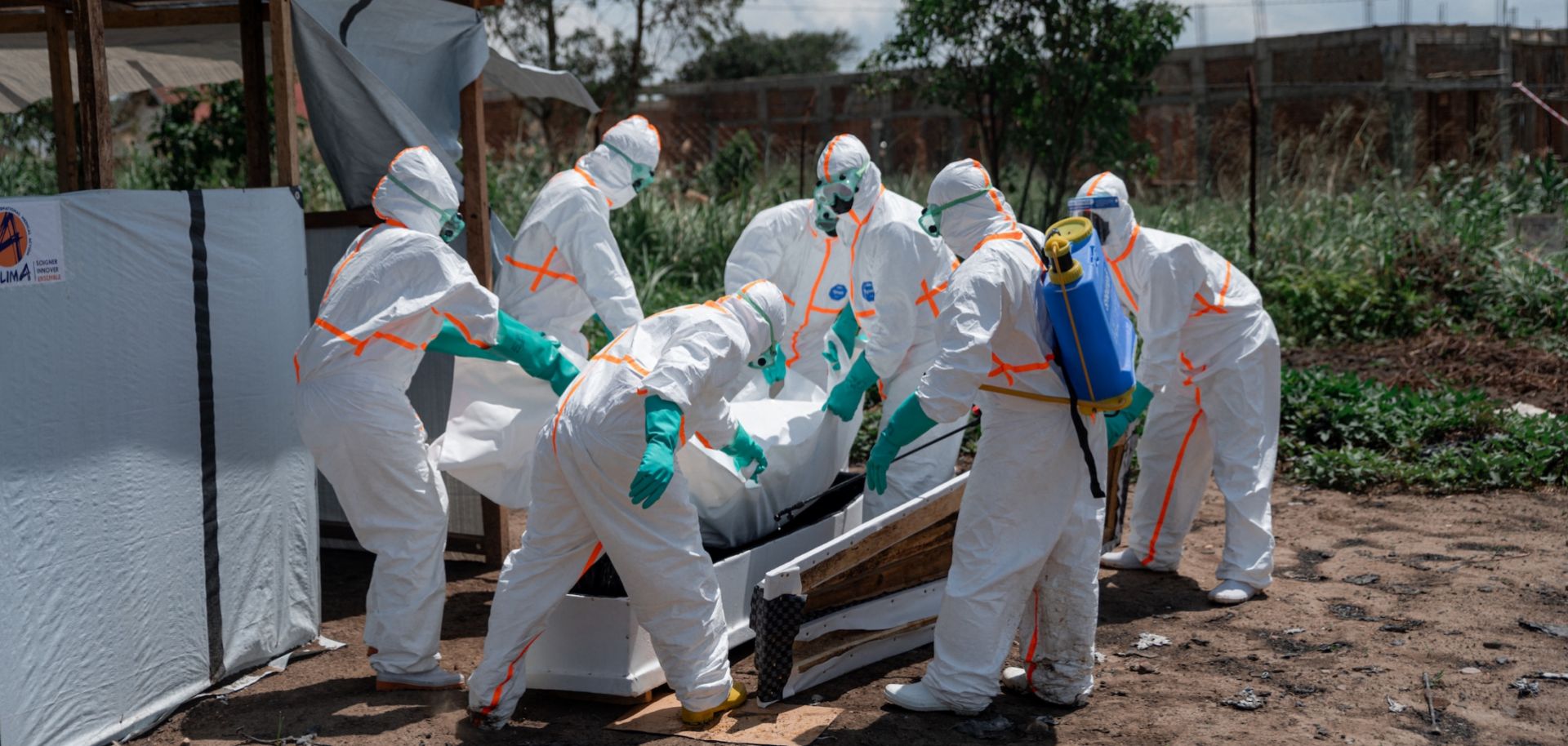
The Ebola outbreak in the Democratic Republic of the Congo will likely persist for at least several more months and result in extended travel restrictions that will disrupt regional supply chains, likely slow deal-making in Congo's mining sector and could delay Uganda's planned start of oil production. On May 17, the World Health Organization, or WHO, declared a public health emergency of international concern following an Ebola outbreak in Congo and Uganda. Cases have largely been concentrated in eastern Congo, where authorities have identified 515 confirmed cases, including 91 fatalities, and 117 suspected cases as of June 7. Meanwhile, 19 confirmed cases and two deaths have been reported in Uganda as of June 5, all of which are in the capital Kampala and neighboring areas and stem from a contact originating in Congo. Amid mounting cases, Rwanda barred all foreign nationals who have traveled to Congo in the past 30 days from entering its territory and mandated quarantine for its own nationals arriving from Congo on May 22, while Uganda closed its border with Congo "with immediate effect" on May 27. Meanwhile, the United States barred entry on May 18 to foreign nationals who have traveled to Congo, Uganda and South Sudan within the last 21 days.

- Ebola outbreaks are most often caused by interactions between human populations and wild animals, either when animals are consumed as bushmeat or encountered in mines, where bats often reside.
- On May 26, Congolese authorities said that they had identified 112 confirmed cases and 11 confirmed deaths, as well as 900 suspected cases and 223 suspected deaths. However, the WHO slashed the total number of suspected cases after it conducted an investigation in the region.
- The Africa Centres for Disease Control and Prevention warned on May 23 that Rwanda, Kenya, Tanzania, Angola, Burundi, the Central African Republic, the Republic of Congo, Ethiopia, South Sudan and Zambia faced a "high risk" of the Ebola outbreak spreading to their territory. However, as of June 8, there have been no confirmed cases outside of the Democratic Republic of the Congo and Uganda.
Congo has struggled to contain this latest Ebola outbreak due to the lack of a vaccine for the specific virus strain, major cuts to Western aid development aid and ongoing security crises in its eastern regions. Congo has experienced 17 Ebola outbreaks since 1976, but the current outbreak is only the second to be caused by the Bundibugyo virus, for which there is no licensed vaccine or therapeutic. This has triggered a global race to develop a new vaccine, and the University of Oxford's Pandemic Sciences Institute said in late May that clinical trials for a vaccine against the Bundibugyo virus could begin in two to three months. While the global vaccine alliance Gavi is supporting efforts to fast-track the vaccine's manufacturing, this latest Ebola outbreak comes as Congo has faced major aid cuts by Western countries in recent years, chief among them being U.S. President Donald Trump's steep cuts to USAID programs in early 2025. The Trump administration has since struck dozens of bilateral health partnerships with African countries, including Congo and Uganda. However, the rapid withdrawal of USAID funding has undermined the preparedness of healthcare systems in both countries by weakening disease surveillance systems and emergency medical stockpiles. In addition to financial constraints, security challenges in eastern Congo, which has endured more than 30 years of conflict, have further complicated efforts to curb the Ebola outbreak. Despite a 2025 peace deal with Rwanda, fighting between the Rwanda-backed M23 and pro-government forces continues in the North Kivu and South Kivu provinces. Meanwhile, the northeastern Ituri province, the center of the epidemic, remains beset by a long-standing ethnic conflict between Hema pastoralists and Lendu agriculturalists, with militias like Codeco — which purports to represent the Lendu — frequently attacking both security forces and civilians in the region. Ituri and the northern parts of North Kivu also face ongoing attacks from Islamic State Central Africa Province (ISCAP), despite years of joint military operations by Uganda and Congo against the group. Uganda, by contrast, benefits from a much more stable security environment. Although ISCAP and its predecessor have historically conducted attacks in the country and continue to harbor such intentions, the group currently appears to lack the capabilities to conduct a large-scale attack in Uganda.
- Of Congo's 17 Ebola outbreaks, 15 were caused by the Ebola-Zaire strain, for which there is a licensed vaccine. Ebola-Zaire is more lethal than the Bundibugyo strain, with untreated mortality rates reaching 60-90% compared to 25-50% for Bundibugyo. Most of Congo's past Ebola outbreaks lasted two to four months; the latest outbreak in Kasai province, for example, began in late August 2025 and tapered off in early December 2025. However, eastern Congo faced a protracted epidemic between August 2018 and June 2020 that caused over 2,200 reported deaths.
- In February, the United States committed $900 million over five years to support Congo's healthcare systems against infectious diseases and maternal and child mortality. However, this is still a far cry from the $1.4 billion in U.S. development aid that Congo received in 2024 alone, of which nearly $400 million was allocated specifically to the country's healthcare sector. Meanwhile, Uganda struck a $2.3 billion health agreement with the United States in December 2025 in which Washington pledged to invest $1.7 billion in Uganda's healthcare system, with Uganda to co-invest the outstanding sum.
- ISCAP is also known as the Allied Democratic Forces, or ADF.
The Ebola outbreak in Congo will likely worsen for at least several more months due to medical, logistics and security challenges, though an emerging international response could help slow the virus's spread before the end of the year; meanwhile, the outbreak in Uganda will likely prove more manageable. As the crisis deepens, militant groups like ISCAP and Codeco will be incentivized to target medical centers and their supply lines, either to conduct kidnap-for-ransom operations or to shore up their credentials for recruitment purposes. Although M23 rebels will likely be more willing to cooperate with relief efforts to protect Rwanda's international standing, the volatile security situation in eastern Congo will hamper the deployment of medical staff to affected areas, slowing efforts to isolate infected individuals, trace contacts and conduct safe burials. Furthermore, deep-seated local distrust of international and medical organizations will likely trigger additional unrest at medical facilities that damages property and allows infected patients to escape. Logistics are also a major hurdle, as the region's underdeveloped transport networks impede the delivery of supplies and personnel. This infrastructure deficit is compounded by the poor state of eastern Congo's healthcare facilities, many of which struggle with a lack of isolation space, insufficient equipment and chronic understaffing. These security, logistical and medical challenges will be far more manageable in neighboring Uganda, though which suggests that Ugandan authorities stand a much better chance of containing the outbreak within a few weeks or months. Although the absence of a vaccine will complicate efforts to contain the virus, the global emergency response to the epidemic is set to scale up in the coming weeks, with Western nations and various international organizations providing hundreds of millions of dollars in financing, logistical support and medical supplies to help counter the outbreak. Non-governmental organizations are also rapidly expanding their support. Although challenges facing healthcare teams and the epidemic's relatively late detection indicate that infections will likely increase in Congo in the coming months — and may result in limited outbreaks outside of the Great Lakes region — this emerging international response stands a good chance of slowing, if not containing, Ebola's spread by the end of the year.
- The United States has allocated an estimated $162 million to counter the Ebola outbreak, which reportedly enabled the establishment of six dedicated Ebola response clinics and is supporting dozens of other clinics in screening potential cases and treating infected patients. Meanwhile, the European Union has allocated 15 million euros ($17.4 million) in humanitarian funding to support emergency operations in areas affected by the outbreak. The bloc has also launched an air bridge to deliver 100 tonnes of emergency supplies to eastern Congo, including medicines, protective equipment and tents. Africa CDC Chair Jean Kaseya said that donors had pledged $315.8 million to counter the epidemic as of June 5.
The rise in Ebola cases portends extended border closures in Africa's Great Lakes region that will disrupt regional supply chains and weaken economic growth; the epidemic is also likely to temporarily slow deal-making in Congo's mining sector and could delay Uganda's planned start of oil production. Uganda and Rwanda will likely maintain border restrictions with Congo for the next few months to curb the spread of the virus. Although transit remains open for humanitarian and medical personnel, these measures will still severely disrupt the flow of goods and people across the border. Agricultural markets will be most affected, but the export of critical minerals from eastern Congo, such as tin and tantalum, will likely be temporarily disrupted. Although tin and tantalum will continue to be shipped through informal border crossings, capacity constraints could still lead to a decline in total export volumes as traders adapt to new routes. This could eventually result in higher costs for industrial users such as electronics manufacturers, though it would likely take many months of severe disruption to meaningfully affect prices, given supply chain lead times and smelters' stockpiles. More broadly, the Ebola outbreak risks causing a temporary slowdown in foreign investment in Congo's mining sector. While the risk of a major outbreak in the mineral-rich Katanga region remains low, given that it is located over 1,400 kilometers (900 miles) from the epicenter in Ituri, health concerns and travel restrictions imposed by third countries will still stall many business trips to Congo, likely slowing deal-making. For similar reasons, Uganda's tourism sector — which accounts for over 3% of its GDP — will likely see a sharp decline in international visitors for the duration of the outbreak, reducing the country's foreign-exchange revenue. The epidemic also threatens to delay the planned start of oil production from French major TotalEnergies' Tilenga and Kingfisher projects, which are located in western Uganda near the border with Congo. While no Ebola cases have yet been reported in the area, corporate health and safety protocols could forestall the deployment of high-skilled expatriates needed to finalize the projects. Similar challenges could delay finalization of the $5.6 billion East African Crude Oil Pipeline, which would raise the likelihood that Tilenga and/or Kingfisher's commercial operations begin in 2027, rather than in the second half of 2026 as planned.