
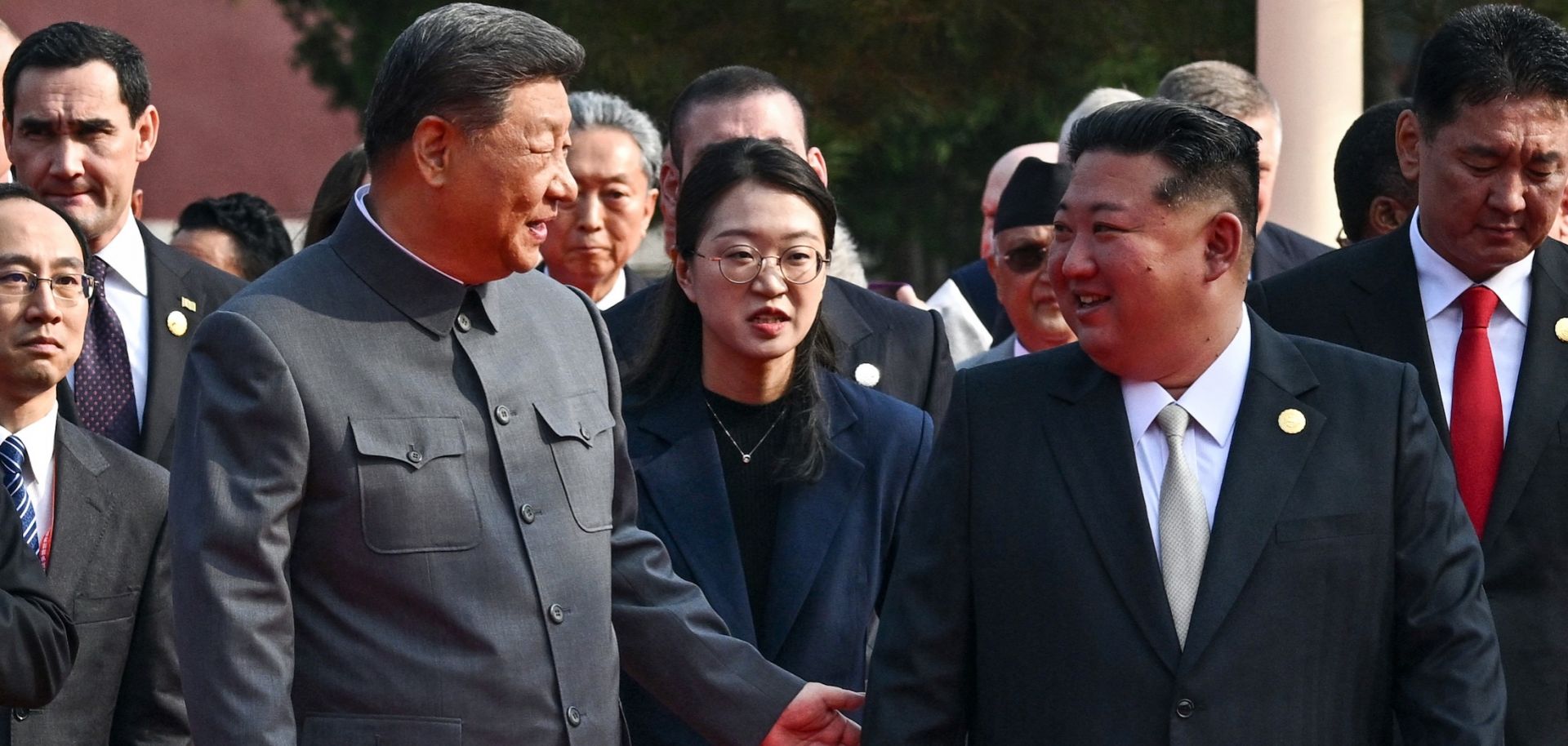
A summit between the leaders of China and North Korea likely signals a belated thaw in bilateral ties, may be an early indicator of U.S.-North Korea engagement, and will likely yield modestly expanded economic engagement. Chinese and North Korean state media outlets announced on June 5 that Chinese President Xi Jinping would visit Pyongyang, North Korea, at the invitation of leader Kim Jong Un from June 8-9. Neither side noted possible topics of conversation. This comes after a recent uptick in diplomatic activity in Beijing and Pyongyang, including recent bilateral engagement. Kim traveled to Beijing in September to attend a military parade alongside Xi, Kim's first trip to China since January 2019. Chinese Foreign Minister Wang Yi also visited Pyongyang in April 2026, presumably to pave the way for Xi's upcoming visit. The visit comes as North Korea's nuclear weapons program continues to develop, with Kim revealing a likely fourth uranium enrichment facility, in Yongbyon, in KCNA footage aired on June 4. China has sought to moderate North Korea's nuclear brinkmanship, long fearing insecurity and instability on the Korean Peninsula. But Beijing has also long valued close relations with Pyongyang as a geographical and political buffer against the U.S.-backed government in South Korea.

- U.S. President Donald Trump and Russian President Vladimir Putin separately met with Xi in Beijing in quick succession in mid-May. In both summits, the two sides discussed the Korean Peninsula.
- Vietnam's leader To Lam and Laotian President Thongloun Sisoulith both visited North Korea in October 2025, and Belarusian President Alexander Lukashenko visited in March 2026. Singaporean Foreign Minister Vivian Balakrishnan also met with his North Korean counterpart in Pyongyang in May 2026, for the first time since 2019.
- Pyongyang's deepening relationship with Moscow has yielded rapidly expanding defense cooperation, including the deployment of North Korean troops to support Russia's war in Ukraine, as well as what appears to be a significant acceleration of North Korea's development timeline for a nuclear-powered, and likely nuclear-armed, submarine.
China is likely seeking to revive ongoing diplomacy with North Korea, partly to counter growing Russian influence, but Xi and Kim's poor personal relationship and related diplomatic sensitivities could derail a sustained rapprochement. Despite Xi's infamously poor personal relationship with Kim, Beijing is belatedly taking the diplomatic offensive to bolster ties with Pyongyang. This comes after years of diplomatic inaction by China despite North Korea's steadily expanding relations with Russia, with which China has for decades competed for influence over their shared neighbors. In addition, North Korea's accelerated weapons program development, along with signs from Washington and Pyongyang about openness to future talks, is likely further motivating China to improve relations with North Korea. Against this backdrop, the visits by Wang and now Xi likely signal the beginning of a new period of China-North Korea diplomatic exchanges, so long as neither Xi nor Kim offends the other. This is a key contingency to watch for, as Beijing under Xi has viewed Kim as unpredictable and insubordinate, in contrast to the hermit kingdom's traditionally subservient political relationship with Beijing; Kim, meanwhile, has conversely viewed China under Xi as patronizing, overbearing and insensitive to North Korea's development needs. The extent of coverage of this meeting by state-run outlets in both countries, including North Korea's KCNA and China's Xinhua, will be a leading indicator of whether the two leaders have successfully rekindled ties without incident. A cursory, two-sentence summary of the meeting could suggest that talks were fraught, or at least that Xi is approaching the revival of ties with a very slow and methodical mindset, and is thus not eager to rush expanding economic relations. Longer, more detailed coverage, and particularly multi-part series covering the summit, would suggest a more productive meeting and portend sustained engagement going forward. In the latter scenario, closer ties with China could bolster North Korea's efforts to expand diplomatic engagement with other countries, particularly nearby Asian nations that are seeking to minimize regional security threats amid great-power competition. This is partly because China, a highly internationally integrated economy and diplomatic power, engaging with North Korea lessens the taboo on Asian partners doing the same. In addition, regional military powers like Singapore want to maintain their own balance of power to avoid being at odds with a potential united China-North Korea-Russia axis, particularly in the event of a conflict over Taiwan.
China is also seeking to protect its security and economic interests on the peninsula in preparation for a potential revival of U.S.-North Korea talks, while encouraging restraint regarding North Korea's nuclear program. Through this meeting, Xi is seeking to strengthen China's influence as an advisor to the Kim regime, with the goal of preserving China's security and economic interests on the peninsula in the event that North Korea restarts talks with the United States or other Western nations. More broadly, this strategy also seeks to ensure that a nuclear-armed power on China's border does not lean too far toward Washington. Although the Xi-Kim summit by no means guarantees that U.S.-North Korea talks will resume soon, it is another piece of evidence in favor of that scenario. This is because China has historically expanded diplomatic engagement with Pyongyang whenever North Korea increases engagement with the United States, as Beijing did during the Trump-Kim talks in 2018-2019. Additionally, Beijing likely aims to advise Kim toward moderation and restraint in the pace of development of North Korea's nuclear weapons program — especially as the sophistication of the technology on display in Pyongyang's weapons tests has grown and North Korea has recently used constitutional revisions to disavow unification with South Korea. North Korea's expanding nuclear arsenal, including the submarine component, is also driving U.S. military allies like South Korea and Japan to push for their own nuclear submarine programs, threatening Beijing's military dominance in the South and East China Seas.
- Through the Xi-Kim meeting, China is also seeking to shape the direction of U.S.-North Korea talks, if they do occur. This strategy stems from Beijing's limited control over Pyongyang's diplomatic outreach to Washington, as well as China's desire to preempt any U.S. efforts that might shift the status quo on the peninsula. For example, if the United States were to recognize North Korea as a nuclear power, it would undermine future Chinese attempts to call for an arms drawdown from South Korea.
During this and future meetings, Xi will likely concede to at least some of Kim's demands for greater economic cooperation, including reduced travel restrictions and increased infrastructure support, though China will maintain a cautious approach to avoid violating sanctions. China-North Korea economic ties have long been curtailed by U.S. and international sanctions, which China has been less willing to flout as openly as Russia. However, Kim will nonetheless likely request an improvement of cross-border people and goods flows, infrastructure and/or Chinese investment and technological support. China will likely remain hesitant to expand defense cooperation as rapidly as Russia, though it may be willing to bolster some travel and infrastructural ties with North Korea. Still, while it has long denounced foreign sanctions on North Korea, China will remain careful not to blatantly violate them to avoid direct confrontation with Western powers. Thus, any expansion of economic ties would likely be clandestine and gradual, enabling Beijing to cover its tracks. However, such expansion may wait until follow-up visits, as Xi tends to prioritize rekindling personal relationships before signing deals.
- While China's reengagement with North Korea will weaken Russia's relative influence over the country, Beijing and Moscow have proven adept at disentangling their competition for regional influence from the general trajectory of Sino-Russian economic and security cooperation. This dynamic will likely persist, particularly given the enduring and close personal relationship between Xi and Putin.