
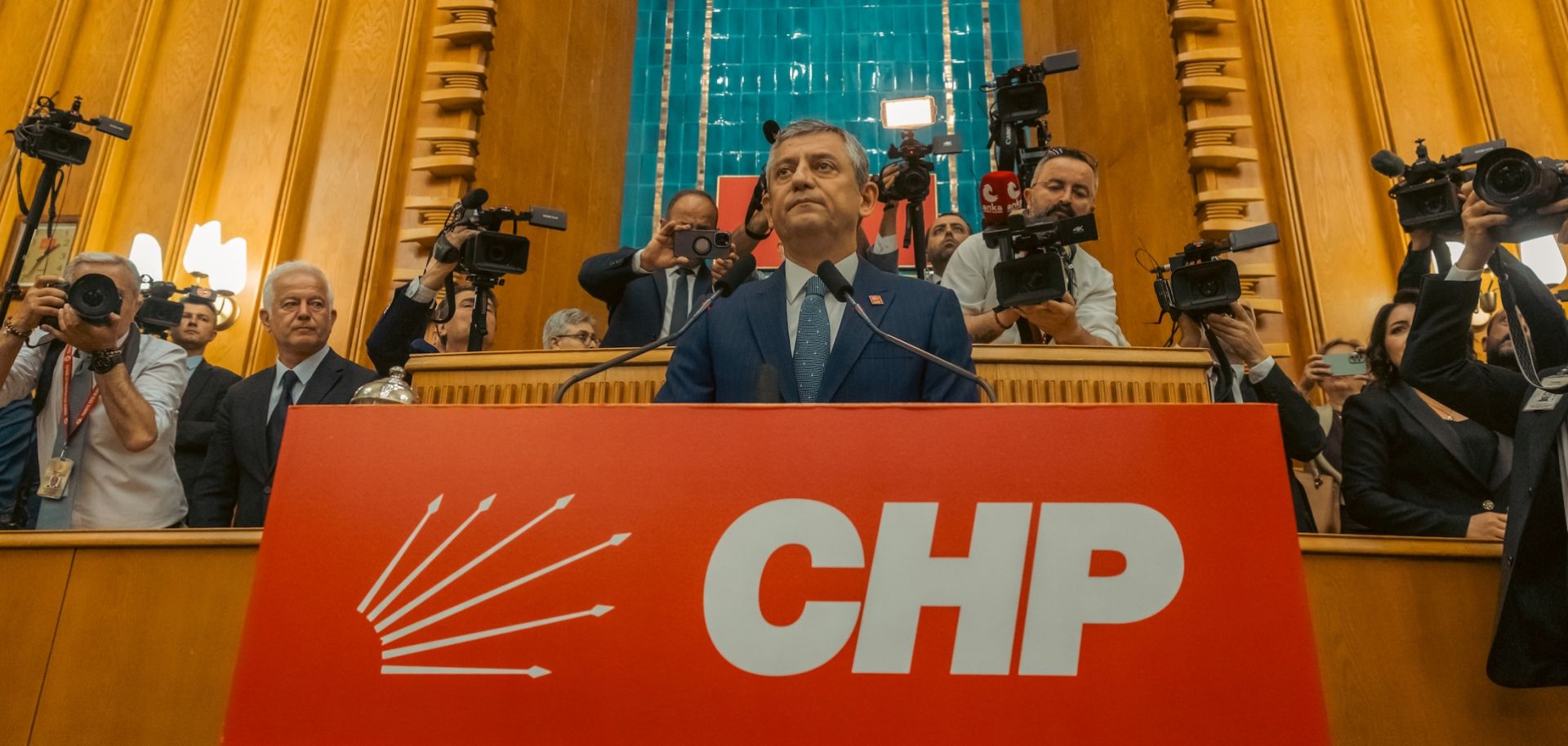
Disputes among the leaders of Turkey's main opposition party risk fragmenting the opposition and lowering the bar for the ruling party to return to an increasingly hot economy ahead of the next election cycle. On June 1, Anka News reported that Turkey's main opposition party, the Republican People's Party, or CHP, had secured enough signatures to hold an extraordinary party convention, just hours after the CHP's former leader, Ozgur Ozel, said he had launched a campaign to acquire the necessary signatures. The push for a new party convention comes after a May 21 Turkish appeals court ruling that nullified the results of the 2023 CHP party congress that elected Ozel and other CHP leaders. As a result of the nullification, former CHP leader Kemal Kilicdaroglu and his administration were provisionally reinstated. The court ruling led to a standoff at the CHP's headquarters in Ankara after Ozel and his supporters barricaded themselves inside for three days after the verdict. At the request of Kilicdaroglu's lawyer, Turkish police forcibly removed Ozel and his supporters from the premises and enabled Kilicdaroglu and his administration to enter the facilities. Kilicdaroglu has also called for a party congress after the Turkish court injunction is lifted. Despite the friction between Ozel and Kilicdaroglu, on May 23, Ozel said, "We have no intention of forming a new party."

- After Ozel was removed from the CHP headquarters, he led a small march to Turkey's Grand National Assembly building and said the CHP was "de facto shuttered," calling on supporters to rebuild the party. The CHP has protested the verdict in CHP-governed municipalities, including Istanbul, Izmir and Ankara, and, on May 30, Ozel held a rally in Ankara that drew thousands of CHP supporters.
- In the first Turkish elections under Ozel's leadership, the CHP beat the ruling Justice and Development Party, or AKP, in the March 2024 municipal elections. The electoral results came around a year after Turkish President Recep Tayyip Erdogan beat Kilicdaroglu in the second round of the 2023 presidential election.
- Friction between Ozel and Kilicdaroglu has extended into Turkey's Grand National Assembly; Kilicdaroglu has appealed to the parliamentary speaker's office to invalidate the vote that selected Ozel as the CHP's parliamentary group chair, arguing the vote was invalid because it occurred after the now-nullified 2023 congress.
The appeals court ruling comes amid the AKP's ongoing efforts to weaken the CHP through legal challenges targeting the party's senior leadership. The AKP has long leveraged its influence over Turkey's legal system to embroil opposition lawmakers in legal battles and bureaucratic red tape. For instance, the 2022 trial of CHP Istanbul Mayor Ekrem Imamoglu on allegations of insulting a public official resulted in a prison sentence and an over two-year ban from politics. Though Imamoglu's appeal of the verdict resulted in a stayed sentence, the uncertainty surrounding his case led the CHP to select the less popular Kilicdaroglu as its presidential candidate for the 2023 election. The CHP has since selected Imamoglu as its 2028 presidential candidate, but the opposition figure was again detained in March 2025 as part of a corruption investigation, once more undercutting his path to running in the next presidential election. Turkish authorities have levied additional legal cases against other senior CHP members, including popular, charismatic leaders such as Ozel, in efforts to remove them from their posts and/or imprison them.
- In addition to targeting key opposition figures, the AKP is pursuing constitutional reform that would allow President Recep Tayyip Erdogan to run for reelection in 2028.
- The ruling party's campaign against the opposition comes amid waning popular support for the AKP, as evidenced by the party's gradual loss of seats in each parliamentary election since 2015. The CHP has benefited most from this trend.
The CHP's likely worsening internal disputes risk fragmenting the party ahead of parliamentary and presidential elections in 2028. Both Kilicdaroglu and Ozel have called for a new party congress, and Ozel has publicly rejected the idea of forming a new, separate party, signaling an effort by both leaders to maintain party unity. However, Kilicdaroglu and Ozel are pushing disparate visions for the party's future, with Kilicdaroglu advocating a return to the CHP's founding principles and "moral values," while Ozel pursues a social democratic reformist approach. Amid these divergences, the CHP will challenge the May 21 appeals court ruling in Turkey's Supreme Court, resulting in protracted uncertainty over the party's leadership. Meanwhile, even if the CHP holds an extraordinary party congress, Ozel's and Kilicdaroglu's supporters would likely fight over procedures and the election process for a new party chair, threatening further fragmentation. Although there is still a potential for a rapprochement between Ozel and Kilicdaroglu ahead of the next election cycle, protracted internal disputes may have long-lasting implications that undermine the CHP's ability to compete with the AKP in 2028. Additional legal challenges against the CHP — such as Imamoglu's ongoing investigation — will further weaken the party.
- The risk of protests will rise surrounding verdict announcements on cases against opposition figures, most acutely in the CHP-led cities of Ankara, Izmir and Istanbul. However, nationwide protests are less likely, except in high-profile cases such as those against Imamoglu or Ozel. Other opposition parties, such as the pro-Kurdish Peoples' Equality and Democracy Party, have denounced the politically motivated court rulings against the CHP, but the CHP has had only limited success in galvanizing a widespread opposition movement against the ruling coalition. This lack of momentum stems from longstanding policy differences among opposition parties and their own ambitions, especially after the disappointing result of the 2023 presidential election, in which Kilicdaroglu's ideologically diverse Nation Alliance coalition failed to oust Erdogan and the AKP.
A more divided and weaker CHP would lower the bar for the AKP to reverse Turkey's recent orthodox economic policies and boost government spending ahead of the next elections, though inflationary pressure will present constraints. Under Erdogan's previous term, Turkey pursued unorthodox monetary policies that involved cutting interest rates in an ostensible effort to curb inflation, though these policies instead led to hyperinflation and depreciation of the Turkish lira. Following the government's spending spree ahead of the 2023 presidential election, the Central Bank has maintained more orthodox policies to decrease annualized inflation rates amid rising living costs. These rising costs have historically led some voters to defect from the AKP to the CHP, further motivating the AKP to exercise some restraint in its economic policy. However, if infighting and legal battles sufficiently weaken Turkey's political opposition ahead of the 2028 elections, the AKP may feel freer to return to its previous unorthodox economic policies, secure in the belief that related defections will not cost it the election. As such, the AKP could become more likely to depart from its medium-term economic goals in favor of expanding government spending ahead of 2028. Even so, the fact that Turkish inflation is elevated amid current, increased global energy prices will present constraints, as will the possibility that rampant inflation could push voters toward AKP splinter parties, such as the Democracy and Progress Party.