
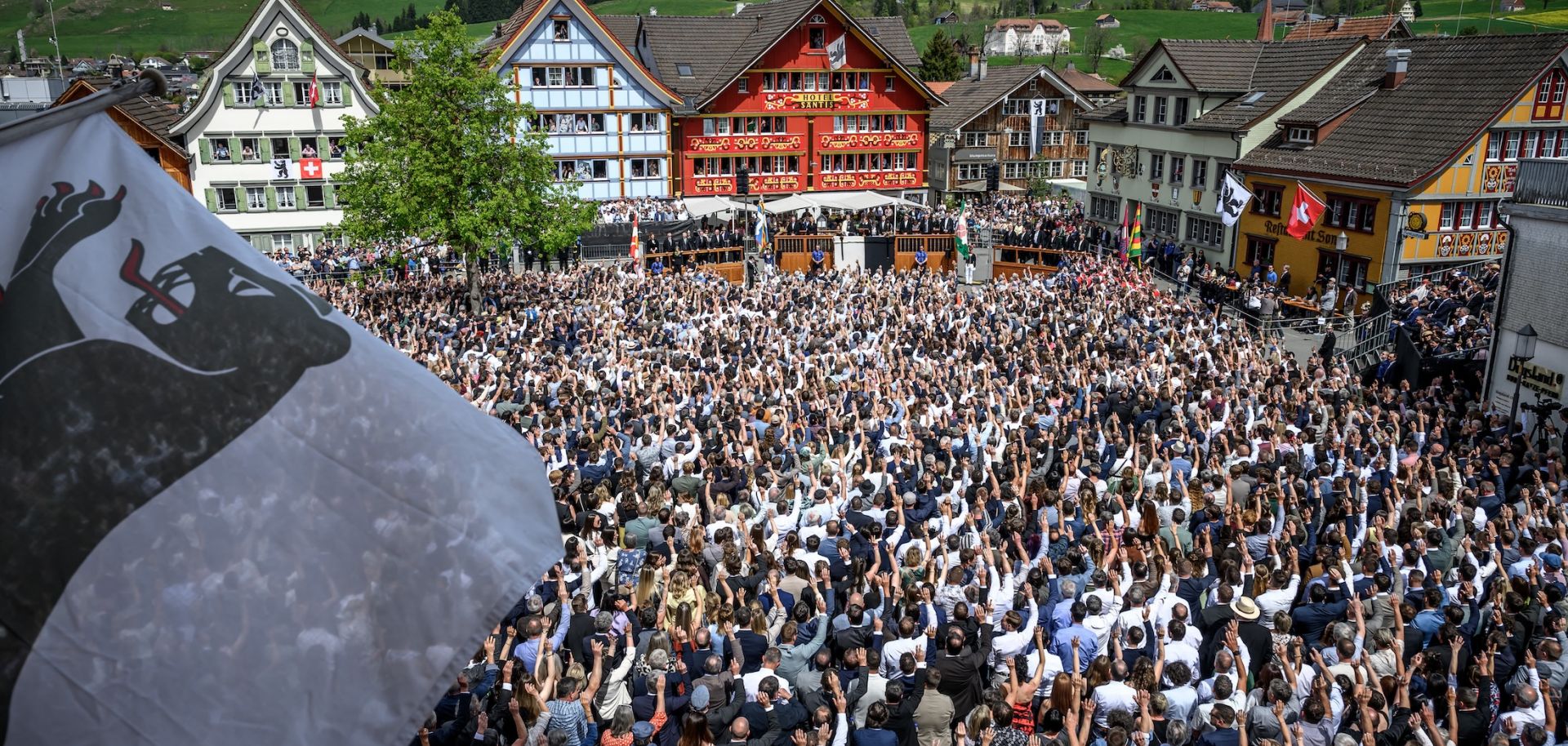
Citizens vote by raising their hands during the Landsgemeinde, a traditional public, non-secret ballot conducted by majority rule, in Appenzell, eastern Switzerland, on April 26.
(Fabrice COFFRINI / AFP via Getty Images)
Citizens vote by raising their hands during the Landsgemeinde, a traditional public, non-secret ballot conducted by majority rule, in Appenzell, eastern Switzerland, on April 26.

Switzerland's population cap referendum passing would result in a gradual tightening of immigration policy that could strain its EU free-movement framework and create medium-term risks of labor shortages, higher business costs and potential friction with the EU single market. On June 14, Switzerland will hold a referendum to amend the Swiss constitution to limit the country's permanent resident population to fewer than 10 million people through 2050. The proposal was launched and is being promoted primarily by the right-wing Swiss People's Party (SVP), Switzerland's largest political party, which argues that rapid population growth driven largely by immigration is placing unsustainable pressure on housing, transportation infrastructure, public services and the environment. Switzerland's population has grown from roughly 7.3 million in 2002 to more than 9 million today, with much of that increase attributable to immigration, particularly from EU countries under Switzerland's agreements with the European Union on the free movement of people. Under the initiative, the federal government would be required to take corrective measures once the population approaches 9.5 million (expected by the end of the decade). If existing international agreements (such as those with the European Union) prevent Switzerland from achieving that objective, the government would be required to seek exemptions, renegotiate those agreements, or, if necessary, terminate them. Cross-border commuters would not count toward the 10 million ceiling.

  • Though Switzerland is not a member of the European Union, it is highly integrated with it through more than 100 bilateral agreements that give it partial access to the EU single market, which accounts for roughly two-thirds of Swiss exports and around half of its imports. Under these agreements, Switzerland participates in the European Union's free movement of people system, meaning that EU and EFTA citizens make up around one-quarter to one-third of the resident population of Switzerland's workforce, depending on the criteria, supporting sectors such as healthcare, engineering, construction and advanced services.
  • This arrangement allows Swiss firms to recruit relatively freely from across the European Union, while also enabling Swiss goods, financial services and pharmaceuticals to access EU markets with comparatively low barriers, making the European Union Switzerland's single most important trading partner by a wide margin.
  • Recent polling suggests support for the initiative is softening. One June 3 poll found 45% of voters in support of the measure compared to 52% against, marking a shift from an earlier April poll that showed a near 50-50 split. The trend therefore indicates a modest movement toward rejection, but the gap is still narrow enough that the outcome remains uncertain. Because this is a constitutional amendment, it requires both a majority of the popular vote and a majority of the 26 cantons to vote in favor. This makes it harder to pass than referendums on non-constitutional issues.

If the referendum passes, the short-term economic and business consequences would be limited, with the primary near-term impact stemming from regulatory uncertainty rather than immediate operational disruption. The initiative would not itself impose immediate immigration restrictions; rather, it would create a constitutional obligation for policymakers to reduce future population growth. As a result, the first effects would likely be political and regulatory uncertainty rather than abrupt economic disruption. Businesses would need to assess the possibility of tighter labor-market access in the coming years, particularly in sectors that depend heavily on foreign workers, including healthcare, engineering, construction, hospitality, information technology, financial services and scientific research. Companies considering long-term investments or expansions could delay decisions while waiting to see how the government intends to implement the initiative and whether negotiations with the European Union become necessary. Labor markets would initially remain largely unchanged because existing workers would continue to reside in Switzerland and any policy adjustments would likely be phased in over time. Nonetheless, business groups and multinational employers would probably view the referendum's passage as signaling a less predictable future regulatory environment.

  • Because the cap would only impact permanent residents, cross-border workers coming from neighboring countries would still have access to jobs in Switzerland. Swiss companies would still be allowed to hire them, provided that they don't become Swiss residents. As a result, Swiss economic hubs such as Geneva (close to France), Basel (close to France and Germany) and Ticino (close to Italy) would be less affected by the cap than economic hubs in the Swiss interior.

The long-term economic and business implications of the referendum passing would depend heavily on whether Switzerland can reduce population growth while preserving its economic relationship with the European Union. This scenario would limit the disruptive impacts of the limit compared to the more escalatory scenario of a stronger break with the European Union. In a low-impact scenario, Switzerland severely reduces the scope and depth of the legal changes required by the referendum or successfully negotiates accommodations (such as quotas or bureaucratic requirements that make it harder for EU citizens to work in Switzerland without outright banning them) that allow it to maintain broad access to European labor and product markets while modestly reducing immigration flows. Under this outcome, population growth would slow, housing and infrastructure pressures would ease and economic growth would likely continue, albeit at a somewhat slower pace due to weaker labor-force expansion. Businesses would face tighter labor markets and potentially higher wage costs, but Switzerland's highly productive economy could adapt through greater automation, increased capital investment and a stronger focus on productivity growth. A more disruptive scenario would arise if the population cap were to force Switzerland to curtail free movement with the European Union or lead to a deterioration in the broader network of bilateral agreements that underpin Swiss-EU economic integration. In that case, Swiss employers would encounter greater difficulty recruiting skilled workers from Europe, forcing them to increase their reliance on cross-border commuters or short-term contracts that do not turn the workers into residents. Labor shortages could become more acute and sectors dependent on international talent — including pharmaceuticals, advanced manufacturing, financial services, technology and research — could face higher operating costs and reduced competitiveness. Uncertainty regarding market access could also discourage foreign investment and encourage some multinational firms to expand elsewhere in Europe. Because the European Union is Switzerland's largest trading partner, any reduction in economic integration could gradually weigh on exports, innovation and long-term growth. The most likely outcome, even in a more disruptive scenario, is not an economic crisis but population growth and economic expansion both slowing.

  • The Swiss government seeking to end the arrival of EU workers would risk ending all bilateral agreements. EU-Switzerland agreements have a so-called "Guillotine Clause," according to which if either Switzerland or the European Union terminates or fails to renew even a single agreement (such as the free movement of people), all other agreements automatically end after six months.
  • If the referendum does not pass, Switzerland will continue with its current immigration framework, including bilateral agreements with the European Union and the free movement of people, avoiding any immediate legal or institutional changes. This would likely preserve the existing advantages of a flexible labor market, allowing businesses continued access to EU workers and supporting sectors that depend on foreign labor. However, underlying pressures — particularly housing demand, infrastructure congestion and population growth — would remain in place, likely keeping immigration and urban capacity as recurring political issues in the years ahead and keeping alive the possibility of new immigration-related referendums in the future.
RANE
SUBSCRIBERS ONLY

Expert analysis when it matters most.

Get access to RANE's decision-grade geopolitical intelligence.