
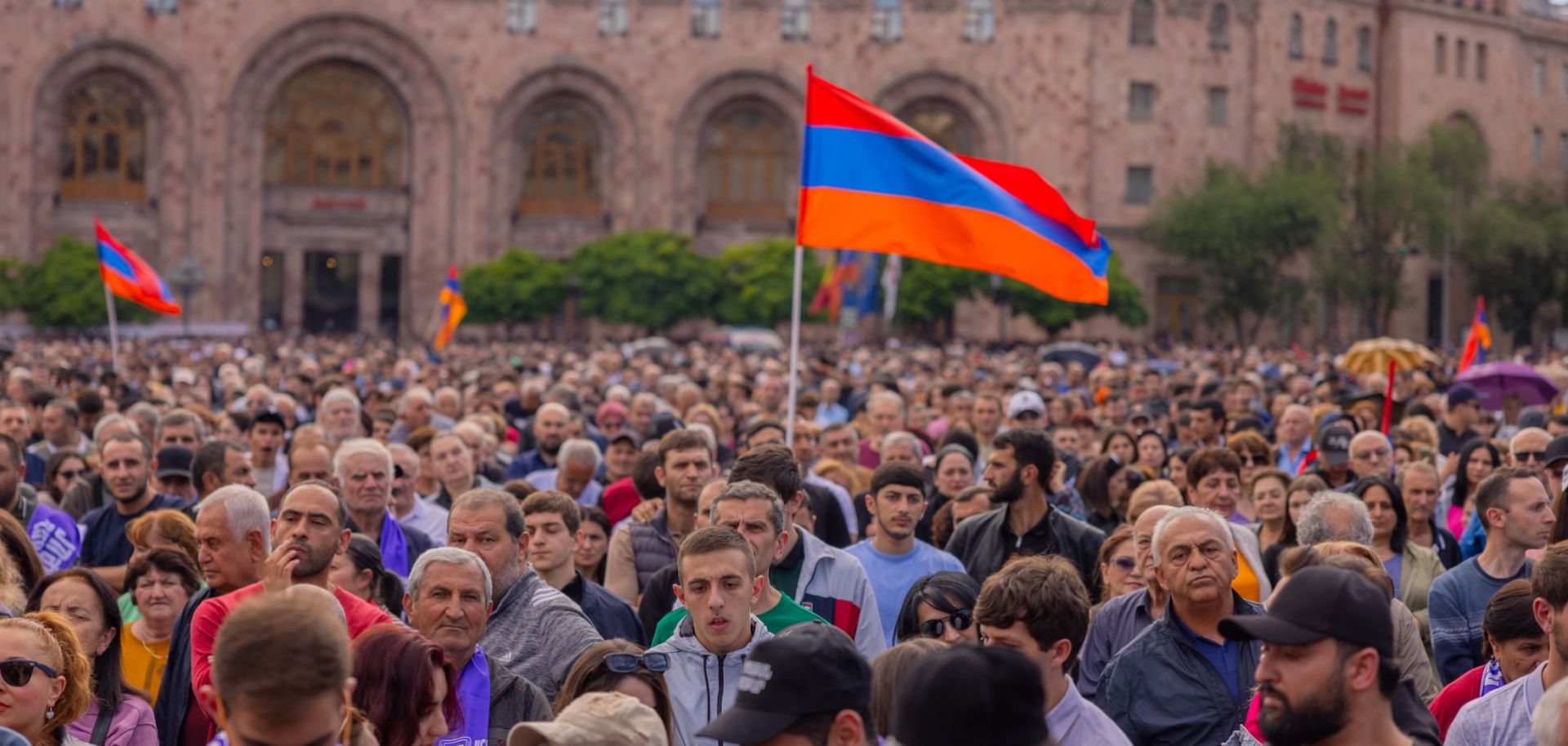
Armenia's upcoming elections will likely provide the incumbent government with a mandate to conclude a peace treaty with Azerbaijan and deepen ties with the West, but Russia's entrenched economic leverage and potential domestic resistance to constitutional revisions could precipitate a political crisis and slow Armenia's efforts to decouple from Russian influence. On June 7, Armenia will hold its first parliamentary election since Azerbaijan seized full control of the Nagorno-Karabakh region in 2023. Armenian Prime Minister Nikol Pashinyan and his Civil Contract party have campaigned on abandoning historical irredentism in favor of securing the country's internationally recognized borders, finalizing a peace accord with Azerbaijan, normalizing ties with Turkey, and deepening economic and security integration with the European Union and the United States. Pashinyan's electoral challenges stem from his own low approval ratings and pressure from pro-Russian, nationalist opposition groups — most notably the Strong Armenia alliance backed by Russian-Armenian oligarch Samvel Karapetyan, and former President Robert Kocharyan's Armenia Alliance, both of which have accused Pashinyan's government of compromising national sovereignty. While polling in Armenia is often unreliable, recent surveys show Civil Contract holding a tenuous lead over the opposition parties, though a large percentage of the electorate remains undecided. In the lead-up to the vote, Russia has escalated beyond rhetorical warnings to implement punitive economic measures against Armenia, including import restrictions, border delays and active disinformation campaigns designed to undermine Pashinyan. Meanwhile, Western capitals have ramped up diplomatic and financial support for Pashinyan's administration.

- Armenia's parliament consists of at least 101 seats elected through proportional representation. Parties must pass a 4% threshold to enter, while alliances face thresholds of 8% or 10%, depending on their size. Electoral laws mandate that the parliament must contain at least three political forces regardless of these thresholds, and a party or bloc must secure a majority of 52% of seats to govern alone; failing this, a coalition must be formed within 6 days.
- In September 2023, Azerbaijan reclaimed full control of Nagorno-Karabakh following a military operation. Since then, Baku and Yerevan have engaged in negotiations to finalize a comprehensive peace treaty, signing a U.S.-brokered draft deal at the White House in August 2025.
- Pashinyan's "Real Armenia" agenda seeks to reorient the state's ideology away from the defense of ethnic Armenians in Nagorno-Karabakh — the paradigm that dominated Armenian politics for three decades — toward state resilience, economic diversification and European integration.
- The Armenian opposition, while fragmented, draws financial and media backing from Russian-aligned oligarchs. Their platform advocates for restoring Armenia's traditional security reliance on Russia, including by reaffirming its role within the Collective Security Treaty Organization (CSTO), and strengthening ties with Iran.
- A May 2026 poll by the International Republican Institute placed Civil Contract at 32% among eligible voters, outperforming pro-Russian opposition groups: Strong Armenia (6%), the Armenia Alliance (3%), and Prosperous Armenia (1%). A Gallup-MPG poll projects a narrower race, placing Civil Contract at 29%, Strong Armenia at 15%, Armenia Alliance at 9% and Prosperous Armenia at 6%. Crucially, both pollsters highlight that a large number of respondents remain undecided or refused to state a preference.
If reelected, Pashinyan would accelerate Armenia's strategic shift toward the West and pursue a constitutional referendum to finalize a peace treaty with Azerbaijan, though failure to pass the referendum could paralyze the peace process and invite renewed Azerbaijani coercion. Should Civil Contract again secure a governing majority, Pashinyan's administration will claim a clear public mandate to advance a constitutional referendum to remove language calling for the unification of Armenia and Nagorno-Karabakh, which is Baku's prerequisite for a final peace treaty. This referendum would likely take place in 2027 and be bundled with a concurrent vote on EU integration, in order to offset domestic resistance to the constitutional changes by leveraging broad pro-EU sentiment. However, given that the required constitutional changes are deeply entangled with the traumatic legacy of Nagorno-Karabakh, the initiative would likely mobilize conservative and nationalist factions, triggering acute domestic polarization. Should voters ultimately reject the amendments at the ballot box, the regional normalization process would stall, depriving Yerevan of the diplomatic breakthrough required to secure Western infrastructure investments and open the land border with Turkey. Domestically, a failed vote would embolden nationalist opposition blocs and likely galvanize the roughly 100,000 displaced Karabakh Armenians. Although Pashinyan would legally remain in power, the collapse of his core political mandate — finalizing a peace treaty — would leave his administration politically paralyzed, likely triggering a legitimacy crisis. Furthermore, a stalled peace process would leave Armenia militarily vulnerable, as Baku appears to lack a diplomatic contingency plan for a referendum failure, and Azerbaijan would likely rely on localized military coercion to extract further concessions.
- Armenia's constitution references the 1990 Declaration of Independence, which cites a 1989 joint decision on the "reunification of the Armenian SSR and the Mountainous Region of Karabakh." Azerbaijani President Ilham Aliyev has stated that Baku will not sign a final peace agreement until Yerevan removes these implicit territorial claims from its constitution.
- Under Armenian law, adopting a new constitution requires a national referendum in which the "yes" votes must account for a majority of participants and at least one-quarter of all registered voters. Given the high rates of voter apathy and the contentious nature of the concessions, achieving this threshold would likely prove challenging for the Pashinyan administration.
- In a scenario where Civil Contract secures a plurality of votes but falls short of the 52% threshold required for a stable majority, Pashinyan will have six days to form a coalition. Civil Contract's ability to govern would then depend on smaller pro-Western factions crossing the 4% threshold; should none enter parliament, or if coalition talks fail, the resulting deadlock would force snap elections.
Armenia's continued pro-EU pivot under Pashinyan would also risk inviting further retaliation from Russia, which could weaponize its energy and rail monopolies to undermine the country's strategic autonomy and regional connectivity. If reelected, Pashinyan would likely seek to moderate Yerevan's geopolitical posture and mend fractured ties with Moscow to forestall further economic blowback beyond the already-imposed import restrictions. This means that while Pashinyan's government may formalize Armenia's withdrawal from the CSTO, it would stop short of evicting Russia's 102nd Military Base in Gyumri to prevent a complete bilateral rupture. It would also seek to keep Armenia's membership in the Russia-led Eurasian Economic Union (EAEU), recognizing that actual EU accession remains a distant prospect. However, should these efforts fail to satisfy the Kremlin, or if a renewed mandate emboldens Pashinyan to eschew diplomatic balancing, Russian retaliation could quickly escalate. Initial steps could involve targeted harassment and deportation of Armenian migrant workers in Russia to choke off remittance flows. Moscow could also weaponize its energy monopoly in Armenia via steep gas price hikes. In response, Yerevan may threaten to nationalize the country's gas infrastructure, though this move would exacerbate supply shortages, as Armenia has no independent domestic gas production. Should Moscow breach bilateral energy agreements, Pashinyan could also retaliate by denouncing the treaty that formalized the deployment of the 102nd Russian Military Base in the Armenian city of Gyumri. Even if both sides manage to avert such an escalation, Moscow would not need to resort to drastic measures to undermine Yerevan. Instead, it can passively sabotage Armenia by leveraging Russia's concession rights over the country's rail network, which Moscow refuses to relinquish. This railway monopoly grants Russia de facto veto power over Armenia's integration into the U.S.-backed Trump Route for International Peace and Prosperity (TRIPP) project, reducing it to an artery bridging mainland Azerbaijan with its exclave in Nakhchivan and thereby crippling Armenia's ambition to become a regional transit hub as Western companies are unwilling to work with or invest in Russian-owned infrastructure.
- On June 1, Russia's agricultural watchdog, Rosselkhoznadzor, announced a near-total ban on Armenian fish products, citing alleged veterinary and regulatory violations. This measure compounds a series of targeted embargoes issued throughout late May on Armenian flowers, "Jermuk" mineral water, vegetables and strawberries. The trade restrictions unfolded alongside a May 29 joint statement by the leaders of four EAEU member states, calling on Armenia to hold a referendum on whether to join the European Union or to remain in the EAEU.
- On May 27, Russia warned Armenia that it could unilaterally denounce their 2013 bilateral energy agreement, terminate Armenia's duty-free gas imports and impose market-rate price hikes if the Pashinyan administration continues its geopolitical pivot toward the European Union.
- Azerbaijan and Turkey are building a 140-mile railway line that would connect to the TRIPP corridor and bypass Armenia, despite the economic rationale for using existing Armenian tracks. This costly detour stems from Azerbaijan and Turkey's refusal to rely on future Armenian governments and unwillingness to operate through the Armenian rail system while it remains under Russian concession.
A victory by pro-Russian opposition forces, while unlikely, could halt the peace process with Azerbaijan and reverse Armenia's pro-European trajectory, triggering domestic turmoil. Despite Moscow's aggressive interference campaign, pro-Russian opposition parties are unlikely to win the election outright due to their fragmentation, lingering unpopularity and Pashinyan's likely mobilization of administrative resources. While they could perform better than expected, these parties are unlikely to reach the 52% threshold needed to govern alone. And even if they did, forming a stable coalition would prove challenging due to Kocharyan's deep unpopularity, which would likely deter other opposition figures from allying with him. Nevertheless, pro-Russian parties retain a narrow path to power if high voter turnout reveals that many undecided voters were actually "shy" opposition supporters. Should this scenario materialize, an opposition government would likely suspend the peace process with Azerbaijan and recommit to Armenia's CSTO obligations. Such a geopolitical reversal would clash with prevailing pro-European public sentiment, likely triggering widespread domestic unrest and political gridlock.