
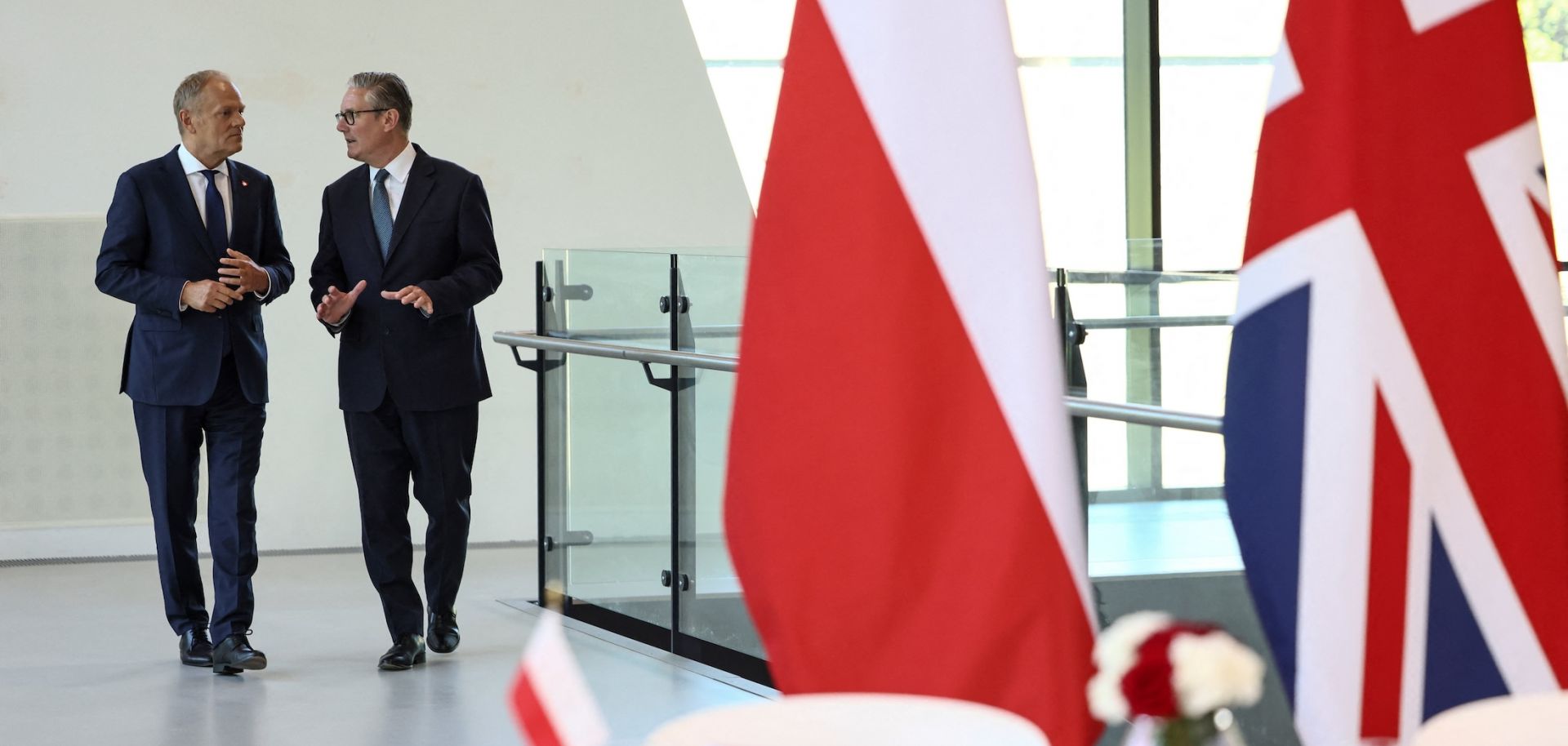
The U.K.-Poland defense and security treaty will deepen weapons coproduction, joint exercises and cooperation against Russian hybrid threats, advancing both countries' efforts to position themselves at the center of a European rearmament drive spurred by growing doubts over U.S. security guarantees. Polish Prime Minister Donald Tusk and British Prime Minister Keir Starmer signed a defense and security treaty in London on May 27. Named the Northolt Treaty, the agreement commits the two countries to combine industrial capability to jointly develop and manufacture weapons in both the United Kingdom and Poland, including the coproduction of a next-generation medium-range air-defense missile. The two will step up the use of uncrewed systems and next-generation land capabilities to reinforce NATO's eastern flank. They will also hold large-scale joint exercises designed to sharpen interoperability across counterdrone warfare, electronic warfare and engineering support. The treaty further establishes cooperation against hybrid attacks by hostile state actors, which in recent years have included arson, cyberattacks, sabotage operations and espionage carried out by Russia-linked actors. Beyond the military domain, the pact extends to economic resilience, energy security and migration, including a new joint action plan aimed at disrupting people-smuggling networks and bolstering both countries' border security.

- The agreement builds on earlier deals the two countries signed in 2017 and 2023 covering areas like military training and cybersecurity, with talks on the new, larger treaty running since January 2025. It is based on a closely aligned view of Russia as the main threat to European security, reflected in both countries' record as two of Ukraine's leading military backers, hawkish stance toward Moscow and shared preference for a robust defensive posture on NATO's northeastern flank.
- Both the United Kingdom and Poland rank among Ukraine's earliest and largest arms suppliers. The United Kingdom leads on tanks, long-range missiles, troop training and intelligence support, while Poland contributes tanks, fighter jets and artillery and serves as the main conduit for Western weapons reaching Ukraine. Both favor permanently stationed combat forces on NATO's eastern flank over a lighter tripwire presence, with Poland the alliance's top defense spender as a share of GDP and the United Kingdom leading NATO's multinational battlegroup in Estonia.
The treaty reflects a convergence of British and Polish strategic interests, particularly in defense-industrial development, security resilience and participation in Europe's changing security architecture. For the United Kingdom, the treaty is part of a broader effort to stay embedded in Europe's rearmament and defense integration process after losing access to EU programs and decision-making channels following Brexit. The partnership with Poland, NATO's largest spender on defense by share of GDP, gives the United Kingdom access to one of Europe's fastest-growing defense markets and a coproduction partner for next-generation systems, opening new opportunities for a defense industry London is eager to revitalize. For Poland, the treaty adds to its growing roster of bilateral security partnerships while supporting Warsaw's ambition to expand domestic arms manufacturing rather than merely import capability, as evidenced by provisions on local production and technology transfer. Commitments to align export strategies, pool procurement and cut regulatory barriers position the two to bid jointly in third markets beyond just arming their own forces. However, the most significant industrial gains will likely take years to materialize as new systems move from design to the field. The treaty also builds in resilience, with interchangeable capabilities letting both militaries field common munitions and equipment and resupply from each other's stocks, a step deeper than mere interoperability. Provisions for security of supply, a steadier order pipeline and joint supply chain work aim to increase the resilience of their defense companies against supply chain disruptions. The hybrid-threat cooperation strand also addresses pressing domestic concerns, giving Poland a capable partner against the espionage, sabotage and disinformation threats it faces as the main logistics hub for Western military aid to Ukraine.
- The British government estimates that defense-industrial cooperation between the two countries has already generated around 8 billion pounds ($10.9 billion) for the United Kingdom over the past three years, underscoring the commercial stakes attached to the deepening partnership alongside its strategic dimension.
- The United Kingdom has recently concluded strategic partnerships with Norway, Germany and France — the latter including unprecedented coordination on nuclear deterrence. London also signed a broader Security and Defense Partnership with the European Union in May 2025, though talks to join the bloc's 150-billion-euro ($174-billion) SAFE defense fund later collapsed over the entry cost. Poland has signed agreements with France, Sweden, South Korea, Japan and, just days before the Northolt Treaty, Canada, while moving to conclude an enhanced defense pact with Germany expected in mid-June.
Rising concerns over potential U.S. disengagement from European security are driving the proliferation of mutual-defense agreements, with the Northolt Treaty serving as one piece of this emerging architecture. European capitals no longer feel they can take automatic U.S. intervention in case of crisis under NATO's Article 5 for granted. U.S. President Donald Trump has openly weighed a withdrawal from the alliance and questioned whether Washington remains bound by its mutual-defense commitment amid disputes with European allies over burden-sharing, weak support against Iran and Greenland. In response, they are accelerating rearmament and building a dense web of bilateral and minilateral pacts, many carrying mutual-assistance clauses, that thicken the continent's security ties without yet supplanting the alliance. A Europe-only alternative remains out of reach given capability gaps, defense-industrial bottlenecks, fiscal divergence, differing strategic priorities and sovereignty disputes among key European powers. The Northolt Treaty, with its mutual-assistance clauses, is one node in this widening network. The United Kingdom and Poland rank among Europe's most committed NATO members and U.S. allies, yet both recognize the risk of American disengagement and the need to hedge against a future in which Europe carries far more of its own security. Should transatlantic ties erode further or Russian aggression escalate, agreements like the Northolt Treaty could form the scaffolding for a more self-reliant European defense posture, providing interlocking obligations and stronger defense-industrial links.
- Trump has increasingly framed U.S. security guarantees as conditional, telling allies unwilling to share more of the defense burden or back Washington's global priorities not to expect unconditional protection. Tensions escalated sharply over U.S. threats to "acquire" Greenland in January and then the fallout from the Iran war, after several European governments declined to support U.S.-Israeli operations. Trump accused allies of "betrayal," said he would "remember" their stance and floated withdrawing from NATO — remarks echoed even by traditionally transatlanticist figures such as Secretary of State Marco Rubio.
- The Pentagon announced a 5,000-troop drawdown from Germany in early May and canceled a planned Tomahawk missile deployment there, then abruptly scrapped a rotational deployment of roughly 4,000 troops to Poland. Trump pledged on May 21 to send 5,000 troops to Poland instead, likely reallocated from the German drawdown. The reshuffling points to a gradual but selective retrenchment that favors allies seen as politically aligned with Washington, Poland among them. The volatile and at times contradictory moves continue to unsettle European capitals — Warsaw included — over the risk of sudden reversals and of capability gaps opening before their own forces can fill them.