
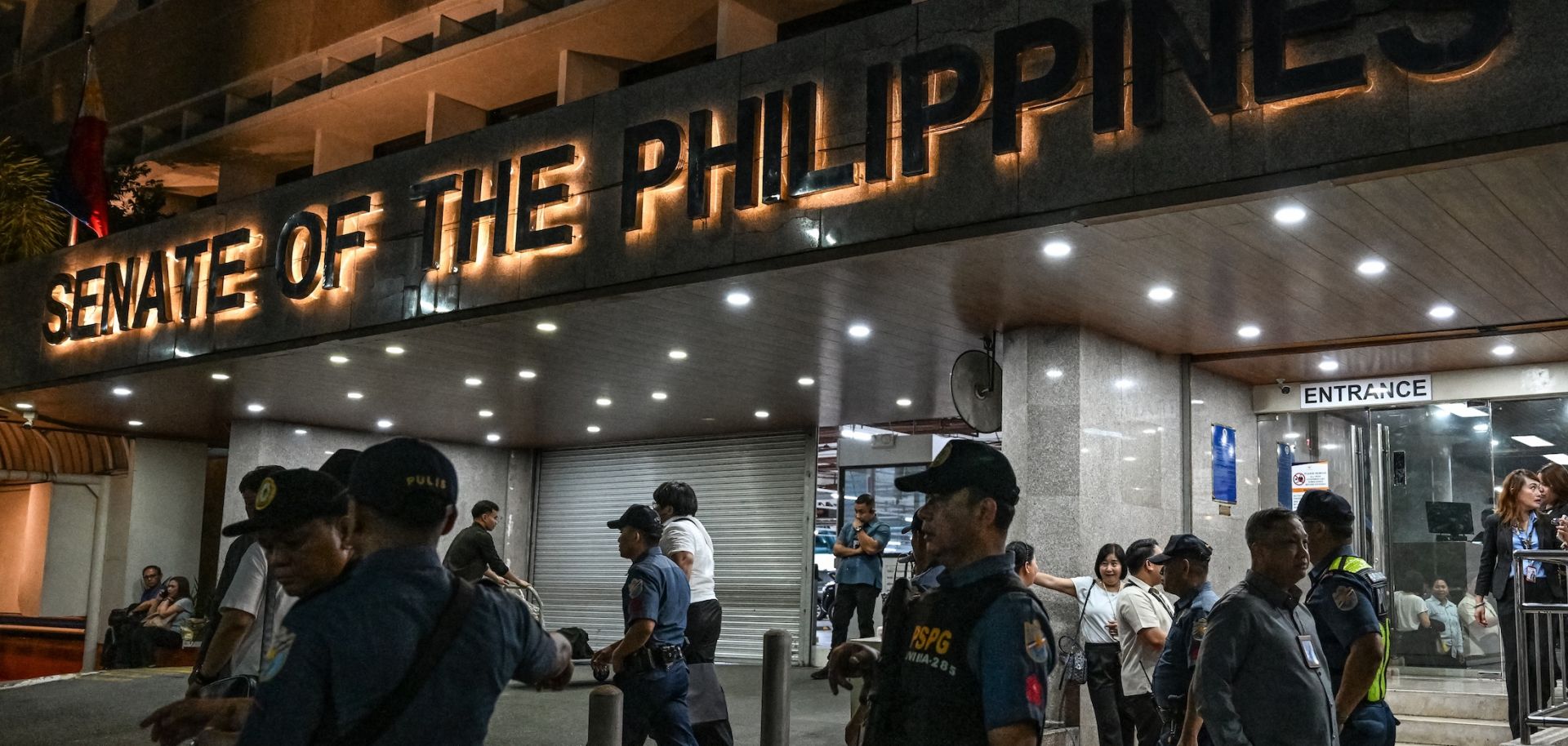
In the Philippines, worsening tensions between rival political dynasties are testing the country's institutions and portending policymaking obstructionism ahead of the next presidential election in 2028. Over the past three weeks, the Philippines has been rocked by developments in two converging high-profile political scandals. On May 11, the House of Representatives overwhelmingly impeached Vice President Sara Duterte and moved her case to the Senate for trial, where it is scheduled to begin on July 6 after she faces a June 1 deadline to answer the articles of impeachment. Also on May 11, senators aligned with the vice president installed a political ally as Senate president, and, on Senate premises, National Bureau of Investigation (NBI) agents tried and failed to serve an International Criminal Court (ICC) warrant on Senator Ronald "Bato" dela Rosa — a former national police chief accused of crimes against humanity during the 2016-2018 controversial anti-drug campaign overseen by Sara's father, former President Rodrigo Duterte. On May 13, gunfire broke out on Senate premises after dela Rosa warned of his imminent arrest and urged his supporters to prevent his transfer to The Hague, though no injuries were reported. Dela Rosa fled the Senate on May 14 and remains at-large, escalating an ongoing feud between the Duterte camp and current President Ferdinand Marcos Jr, the scion of the country's other leading political dynasty. On May 20, the Supreme Court rejected dela Rosa's request for a temporary restraining order to block his arrest or transfer to the ICC (after which the Department of Justice said the ICC warrant is enforceable), ordered law enforcement to arrest dela Rosa and warned that anyone helping him evade arrest could face legal consequences.
- Dela Rosa reappeared at the Senate on May 11 after months in hiding to help install a Duterte-aligned Senate president, giving the bloc the clinching vote to secure the 13 needed to oust the incumbent Senate president in a surprise move. Critics alleged the maneuver was a "legal coup" because it suddenly shifted control of the chamber just as it was about to handle Sara Duterte's impeachment trial and as NBI agents were trying to serve the ICC warrant on dela Rosa, who took refuge with allied senators.
- The Supreme Court's May 20 decision denied dela Rosa's request for immediate protection from arrest but did not settle the broader question of whether an ICC warrant can be enforced inside Philippine territory without a local court warrant, making further legal challenges likely.
The crisis reflects the convergence of three pressures: the collapse of the Marcos-Duterte alliance, the Marcos administration's greater willingness to cooperate with the ICC over Duterte-era drug war killings, and positioning for the 2028 presidential election. Marcos and Sara Duterte ran together in 2022 in a marriage of convenience between two powerful dynasties, but the alliance has since fractured as pressures sharpened over ICC cooperation and foreign policy disputes. Duterte has accused Marcos of political persecution, while the president's allies frame the impeachment case as accountability for allegations that include misuse of public funds, unexplained wealth and assassination threats against Marcos, his wife and his cousin, a former House speaker. The stakes are high because a Senate conviction could remove Duterte from office and bar her from seeking the presidency in 2028, while an acquittal or a procedurally weakened trial could preserve or even bolster her presidential candidacy by framing her as a martyr. The dela Rosa case raises the stakes further because it threatens the wider Duterte network, given that he was the elder Duterte's national police chief and a central defender of the anti-drug campaign now under international prosecution, with his potential arrest posing wider risks to a broader set of former Duterte administration officials. As a result, control over Senate procedure, timing and security decisions has become unusually consequential. The Senate will determine the pace of Sara Duterte's impeachment case, while its handling of dela Rosa will shape whether ICC enforcement is viewed as a lawful accountability process or as an ad hoc element of the broader Marcos-Duterte power struggle.
- The ICC opened a preliminary investigation into Duterte-era drug war killings in 2018, before the Philippines' withdrawal from the Rome Statute took effect in 2019. Marcos initially resisted cooperation by arguing in 2023 that the court no longer had jurisdiction and asserting that Philippine agencies would not assist the probe. But his stance softened as the Marcos-Duterte alliance collapsed and ultimately reversed, culminating in Rodrigo Duterte's March 2025 arrest and transfer to The Hague in cooperation with local authorities. The episode demonstrated that renewed ICC cooperation was a useful way to pressure the Duterte camp through international legal channels rather than a direct domestic prosecution against the president's primary political competition.
- This is the second attempt to impeach Sara Duterte in two years. The House first impeached her in February 2025, but the Supreme Court voided that case in July 2025 after finding it violated the constitution's one-year bar on repeat impeachment complaints. Lawmakers refiled after the bar lapsed, giving both camps a legal basis to challenge the current case if the Senate appears to rush, delay or otherwise extraconstitutionally shape the trial.
- The Marcos-Duterte alliance had been fraying long before the impeachment case, as lawmakers allied with Marcos cut Sara's confidential funds and probed alleged misuse of discretionary spending, Rodrigo and Marcos traded public accusations of drug use and Sara resigned from Marcos's cabinet in June 2024. The rupture also widened over foreign policy, as Marcos has significantly expanded defense cooperation with the United States and has adopted a far more assertive stance against Chinese grayzone activity in the disputed South China Sea, while the Duterte camp favors greater accommodation with Beijing and has warned that Marcos's foreign policy risks dragging the Philippines into conflict with China.
The Duterte-Marcos feud is poised to worsen ahead of the 2028 presidential election, testing the resilience of the country's institutions and slowing policymaking on both key domestic and foreign policy priorities. The Philippines appears set for a widening institutional contest between the Duterte and Marcos camps ahead of the May 2028 presidential election. Marcos cannot run again because Philippine presidents are limited to one six-year term, but his camp has yet to consolidate around a single alternative candidate. Sara, meanwhile, is the Duterte camp's most viable vehicle for returning to power. Her eligibility is thus one of the central stakes of the impeachment trial, which will probably proceed through its early procedural stages, since an outright dismissal or highly visible delay would reinforce claims that newly in charge Duterte-aligned senators are using the chamber to protect the vice president. However, it does not appear headed for an easy conviction. Conviction requires a two-thirds Senate vote, or 16 of 24 senators, and the chamber is less favorable to the Marcos camp in light of the Duterte-aligned Senate president installed on May 11. The trial is unlikely to function as a narrow legal proceeding, as even procedural rulings will be interpreted through the lens of whether the Senate recently shielded dela Rosa and whether its leadership is trying to manage the case toward a politically survivable outcome for the younger Duterte. The trial's July 6 start date leaves time for a verdict before 2028, but procedural fights could stretch the process and keep Duterte's eligibility unresolved deep into the pre-election period. Meanwhile, the arrest effort against dela Rosa is likely to remain a parallel pressure point, with authorities trying to locate him while avoiding another armed confrontation. Given no clear signs of a military break with civilian authority or sustained nationwide unrest, a coup or civil conflict remains unlikely. The more immediate risk will instead stem from institutional brinkmanship in which legal orders, legislative privilege, personal loyalties and law enforcement chains of command increasingly collide, resulting in selective rule-of-law erosion, competing jurisdictional claims, noncompliance by political actors and protest pressures. The feud has already strained institutional coordination through the Senate standoff, ICC enforcement dispute and impeachment calendar. Duterte allies could further use their stronger Senate position, local political networks and public mobilization to complicate Marcos's agenda. However, the Marcos camp is dominant in the House, which has agenda-setting power and can introduce legislation, but its initiatives generally require Senate approval. This raises the likelihood that policymaking, particularly in the Senate, gets bogged down before 2028 due to the worsening political standoff absorbing leadership attention, thereby making key foreign and domestic priorities — like defense site upgrades, South China Sea crisis planning, infrastructure approvals and investment promotion — more vulnerable to delay or politicization.
- Security risks are more likely to be localized than systemic, concentrated around the Senate complex, nearby Metro Manila government and court facilities, NBI and police operations, and Duterte strongholds such as Davao City and other parts of southern Mindanao. Another failed arrest attempt, a public sighting of dela Rosa or a major procedural ruling in the vice president's impeachment trial could quickly draw rival demonstrations in Metro Manila, while an attempt to arrest dela Rosa in Davao or elsewhere in Mindanao would carry a higher protest risk because of the Duterte family's entrenched local support base.
- Rule-of-law risk is visible in the enforcement dispute over dela Rosa, as his lawyers said they will argue that the ICC warrant cannot be enforced without a local court's endorsement. This leaves authorities with a legal opening to arrest him, but it also ensures any enforcement action will likely be politically and procedurally contested.
- Marcos's "Build Better More" program includes roughly $177 billion in flagship infrastructure projects through 2028, while Manila is trying to attract investment in electronics, semiconductors, nickel processing and battery supply chains and accelerate upgrades at Philippine military sites accessible to U.S. forces under the two countries' Enhanced Defense Cooperation Agreement. Political turmoil will not freeze these efforts outright, but it could slow procurement, permitting, agency coordination and investor confidence.
