
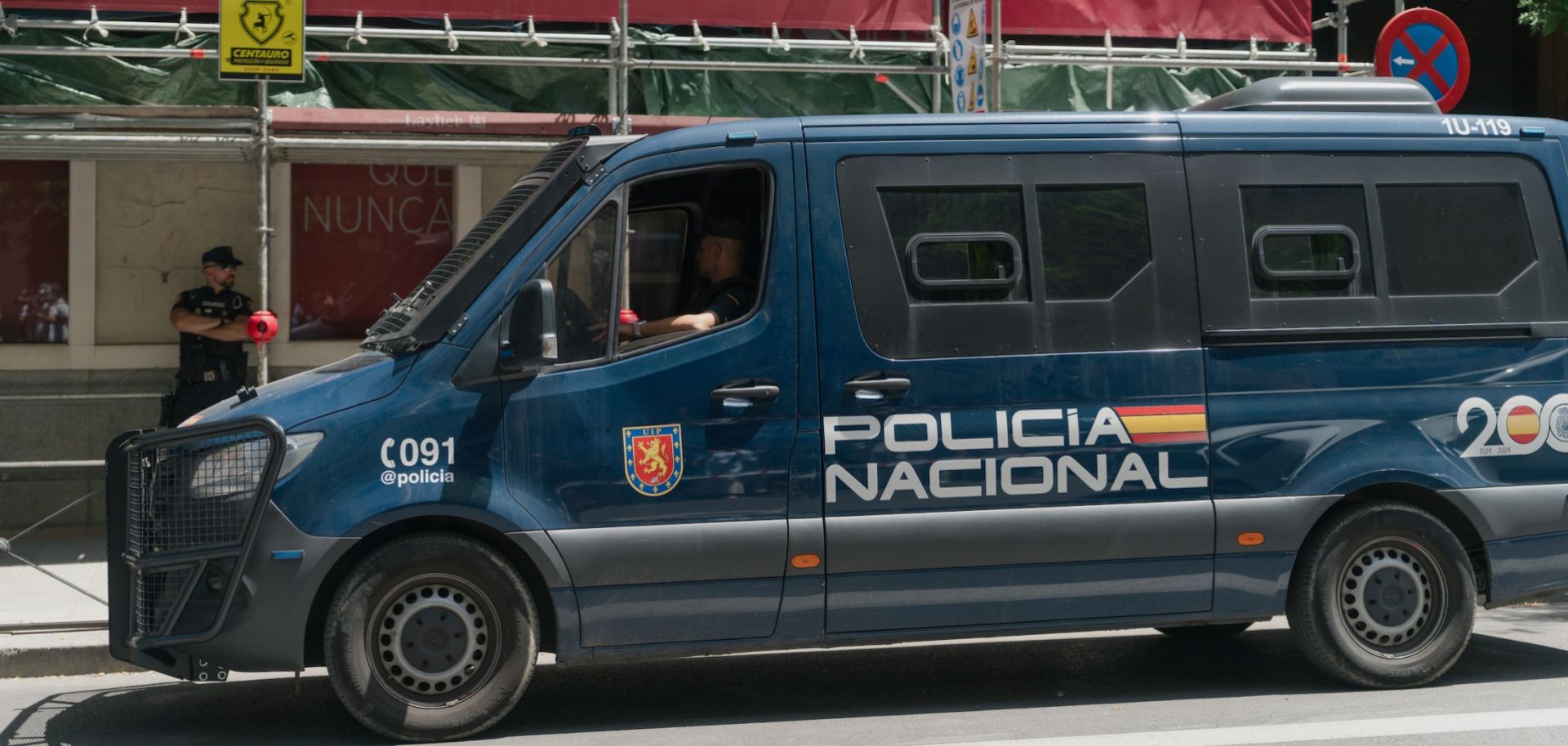
A National Police van is parked in front of the Spanish Socialist Workers' Party headquarters during the Civil Guard's police search on May 27, 2026, in Madrid, Spain.
(Olmo Blanco/Getty Images)
A National Police van is parked in front of the Spanish Socialist Workers' Party headquarters during the Civil Guard's police search on May 27, 2026, in Madrid, Spain.

Corruption investigations will continue to weaken the Spanish government and result in domestic and foreign policy paralysis, while Prime Minister Pedro Sanchez will seek to avoid an early general election that would result in a right-leaning government. On May 27, officers from Spain's Civil Guard's Central Operative Unit (UCO) entered the national headquarters of the governing Socialist Party (PSOE) in Madrid. The raid happened as a part of an investigation into allegations that PSOE-linked operatives attempted to interfere in judicial proceedings, pressure witnesses and discredit anticorruption investigators. The raid happened only a few days after the emergence of a separate scandal involving the 2021 bailout of the Plus Ultra airline. Authorities are examining whether politically connected intermediaries improperly influenced the approval of 53 million euros ($62 million) in public rescue funds for the airline during the pandemic. The investigation has reached former PSOE Prime Minister Jose Luis Rodriguez Zapatero, whose office was searched by police amid allegations of influence peddling, money laundering and financial links to Venezuelan business networks associated with the airline.

  • The May 27 raid was indirectly connected with the so-called "Koldo affair," which began as an inquiry into irregular COVID-era procurement contracts for masks and medical supplies involving former Transport Minister Jose Luis Abalos and his adviser Koldo Garcia. Investigators later expanded the case into alleged bribery, influence peddling, cash payments, illegal commissions and possible party financing irregularities tied to infrastructure and public works contracts.
  • Alongside the Koldo and Plus Ultra cases, several smaller investigations have added to pressure on the PSOE. Some focus on people close to Sanchez, including inquiries related to his wife's professional and academic activities and his brother's public-sector employment, who are both being examined for possible influence peddling or preferential treatment. Broader probes into procurement practices under PSOE-led regional and municipal administrations have also raised concerns about contracting irregularities. While none of these cases directly implicate Sanchez himself, they contribute to a wider narrative of patronage risks within the party's governing network.

The expanding corruption investigations have significantly weakened the government's domestic governing capacity while only marginally affecting its broader foreign policy orientation. Sanchez and PSOE leaders frequently frame the ongoing corruption investigations as politically motivated "lawfare" amplified by conservative media and elements within the judiciary. By contrast, the conservative opposition argues that the breadth of the allegations demonstrates systemic corruption at the heart of government. This environment has intensified political polarization and further fragmented parliamentary cooperation inside an already fragile coalition system. PSOE's governing majority depends on a patchwork alliance of left-wing, Basque nationalist and Catalan separatist parties whose support is transactional and increasingly conditional. As a result, legislative negotiations have become slower and the government has struggled to pass any meaningful policies in recent months. The scandals have also reinforced the opposition strategy, which continues to demand early elections while presenting Sanchez as politically exhausted. In foreign policy, however, the impact has been more limited. Spain remains institutionally aligned with the European Union, NATO and eurozone fiscal frameworks. There has been no major shift in support for Ukraine, migration cooperation or climate initiatives. Nonetheless, the scandals have reduced Sanchez's authority and influence because a leader under constant domestic investigation has less capacity to shape long-term European initiatives. The government has therefore leaned more heavily on symbolic diplomacy — especially a vocal defense of Gaza, criticism of the U.S. government and its war against Iran, and progressive European positioning — partly because foreign policy activism remains one of the few areas where Sanchez can still appear presidential and internationally relevant despite mounting domestic pressure.

  • Regional elections in Aragon, Castile and Leon, and Andalusia in 2026 have shown an electoral environment in which the conservative Popular Party is the dominant force but faces a resilient PSOE and a rising right-wing Vox party, complicating its ability to govern alone. The most notable case is in Andalusia, Spain's largest region by population, in which the Popular Party won the most votes but lost the absolute majority it had secured in 2022, forcing it to negotiate with Vox to form a regional government. This could offer a preview of the next Spanish general election. 

Over the next 12 months, the most likely scenario is not government collapse but progressive political attrition and growing domestic and foreign policy paralysis. Sanchez's government retains several structural advantages that make immediate removal improbable: the opposition lacks an outright parliamentary majority; PSOE's coalition partners remain reluctant to trigger elections that could empower a right-wing government involving the Popular Party and Vox; and the Spanish economy, while uneven, has avoided the kind of financial volatility that produces social unrest and often destroys governments. As a result, the government will probably survive unless prosecutors uncover direct evidence implicating Sanchez personally or coalition allies conclude that association with PSOE has become more electorally toxic than association with the conservative opposition. Nevertheless, the investigations will continue to degrade the government's operational effectiveness. Policy formation is likely to become shorter-term, more tactical and increasingly subordinated to political survival. Large structural reforms — particularly involving taxation, pensions, housing and territorial governance — will slow considerably or stall as coalition cohesion weakens further. Budget negotiations will become even more precarious, raising the possibility of new extensions of existing fiscal frameworks rather than fully negotiated annual budgets (Spain has not approved a new budget since 2022). The scandals are also likely to deepen institutional mistrust by reinforcing public perceptions that the political class, judiciary, police and media are engaged in mutually hostile power struggles. This risks further eroding confidence in democratic institutions across the ideological spectrum and benefiting antiestablishment forces like Vox in the next general elections. Internationally, Spain will remain a stable European actor, though its political weight relative to its economic size will be reduced. European partners will continue working with Sanchez because Spain remains a strategically important EU member state, though they will also increasingly hedge against the possibility of political transition after the next election cycle in 2027. Consequently, Spain's foreign policy over the next year is likely to emphasize continuity and symbolism rather than ambitious new initiatives. 

  • Under the Spanish Constitution, a no-confidence motion can only succeed if the opposition simultaneously presents and secures parliamentary approval for an alternative candidate for prime minister. This makes it structurally difficult for PSOE's parliamentary partners — including the Basque Nationalist Party (PNV) and the Republican Left of Catalonia (ERC) — to support any initiative led by the Popular Party and Vox, since doing so would effectively install a right-leaning government in office. Even the Catalan secessionist Junts party, which has recently withdrawn legislative support for the Sanchez government, is unlikely to endorse a change of government that could empower a Popular Party-led executive, given its focus on Catalan autonomy.
  • Spain's next general election must take place by July 2027. According to current opinion polls, the Popular Party would obtain around 31% of the vote, followed by PSOE at around 29%, Vox at 17-18% and 5.6% for the left-wing Sumar.
RANE
SUBSCRIBERS ONLY

Expert analysis when it matters most.

Get access to RANE's decision-grade geopolitical intelligence.