
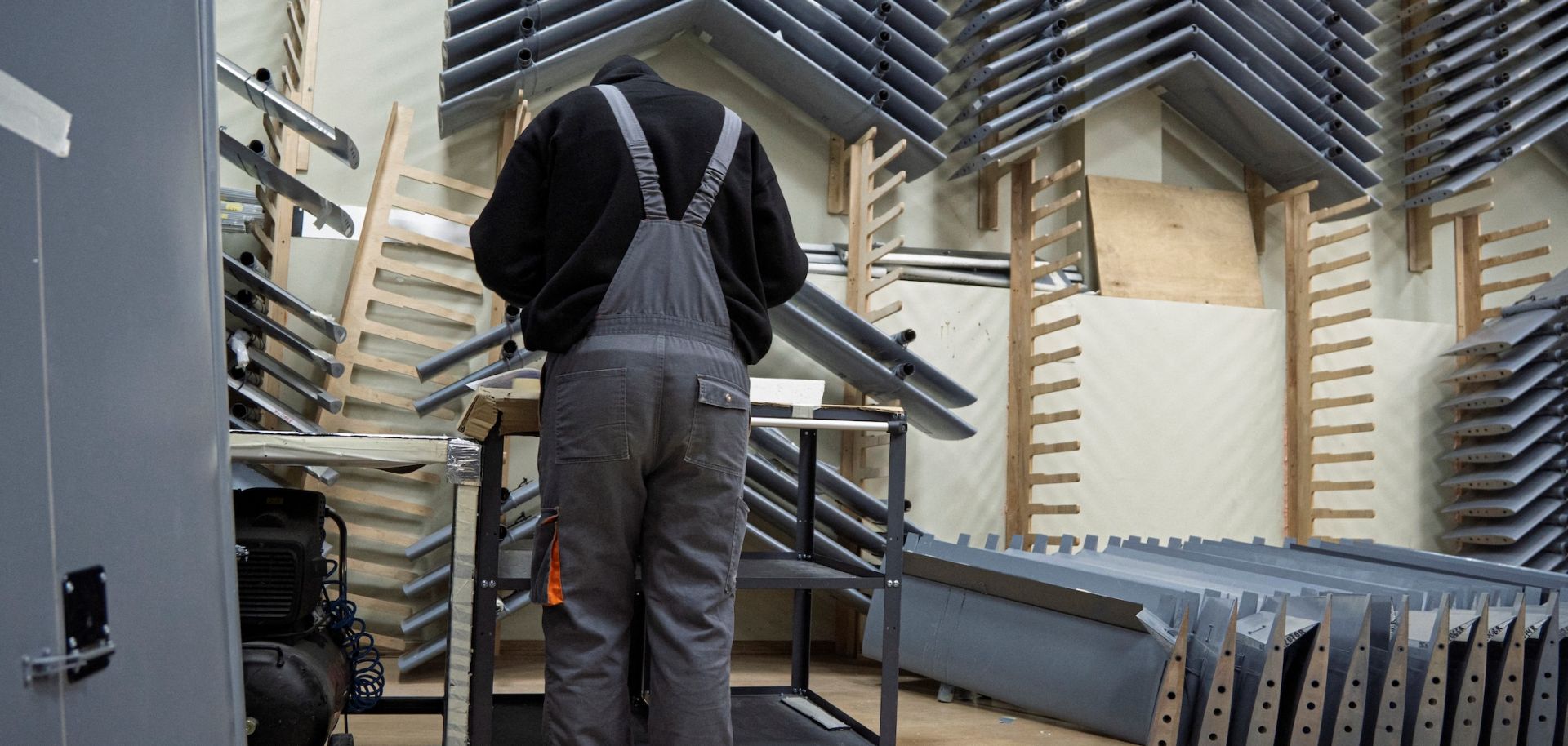
An employee assembles a long-range drone in a workshop of the Fire Point company, which manufactures FP-1 deep-strike drones and FP-2 strike drones, Jan. 29 in an undisclosed location in Ukraine.
(Serhii Okunev/AFP via Getty Images)
An employee assembles a long-range drone in a workshop of the Fire Point company, which manufactures FP-1 deep-strike drones and FP-2 strike drones, Jan. 29 in an undisclosed location in Ukraine.

Ukraine's attractiveness to foreign investors by 2030 will be driven primarily by the evolution of the war with Russia, with outcomes ranging from continued frontier-style, high-risk, selective investment under a stalemate to large-scale reconstruction-led inflows under peace or severe capital flight and market collapse under escalation. Foreign investment prospects in Ukraine by the end of the decade will be primarily determined by how the war with Russia evolves during that period. While issues like the pace of Ukraine's integration with the European Union, domestic institutional reforms and the evolution of the labor force will impact investment decisions, security conditions will remain the dominant driver of capital allocation decisions. Investor appetite will vary significantly depending on whether the conflict intensifies, stabilizes or moves toward resolution. This report examines four plausible scenarios for the evolution of the war in decreasing order of probability and assesses how each would shape Ukraine's investment profile, sectoral opportunities and risk environment. The first part examines the scenarios of the status quo continuing and a frozen conflict. The second focuses on the more extreme scenarios of a comprehensive peace agreement and a drastic escalation of the war.


In 2021, before Russia's full-scale invasion, Ukraine had a diversified economy with a GDP of around $200 billion, driven by agriculture, metallurgy, industry, energy transit and a growing IT sector. The February 2022 invasion caused a severe economic shock, with GDP falling nearly 30% that year as infrastructure, industry and labor capacity were heavily damaged. Roughly 6 million people are believed to have left the country, which had a prewar population of around 42 million. By 2026, Ukraine's economy had partially stabilized through foreign assistance, domestic defense production, reconstruction spending and export adaptation. However, Kyiv still faces significant financial shortfalls as the government has dedicated ever-larger portions of its budget to fund the war. The International Monetary Fund (IMF) and World Bank expect GDP to expand by around 1% to 2% in 2026, reflecting continued security risks and fiscal pressures. Key sectors now include agriculture, defense manufacturing, IT services, energy rebuilding, logistics and construction. Ukraine's recovery and reconstruction needs are estimated at about $588 billion over the next decade, with the highest costs in housing, transport, energy, industry and agriculture. Sustained international financing and private investment will be critical for long-term recovery.


Scenario 1: The Status Quo Continues

In this scenario, Ukraine remains in a condition of managed wartime fragility rather than imminent collapse or peace. Russia retains control of the territories it currently occupies but fails to achieve major additional territorial gains. Western political and economic support for Kyiv endures, particularly from the European Union and key European states, which continue supplying financial assistance, macroeconomic stabilization funding and military equipment. Russian missile and drone strikes against Ukrainian cities and infrastructure remain frequent, although Ukraine's increasingly sophisticated air defenses intercept most attacks. Diplomatic engagement and intermittent peace negotiations continue, but without meaningful breakthroughs, leaving investors to operate under conditions of chronic geopolitical uncertainty rather than transition toward postwar normalization.

This scenario would likely produce selective foreign investment in Ukraine rather than a broad-based surge in capital inflows. Investors would continue to differentiate between frontline regions in the east and south of the country and relatively secure economic hubs in western and central Ukraine, particularly around Kyiv, Lviv and parts of the Dnipro River basin. Capital deployment would remain heavily concentrated in sectors linked to resilience and reconstruction rather than consumer-led growth. Energy infrastructure would emerge as an attractive sector for foreign investors, especially decentralized energy generation, grid modernization, battery storage, gas production and renewable energy projects designed to reduce vulnerability to Russian strikes. Persistent attacks on centralized infrastructure would reinforce demand for distributed energy systems, creating opportunities for utilities companies, infrastructure funds and industrial engineering firms capable of operating in elevated-risk environments.

Ukraine's defense-industrial sector would become increasingly attractive. As the war evolves into a prolonged conflict of attrition, European governments would likely deepen industrial cooperation with Ukrainian defense manufacturers in areas such as drone production, electronic warfare, armored vehicle maintenance, ammunition manufacturing and battlefield software integration. Foreign investment into dual-use technologies would expand, particularly where Western governments provide procurement guarantees or cofinancing mechanisms. Venture capital and private equity firms focused on defense technology would increasingly view Ukraine as an emerging innovation environment shaped by real-world battlefield testing, although investment would remain politically sensitive and highly dependent on export controls and government partnerships.

Agriculture would continue to attract foreign interest despite persistent operational risks. Ukraine's long-term structural advantages — fertile land, large-scale grain production capacity and proximity to European markets — would keep the sector attractive despite the war. Investors would prioritize logistics infrastructure, grain storage, rail transport, food processing and Danube River export corridors rather than large-scale greenfield farming operations in vulnerable areas. Insurance costs, maritime insecurity in the Black Sea, labor shortages and infrastructure disruptions would continue to constrain profitability, but strategic investors would likely view the sector as a long-duration geopolitical food-security play supported by continued European integration.

Ukraine's technology sector would also remain resilient. Despite wartime conditions, Ukraine's IT and software engineering industries have demonstrated considerable adaptability since 2022. Under this scenario, foreign firms would likely continue outsourcing, cybersecurity partnerships, defense-tech collaboration and AI-related development work. Cybersecurity in particular would attract heightened investor interest given Ukraine's unique operational experience defending critical infrastructure against Russian cyber operations. International technology firms may increasingly view Ukraine as a strategic cybersecurity and defense-technology ecosystem integrated with broader European digital-security priorities.

Substantial risks would continue to suppress large-scale conventional foreign direct investment. Persistent Russian missile and drone attacks would keep operating costs high across virtually every sector of the Ukrainian economy, keeping insurance premiums, security expenditures and infrastructure redundancy requirements high. Political risk insurance backed by multilateral institutions such as the World Bank, the European Bank for Reconstruction and Development and export credit agencies would become essential for many transactions. Investors would remain highly sensitive to the possibility of escalation, including renewed Russian offensives against critical infrastructure or changes in Western political cohesion. Long-term infrastructure projects requiring heavy upfront capital expenditure would therefore face slow deployment timelines. Investment deployment would be further limited by ongoing wartime capital controls, which effectively lock legacy profits inside the country and deter risk-averse private equity from navigating complex repatriation limits.

Further complicating Ukraine's investment approach would be the fact that the country would continue to suffer from poor demographics. While some circular migration would continue, especially for lower-income and seasonal workers, most high-skill workers who left the country since 2022 would remain in EU labor markets due to income differentials, stability and schooling considerations for children. The fact that many men of fighting age left the country illegally and are legally considered deserters would further complicate their return. As a result, Ukraine may experience a skills mismatch. The country would simultaneously see shortages in engineering, construction, healthcare and technical trades while still having underutilized labor in more vulnerable or economically depressed regions.

Scenario 2: A Frozen Conflict

In this scenario, Ukraine would enter a transitional phase between active war and postwar reconstruction without achieving a formal political settlement with Russia. The conflict would remain unresolved in legal and geopolitical terms, but the intensity of hostilities would decline substantially. This reduction in violence could emerge through a durable ceasefire, repeated localized truces or simple battlefield exhaustion in which neither side actively pursues major territorial advances. Russian missile and drone attacks would become less frequent, reducing the immediate threat to major urban and industrial centers. At the same time, the absence of a comprehensive peace agreement would leave underlying security risks unresolved, preserving the possibility of future escalation. European financial and political support for Ukraine would continue, helping stabilize the macroeconomic environment and reinforcing Kyiv's long-term integration with European institutions.

The reduction in active combat would somewhat improve investor confidence but not eliminate questions about future escalation. Some international firms that previously viewed Ukraine as operationally inaccessible would begin reassessing market entry opportunities, particularly in sectors tied to reconstruction, infrastructure modernization, manufacturing relocation and EU-oriented supply-chain integration. Capital inflows would likely increase gradually rather than explosively, with investors still demanding elevated risk premiums but increasingly treating Ukraine as a high-risk growth market rather than an active war zone.

Infrastructure and reconstruction-related sectors would become central focuses of investment. Reduced missile attacks would allow large-scale rebuilding projects to proceed more consistently, particularly in transportation, electricity transmission, housing, logistics, ports and industrial facilities. Construction firms, engineering companies, cement producers and infrastructure funds would likely compete for contracts supported by EU financing mechanisms, multilateral development banks and bilateral reconstruction programs. 

Manufacturing and industrial production could also experience growth. Some European firms seeking to diversify their supply chains may increasingly view Ukraine as a lower-cost industrial platform integrated with European markets, facilitated by the EU-Ukraine Association Agreement. Western Ukraine in particular could emerge as an important manufacturing corridor for automotive components, industrial machinery, defense equipment, building materials and consumer goods destined for the European Union. Labor costs would remain competitive relative to Central Europe, while EU accession reforms would gradually improve regulatory alignment and legal predictability. Investors would nevertheless remain cautious about deploying large amounts of capital into the east of the country, vulnerable to future escalation with Russia. 

The energy sector would attract strategic investment, although the emphasis would shift from emergency resilience toward long-term modernization and integration with European energy systems. Foreign investors would likely expand involvement in renewable energy, electricity interconnections with the European Union, natural gas infrastructure, decentralized power generation and energy-efficiency projects. Ukraine's role as a future contributor to European energy security — including possible green hydrogen production and expanded electricity exports — would become increasingly prominent in investor narratives. A lower frequency of attacks would also improve the financial viability of long-duration infrastructure projects that remain difficult to finance under constant bombardment.

Agriculture and agribusiness would likely experience a modest recovery in foreign investment interest. Reduced disruptions to export logistics and lower security risks in transportation corridors would improve profitability across grain exports, food processing, storage infrastructure and agricultural technology. Investors would increasingly view Ukraine not only as a commodity exporter but also as a strategic food-security partner for Europe, the Middle East and parts of Africa. Black Sea shipping risks would remain an important variable, but greater predictability in trade flows could unlock larger-scale investment from multinational agribusiness firms and commodity traders.

Despite these opportunities, the frozen-conflict scenario still contains substantial structural risks that prevent Ukraine from fully normalizing as an investment destination. The absence of a formal peace agreement would complicate political risk assessments, particularly for pension funds, sovereign wealth funds and conservative institutional investors. Questions of territorial sovereignty, security guarantees and the potential for renewed Russian offensives would continue to constrain long-term investment horizons. Moreover, Russia's hybrid warfare against Ukraine would likely continue even if the conventional fighting were to subside. Insurance markets would improve but remain expensive relative to other emerging European economies, and many investors would continue relying on multilateral guarantees or public-private financing structures. Neighbors like Hungary, Slovakia and Romania would probably remain more attractive than Ukraine for nearshoring capital because they offer the same geographic proximity and low labor costs with the greater safety of the NATO umbrella. Moreover, capital controls would only be dismantled gradually, meaning profit repatriation would initially remain capped and bound by fresh capital inflows.

Finally, reduced violence and improved predictability would likely trigger a partial return of Ukrainian migrants. Return migration would be slow, partial and selective. Lower- and mid-skilled workers in construction, manufacturing, logistics and services would be the most likely to return, particularly if wage levels and job security were to improve in reconstruction-linked sectors. By contrast, internationally mobile, high-skill IT, finance and engineering professionals would be less likely to quickly return without strong incentives. The return of those men who left Ukraine illegally would remain problematic. A key feature of this scenario would be a "dual labor system": an expanding domestic workforce in reconstruction and industrial sectors, alongside a semi-permanent Ukrainian diaspora embedded in EU labor markets that would continue to generate remittances and cross-border business links.

Next: Part 2 explores the more extreme options of a comprehensive peace agreement or a severe escalation of the war.

RANE
SUBSCRIBERS ONLY

Expert analysis when it matters most.

Get access to RANE's decision-grade geopolitical intelligence.