
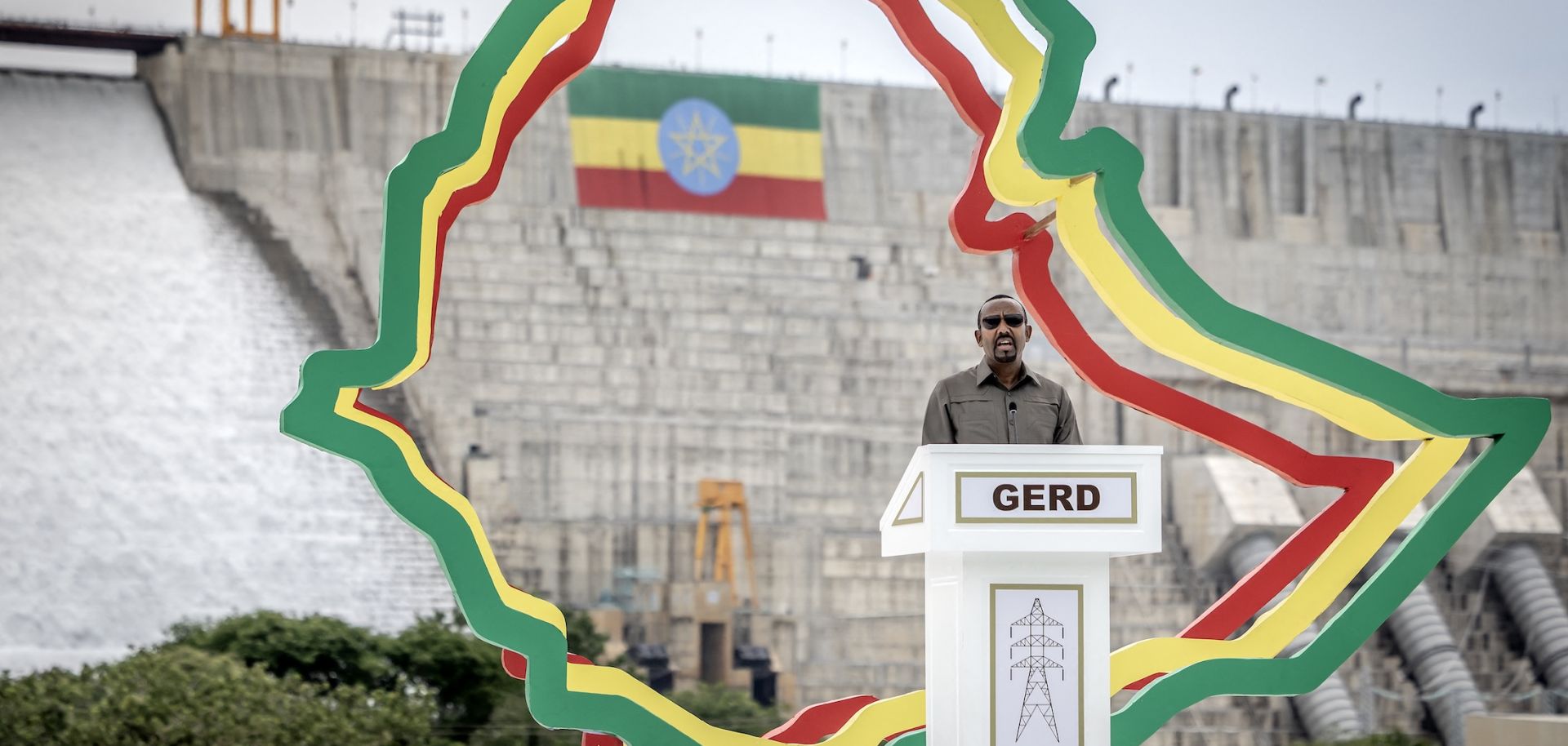
Ethiopian Prime Minister Abiy Ahmed delivers remarks during the official inauguration ceremony of the Grand Ethiopian Renaissance Dam in Guba on Sept. 9, 2025.
(LUIS TATO/AFP via Getty Images)
Ethiopian Prime Minister Abiy Ahmed delivers remarks during the official inauguration ceremony of the Grand Ethiopian Renaissance Dam in Guba on Sept. 9, 2025.

Ethiopia's June 1 general election will likely result in a landslide victory for Prime Minister Abiy Ahmed without triggering sustained nationwide unrest, which would enable Abiy to focus on advancing economic reforms and diversifying landlocked Ethiopia's maritime access; but the country faces a significant risk of escalating tensions in the Tigray region that could fuel a worsening security crisis in the Amhara and/or Oromia regions in a less-likely, higher-impact scenario. On June 1, Ethiopia will hold general elections in which voters will elect lawmakers for the House of Representatives, the country's lower house, and regional state councils for the country's 12 regions and two chartered cities. Lawmakers for the lower house and regional councilors will be elected using a first-past-the-post voting system. Once in office, the lower house will elect a prime minister, who is the head of the executive branch — a position for which Abiy is running for reelection. The run-up to polling day has been marked by restrictions on opposition parties' activities and elevated insecurity across many of the country's rural areas due to ongoing ethno-nationalist insurgencies and criminal activity. 

The general elections come as the federal government is facing rising tensions with the Tigray Peoples' Liberation Front, or TPLF, while high insecurity in many rural areas and socioeconomic grievances have weakened public support for Abiy, prompting a tightening of restrictions on the opposition. Abiy rose to power with a reformist agenda in 2018 amid mounting unrest against the TPLF, which had effectively governed the country since the early 1990s. The ensuing downturn in ties between the federal government and the TPLF paved the way for the outbreak of the Tigray war in 2020, which ended in November 2022 after the two sides reached a peace deal on terms favorable to Addis Ababa. However, Abiy's decision to strike a peace deal without including Eritrea and Amhara special forces, who were decisive in defeating the TPLF, sparked a severe surge in tensions with Eritrea. Meanwhile, the Ethiopian government's ensuing push to disarm Amhara special forces prompted many to rebel in 2023. The insurgents, known as Fano, continue to frequently clash with government forces in Amhara, and Fano's leading coalition has threatened to target parties and individuals partaking in the upcoming general election. Separately, resentment within parts of the TPLF over the 2022 peace deal led to an anti-Abiy faction rising to the party's helm. The TPLF has since formed an alliance of convenience with Eritrea and reinstated Tigray's 2020 regional council in late April, establishing a parallel administration that has de facto seized power in Tigray's regional capital, Mekelle. More broadly, the economic shock resulting from the Tigray war, which came on the back of already high inter-ethnic tensions, has fuelled recruitment by ethno-nationalist and criminal groups in Ethiopia, worsening insecurity in many rural areas. High insecurity and socioeconomic grievances have eroded Abiy's popular support, though it remains significant in larger cities, especially Addis Ababa. Against this backdrop, the federal government has increased its crackdown on opposition forces in recent years, including through arbitrary arrests and restrictions on opposition parties' activities. 

  • Despite shrinking political freedoms, several opposition parties are contesting in the elections, including the Ezema party, the Oromo Federalist Congress, and the National Movement of Amhara. However, most opposition parties face significant funding and organizational challenges and lack easy access to media outlets. 
  • The 2022 peace deal established an interim administration in Tigray to govern the region on a transitory basis. On April 8, the federal government extended the term of chief administrator Lt. Gen. Tadesse Werede by one year amid a deadlock in implementing the peace deal. However, the TPLF said it was not consulted and claimed the move violated the peace deal, and subsequently reestablished the Tigray State Council, elected in September 2020. Since then, the TPLF appears to have sidelined Tadesse, though he has refused to formally resign from his position. 
  • During the Tigray war, Ethiopian authorities revoked the TPLF's legal status. The TPLF was granted the status of a political party "under special consideration" in 2024, but the TPLF leadership rejected it and insisted on regaining its pre-war status. After the TPLF failed to comply with demands from the electoral board, the board revoked the TPLF's 2024 status in May 2025 — thereby leaving the party unable to run in the upcoming general elections. 
  • In January, leading Fano factions formed the Amhara Fano National Movement, establishing a unified military and political structure after years of fragmented leadership. The new organization has warned that anyone who participates in the upcoming elections would be seen as "enemies of the Amhara people."

Abiy is virtually certain to win reelection, but violence will likely still erupt in certain localities during and/or immediately after the vote, especially in Amhara's rural areas, and the vote is unlikely to take place across much of Tigray. The federal government's arrest of dissenters and the absence of a broad opposition coalition indicate that Abiy's Prosperity Party is highly likely to win a landslide victory. However, disgruntlement from the opposition and parts of civil society could spark localized unrest that turns violent, though the heavy deployment of security forces will limit the prospect of major anti-government demonstrations. Separately, localized instances of violence will likely erupt in several areas due to tensions surrounding the outcome of the regional elections, driven by disagreements over the conduct of the vote, land, ethnicity and kinship. In Amhara, Fano militants will likely attack polling stations to disrupt the election process, portending deadly clashes with security forces — especially in rural areas. Other regions facing ethno-nationalist insurgencies, such as Oromia and Benishangul-Gumuz, will also face a comparatively higher risk of armed clashes. Meanwhile, the election is unlikely to be held in most of Tigray due to the breakdown in ties between the federal government and the TPLF. Nonetheless, areas under the control of pro-government forces might still participate in the vote, despite high insecurity.

  • In January, Ethiopia's election board vowed to hold the general election in Tigray, but local media reports indicate the board was unable to access the region to conduct voter registration in late March and April due to rising tensions between the federal government and the TPLF. This suggests that preparations for the general election have not been made. 

Abiy's expected victory is unlikely to trigger sustained nationwide protests due to security forces' aggressive tactics, the lack of competitive elections and opposition fragmentation, though tensions in certain areas could persist for months due to the need for local repolls. The lack of a viable challenger to Abiy will mitigate the risk of widespread allegations of electoral fraud, given that no single party or coalition would likely be able to defeat his Prosperity Party on its own. Abiy's largely anticipated victory will also drive apathy among opposition supporters, which, together with expectations of a heavy-handed security crackdown, will likely limit turnout at any potential protests contesting the outcome of the election at a federal level. Alongside the opposition's fragmentation, these realities suggest that Ethiopia is unlikely to face nationwide post-election protests lasting more than a few weeks. However, localized tensions may persist for months in constituencies where voter fraud allegations or logistical disruptions necessitate repolling. This risk will be higher in rural areas of Amhara and Oromia, where insurgent activity may make it impossible to conduct the vote peacefully, but will remain relatively low in Addis Ababa, where Abiy retains significant public support.

  • National Election Board of Ethiopia Chair Melatwork Hailu requested 10 billion birr ($63.5 million) in mid-May, in addition to funding from national authorities. This points to the potential need for a repoll in certain areas after June 1 due to security challenges and/or contested results. 

The TPLF's likely rejection of the election's outcome and subsequent effort to consolidate power in Tigray could trigger a severe escalation with pro-government forces within weeks, even as Abiy attempts to avoid an escalation in the short term due to logistical challenges resulting from the rainy season and fuel shortages. The TPLF is unlikely to recognize the outcome of the general election, as doing so would pave the way for its local rivals to take over Tigray's regional government, given its inability to run. While this move would represent a direct challenge to Abiy's authority, it is unlikely to prompt the federal government to rapidly escalate against the TPLF, as the Ethiopian military is already stretched thin by ethno-nationalist insurgencies across the country. Such a military intervention would also face severe logistical difficulties due to fuel shortages caused by the Kiremt rainy season and the fuel shortages resulting from the Iran war. But while this means the federal government will likely favor restraint through mid-September, the likelihood of more decisive action against the TPLF will grow thereafter. Meanwhile, the TPLF will likely seek to capitalize on Abiy's apparently low appetite for escalation in the short term to consolidate its hold over Tigray. This could materialize through a limited offensive to recapture disputed territories between the Tigray and Amhara regions, namely Western Tigray and Tselemti. However, the TPLF would likely struggle to make significant advances due to Abiy's military buildup around Tigray. Moreover, the federal government would likely conduct aerial strikes on TPLF positions and/or tighten its economic blockade on TPLF-held areas to coerce the party into de-escalating. While this suggests the party would likely de-escalate following the federal government's response, the TPLF could test Abiy's resolve and double down on its offensive in a less-likely, higher-impact scenario — for example, by launching coordinated attacks in Western Tigray using its forces based in eastern Sudan and/or expanded Eritrean support. This would increase pressure on Abiy to press ahead with a more forceful response, and while the government would likely refrain from a full-blown intervention in Tigray during the rainy season, it could intensify aerial strikes on TPLF positions and ground operations along the line of contact. 

  • Several thousand TPLF fighters fled to eastern Sudan during the 2020-2022 Tigray war in a unit known as Army 70. These fighters have since been recruited by the Sudanese Armed Forces, or SAF, in its fight against the Rapid Support Forces, or RSF. Abiy's apparent tilt toward the RSF in recent months suggests that the SAF would likely approve an offensive by Army 70 into Western Tigray.

In a low-probability scenario, widespread disruptions to voting in Amhara and/or Oromia could trigger major post-election unrest that severely degrades the security environment in those regions, likely emboldening the TPLF and threatening to destabilize the country at large. Fano's internal coordination efforts point to a significant risk that it will launch synchronized attacks across Amhara on polling day. While Ethiopian security forces are heavily deployed in the region, these attacks could severely undermine the credibility of the vote in Amhara in a less-likely, higher-impact scenario. In Oromia, inter-ethnic tensions, election-related disputes and/or insurgent activity from the Oromo Liberation Army, or OLA, could result in a similar outcome. In either region, this could trigger large protests calling for a repoll. The upsurge in instability would create a dilemma for Abiy, as region-wide repolls could de-escalate tensions but would prolong political volatility. Against this backdrop, the federal government would likely make some politically conciliatory moves, such as local repolls, while simultaneously cracking down on demonstrators to end the protest movement. However, a violent post-election crackdown involving mass arrests and potentially hundreds of fatalities would increase the risk of civilian opposition groups coordinating with either Fano or OLA militants. This collaboration would likely manifest as increased militant attacks against security forces' supply lines to impede their ability to suppress urban riots led by the civilian opposition, which would pressure the federal government to redeploy troops currently dispatched near Tigray. Consequently, the TPLF — with Eritrea's backing — would become more likely to attempt recapturing Western Tigray and/or Tselemti. Such a multi-front crisis would likely force Abiy to make tradeoffs, most likely through limited concessions to the TPLF and expanded repolls in Amhara and/or Oromia. However, these concessions and Abiy's perceived weakness would fuel factionalism within his Prosperity Party and encourage insurgents to escalate operations, threatening Ethiopia's nationwide stability and risking a severe escalation in tensions with Eritrea, on which Abiy could deflect responsibility for the crisis.

If the election does not trigger mass unrest, Abiy will likely focus on securing external financing and advancing market-friendly reforms, as well as diversifying Ethiopia's maritime access, which could escalate tensions with neighboring Eritrea and Somalia. With Ethiopia's trade deficit set to remain large in the years ahead, Abiy will prioritize securing external financing to address Ethiopia's current account imbalances, for which continued support from the International Monetary Fund will be critical. To that end, his government will likely deepen its push to ease foreign exchange controls, expand domestic revenue mobilization and make progress in restructuring Ethiopia's debt with bilateral creditors. While finalizing the debt restructuring will prove challenging due to disagreements with eurobond holders, the IMF's assessment that Addis Ababa is acting in good faith indicates that the country is likely to receive its next few biannual tranches from the fund. This will likely help Ethiopia attract more foreign investment and secure concessional financing from bilateral donors and multilateral banks, reducing the risk of a severe hard-currency crunch while helping sustain high economic growth rates. However, the scale of foreign exchange imbalances means that external financing may prove insufficient to avert a further depreciation of the Ethiopian birr, thereby sustaining the risk of resurging inflation. Meanwhile, Abiy will also sustain his push to diversify landlocked Ethiopia's maritime access, firstly by seeking access to Eritrea's port of Assab. Although Asmara has categorically rejected such demands, Addis Ababa will likely pursue a deal with Egypt in which Cairo agrees to nudge Eritrea toward an Assab deal in exchange for Ethiopia implementing drought-mitigation measures in its operation of the Grand Ethiopian Renaissance Dam. Nonetheless, the prospect of such an arrangement appears low in the short term, as Cairo and Asmara have little incentive to compromise at a time when Abiy faces significant domestic challenges. The ensuing deadlock will fuel regional tensions, but Ethiopia's domestic security constraints make it unlikely to invade Assab for the remainder of 2026. Consequently, the Ethiopian government will likely place greater emphasis on developing its trade corridor through Somaliland's Berbera port, which could spark a fresh crisis with Somalia's federal government. 

  • After reaching a 48-month support program with the IMF in July 2024, Ethiopia free-floated the birr, which lost 60% of its value against the U.S. dollar through October 2025 before stabilizing. Ethiopia's exports are on track to reach $10 billion in the current fiscal year, up from $3 billion three years ago, due to Abiy's reforms and rising commodity prices. However, the IMF foresees Ethiopia's trade deficit expanding from $12.7 billion in fiscal year 2025/2026 to $18 billion in 2029/2030.
RANE
SUBSCRIBERS ONLY

Expert analysis when it matters most.

Get access to RANE's decision-grade geopolitical intelligence.