
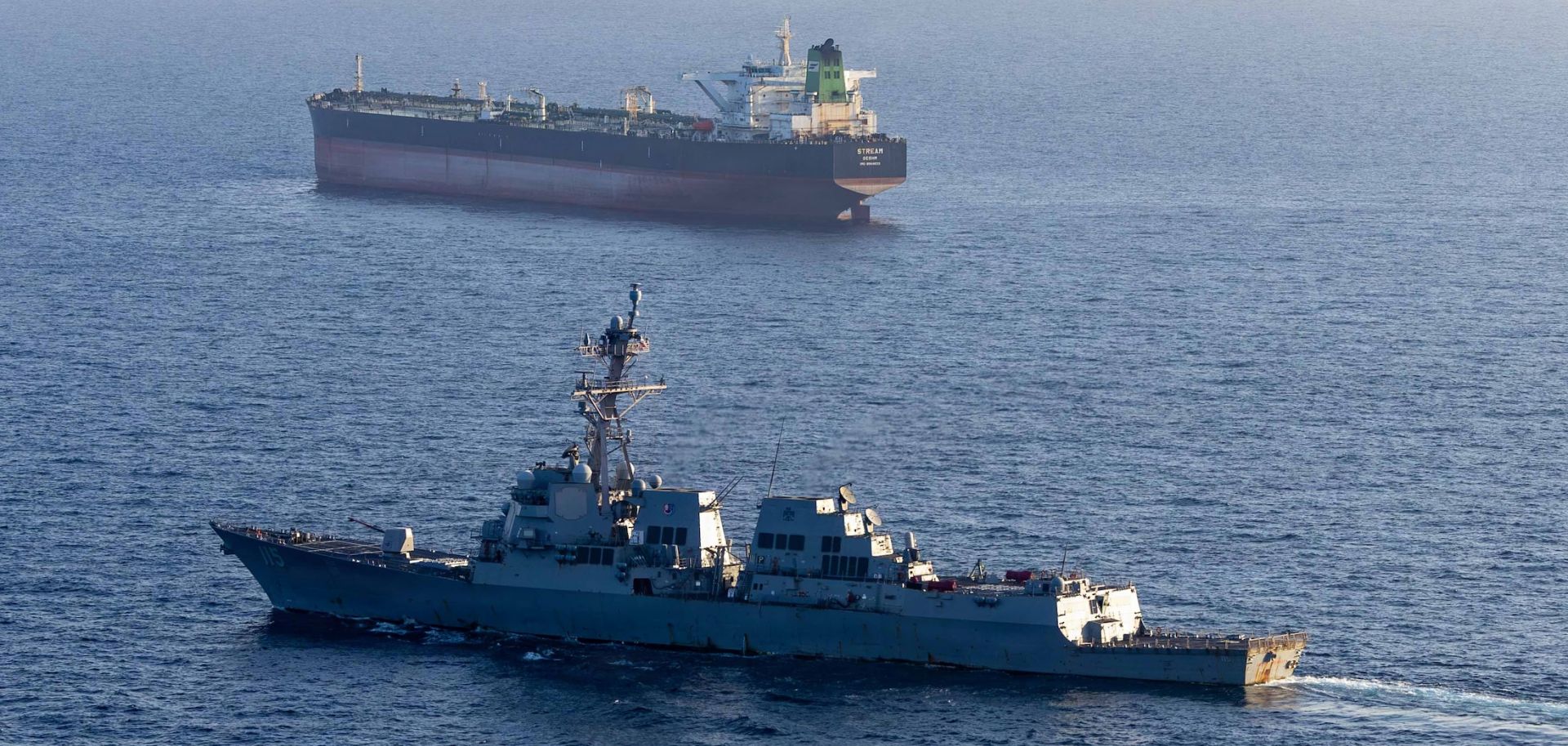
The USS Rafael Peralta implements a maritime blockade against an Iranian-flagged ship attempting to sail toward an Iranian port on April 26, 2026, in the Arabian Sea.
(U.S. Navy via Getty Images)
The USS Rafael Peralta implements a maritime blockade against an Iranian-flagged ship attempting to sail toward an Iranian port on April 26, 2026, in the Arabian Sea.

Despite ongoing U.S.-Iran diplomatic engagement, continued ceasefire violations and unresolved disputes make prolonged, unstable containment more likely than a comprehensive, long-lasting peace agreement. On May 25, U.S. CENTCOM said it had conducted "self-defense" strikes in southern Iran around the port city of Bandar Abbas near the Strait of Hormuz, targeting naval assets and missile launch sites and boats laying mines. The strikes, which Iran said killed at least four navy personnel, were reportedly in response to Iranian attacks on U.S. air assets earlier that day, with Iran claiming it had downed a U.S. drone and fired on a U.S. fighter jet (though this could not be verified). Iran's Islamic Revolutionary Guard Corps has since threatened further escalation, while Supreme Leader Mojtaba Khamenei warned that U.S. bases would no longer serve as a shield for Gulf Arab states. But despite the recent military tit-for-tat, U.S.-Iran negotiations to end the conflict reportedly remain underway. On May 26, U.S. Secretary of State Marco Rubio said a deal was still possible, as an Iranian delegation arrived in Qatar on May 25 for the first time since the war began to continue talks, including top negotiator and Parliamentary Speaker Mohammed Bagher Ghalibaf and Foreign Minister Abbas Araghchi. 

  • Intermittent ceasefire violations, including an Iranian-backed attack on the Barakah nuclear power plant in the United Arab Emirates on May 17, have plagued U.S.-Iran negotiations, though the May 25 U.S. strikes were the first on Iranian territory since President Donald Trump declared a ceasefire on April 4. 
  • A May 26 explosion also damaged a tanker off the coast of Oman, likely due to an Iranian-backed attack. 

Major disagreements over Iran's nuclear program, sanctions relief, regional security and the handling of enriched uranium continue to threaten the prospects for a durable U.S.-Iran agreement. Trump has repeatedly said he wants "no nuclear weapons" for Iran, with the nation's stockpile of highly enriched uranium being the primary point of contention. On May 24, U.S. officials said Iran had agreed to hand over its highly enriched uranium to the United States. But Iran denied this and instead suggested it might be open to diluting the material domestically or through a third-party intermediary such as China. Tehran and Washington also disagree on the sequencing of concessions. Before taking action to weaken its nuclear program, Iran wants the United States to provide economic relief by unfreezing Iranian assets, easing sanctions and/or lifting the U.S. blockade in the Strait of Hormuz. But the Trump administration has insisted that such steps will not take place until after Iran's nuclear program is dismantled, maintaining a principle it has called "relief for performance." Meanwhile, Iran hawks in both Israel and the United States have publicly urged Trump to maintain a hard-line approach in negotiations and to even launch fresh strikes aimed at overthrowing the Iranian regime. The Israel-Lebanon conflict further complicates matters, as Iran insists that any ceasefire reached with the United States must cover the entire region, including a halt to Israeli strikes on Hezbollah in Lebanon. However, the Trump administration views that conflict as largely separate from the Strait of Hormuz crisis, and recently granted its political support for new Israeli attacks on Hezbollah.

  • Much of Iran's highly enriched uranium remains buried at the Isfahan, Natanz and Fordow nuclear sites. However, after the U.S. and Israeli strikes targeted these facilities in June 2025, it remains unclear who would be responsible for recovering and verifying the transfer of this uranium to a safe location. 
  • Sequencing challenges also plagued the diplomatic efforts that culminated in the 2015 Iran nuclear deal. However, not only is distrust between the two sides now deeper, but Iran's demands are broader, with Tehran currently seeking to secure permanent influence over the Strait of Hormuz.
  • On May 23, rumors emerged that the United States might unfreeze Iranian assets as part of diplomatic talks. Republican Iran hawks in the Senate, including Lindsey Graham, Ted Cruz and Thom Tillis, were quick to criticize the move, suggesting that it replicated the 2015 Iran nuclear deal that Trump himself had argued was a bad deal for years before exiting it in 2018. 

Iranian and Iranian-backed attacks against U.S. interests in the region are likely to continue, though the United States remains focused on proportional retaliation for now, leaving the diplomatic process largely as a means to contain conflict rather than resolve it. In the coming days, Iran and its proxies will likely conduct limited, calculated attacks against U.S. interests, regional shipping and Gulf Arab states — particularly the United Arab Emirates, which has emerged as Iran's primary target since the war began in February and has reportedly conducted its own strikes on Iran. For Iran, these attacks serve a dual purpose: to defend Iranian territory after U.S. strikes and to secure diplomatic leverage by maintaining economic pressure via regional shipping disruptions. Despite this, the Trump administration will remain focused on proportional retaliation, largely due to domestic political pressures. Americans, including Republicans, are growing wary of the Iran war and the resulting economic uncertainty. This has translated to dwindling support in Congress, as evidenced by the Senate's 50-47 procedural vote in favor of a War Powers Act resolution to end the conflict, with four Republicans joining Democrats. Furthermore, under its "relief for performance" framework, Washington is relying on sustained economic pressure to ultimately force Tehran to accept concessions on its nuclear program. As a result, diplomatic efforts remain focused on containing the conflict and extending the ceasefire, even as periodic violations and technical complexities in nuclear talks continue. This dynamic will leave the Strait of Hormuz largely restricted, with only a limited number of vessels attempting to run the blockade or transit via Iranian-preapproved routes.

  • Iran has repeatedly threatened to resume strikes both within the region and beyond as part of its pressure campaign to deter further U.S. and Israeli strikes.

In a less likely scenario, mutual economic and political pressure could result in limited normalization of Hormuz and a slow path toward diplomatic progress to return to the pre-war status quo ante. Approaching summer energy demands, sustained international pressure and general war weariness in both countries will increasingly influence U.S.-Iran dynamics. For the United States, dwindling domestic political support, military constraints and growing energy demands may push Washington to favor a sequencing that Iran can accept, such as limited releases of frozen assets and a lift of the Strait of Hormuz blockade, specifically to push Tehran toward fully reopening the Strait and pledging to limit its nuclear program through technical talks. This environment could also make Iran more amenable to concessions on control of Hormuz and its nuclear program. This would push the dynamic away from conflict containment and toward a slow, uneven path of unstable diplomacy and conflict resolution.

  • A May 22 Economist/YouGov poll found that 59% of Americans disapprove of Trump's handling of the war in Iran, a number that has remained largely consistent since the start of the war in late February.

The United States may also resume strikes on Iran at scale to try to weaken its resistance to concessions and/or reopen the Strait of Hormuz, resulting in a resumption of region-wide warfare. This escalation could take several forms. The first scenario would involve a light-touch operation focused on resuming shipping in Hormuz by destroying Iran's navy and blockade capabilities in and around the strait. However, this would likely incentivize Iran to strike targets across the region, especially in the Gulf. A second, more expansive scenario would involve operations designed to damage Iranian critical infrastructure and weaken its economy further. But this, too, would guarantee that Iran retaliates against targets across the Gulf. Finally, the third, most escalatory scenario would involve a major air assault, possibly including landings on Iranian islands as part of a renewed pressure campaign. Such an operation would be designed to quickly reopen Hormuz, weaken Iran and potentially replace its leadership. But it would guarantee region-wide mass retaliation and the destruction of regional supply chains and energy infrastructure.

  • The United States' 31st Marine Expeditionary Unit remains in the region conducting blockade operations, with the 11th Marine Expeditionary Unit in Singapore as a potential backup to be sent to the Persian Gulf. 
RANE
SUBSCRIBERS ONLY

Expert analysis when it matters most.

Get access to RANE's decision-grade geopolitical intelligence.
