
Recent developments point to a U.S. effort to lay the groundwork for using force against Cuba, most likely in the form of a targeted operation to capture key, high-ranking officials, though a scenario of more extensive U.S. military operations remains possible. On May 20, U.S. federal prosecutors unsealed an indictment charging former Cuban President Raul Castro (2008-2018) on various charges in connection with the Cuban government's fatal downing of two planes piloted by U.S.-based exiles in 1996. The same day, U.S. Secretary of State Marco Rubio (the son of Cuban immigrants) released a Spanish-language video addressed to the Cuban people in which he blamed recent hardships on the country's communist leadership and said "President [Donald] Trump is offering a new relationship between the U.S. and Cuba. But it must be directly with you, the Cuban people, not with GAESA," a reference to Cuba's highly influential military conglomerate. Rubio also said the Trump administration is offering $100 million in food and medicine to the Cuban people, and on May 21 he announced that the Cuban government accepted the offer of aid. Also on May 20, the USS Nimitz aircraft carrier and its strike group arrived in the Caribbean region. And on May 22, reporting by The Wall Street Journal indicated that U.S intelligence has identified an expansion of Chinese and Russian intelligence activities in Cuba, with both nations actively running multiple signals intelligence sites on the island. These developments came after Axios reported on May 17, citing an anonymous U.S. official, that Cuba had acquired over 300 military drones and has recently discussed plans to deploy them against the U.S. military base at Guantanamo Bay and Key West, Florida (located only 90 miles from Cuba), if hostilities with the United States were to break out.

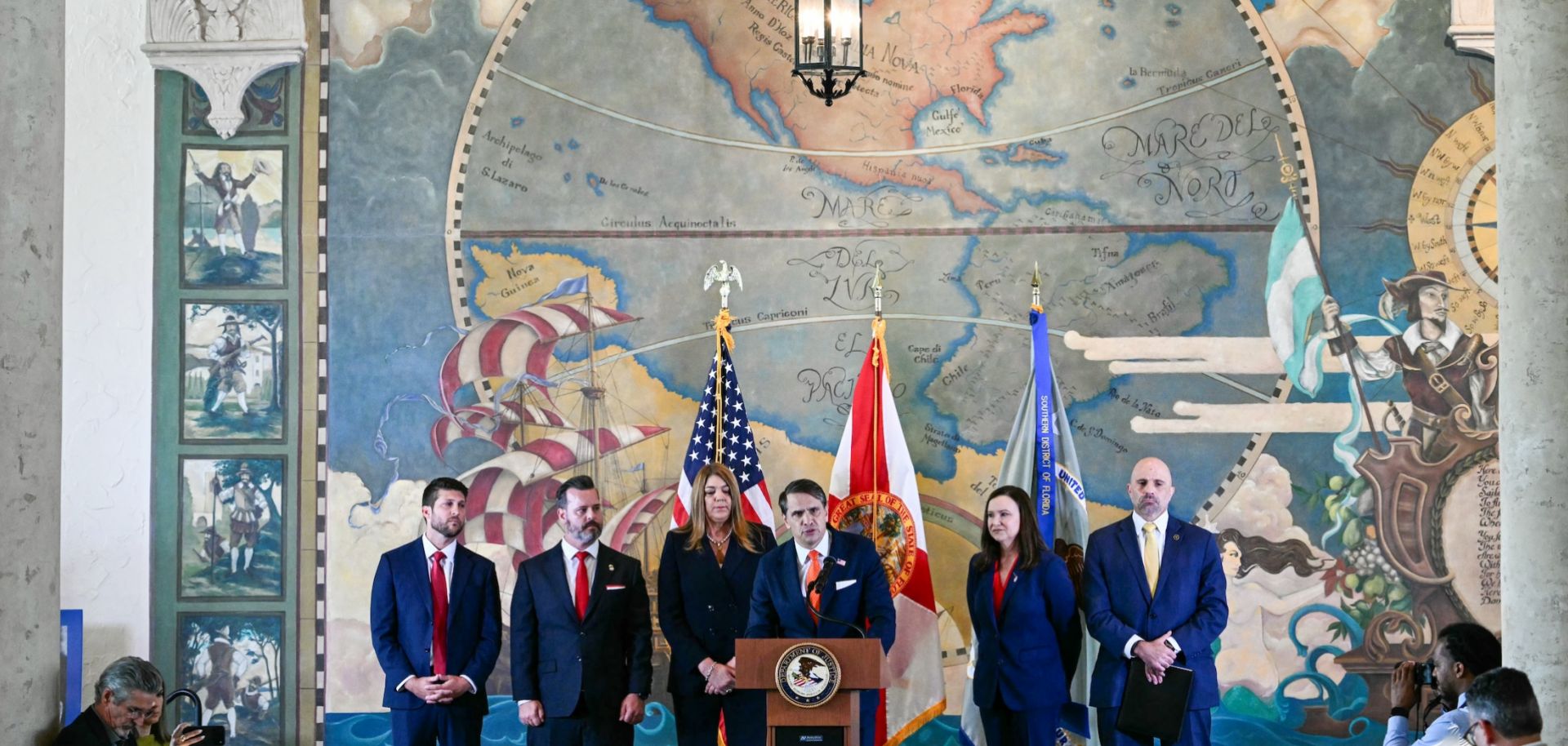
- In February 1996, when Raul Castro was Defense Minister, the Cuban air force shot down two civilian planes operated by the Cuban exile group Brothers to the Rescue. The action killed four people, three of whom were American citizens, while a third plane associated with the group managed to escape without being shot down. The indictment also included five other defendants, identified as Cuban fighter pilots. The flights by Brothers to the Rescue were to search the waters between Florida and Cuba for refugees and to drop propaganda leaflets over Havana.
- On May 18, the U.S. State Department sanctioned 11 Cuban officials, including Communications Minister Mayra Arevich Marin, high-ranking Communist Party members and several military leaders. The sanctions bar the targeted officials from entering the United States and freeze any of their assets connected to the U.S. financial system.
- GAESA, or Grupo de Administracion Empresarial S.A., is a Cuban military-run business conglomerate that controls over 40% of the Cuban economy (with some estimates as high as 70%).
- May 20 is Cuban Independence Day, commemorating the 1902 establishment of the Republic of Cuba. Cuba does not officially celebrate the holiday because of its perceived association with U.S. imperialism toward Cuba, but the holiday is widely celebrated by Cuban diaspora groups in the United States.
The charges against Castro and reporting on Cuban drone threats suggest that the White House is building the case to move beyond economic and political coercion to conduct kinetic operations on Cuban territory. Recent developments follow months of expanding U.S. pressure on Cuba, as the Trump administration has blocked all but one fuel tanker from delivering fuel to the country since February 2026. The resulting fuel shortages have worsened in recent weeks, with the country's energy ministry announcing on May 13 that the island has run out of oil and diesel. Cuba has experienced severe electricity shortages for years, but since 2025, they have escalated to near-constant outages lasting up to 22 hours per day. This has resulted in major shortages of basic necessities, including water, food and medical supplies, flight cancellations to Cuba, and severe damage to the country's economically important tourism sector. Despite reportedly ongoing negotiations between U.S. and Cuban government representatives, there has been little sign of progress toward a larger deal to end the U.S. blockade. In fact, recent developments suggest growing U.S. frustration and represent a further escalation in U.S. rhetoric and policy toward Cuba. While Washington will continue to pressure Havana to make political and economic concessions to avoid military action, the Trump administration appears to be creating a pretext for a U.S. military and/or law enforcement operation targeting the island. In particular, the timing and framing of the Axios report detailing leaked U.S. intelligence on Cuba's drone fleet suggest that Washington is attempting to build a political narrative and legal case for military action by demonstrating that Cuba poses an imminent national security threat. Further indicating this is the fact that the new charges against Raul Castro are similar to those that the United States launched against former Venezuelan President Nicolas Maduro, which were only unsealed after he was captured on Jan. 3 and brought to the United States to face the charges.
- When questioned about how Castro would stand trial, U.S. officials have not ruled out bringing him to the United States. Acting Attorney General Todd Blanche, who announced the charges against Castro, said the Justice Department intends to try the case, noting that there were "all kinds of different ways" to bring defendants to the United States.
- On May 14, CIA Director John Ratcliffe traveled to Havana for rare, high-level meetings with top Cuban officials in which he reportedly called for the end of intelligence cooperation with U.S. adversaries, namely China, Iran and Russia, and referenced developments in Venezuela as a warning. There was no indication that the visit resulted in substantial progress in negotiations.
- U.S. demands for Cuba reportedly include leadership and, according to some leaks, full regime change, the release of political prisoners, the cutting of intelligence and other ties to adversaries such as China and Iran, and broad economic reforms to open the Cuban economy to U.S. businesses. The United States has also brought up potential compensation for U.S. residents and corporations whose assets were confiscated during the 1959 Cuban Revolution. On May 21, the U.S. Supreme Court ruled in favor of Havana Docks Corporation, a U.S. port company that had its docks confiscated by the Cuban government in 1960, allowing a lawsuit alleging U.S. cruise lines that operated in the company's confiscated ports owe the company compensation. This ruling could open the door for further cases by companies and individuals demanding compensation.
- On Jan. 3, the United States launched coordinated strikes against Venezuela, with a particular focus on Caracas, after months of escalating tensions between the two governments. The operation involved special forces and more than 150 aircraft. The strikes killed over 50 people, most of whom were Venezuelan and Cuban security personnel. While the U.S. military led the operation, the Trump administration has publicly framed it as a law enforcement operation designed to facilitate Maduro's removal to the United States to face charges.
Any near-term U.S. use of force against Cuba would likely involve a short operation aimed at installing a leader more willing to appease U.S. demands, but it remains unclear whether such a figure exists in Cuba. Several factors indicate that U.S. kinetic operations against Cuba could occur within weeks or months. First, humanitarian conditions in Cuba are quickly deteriorating amid the U.S. fuel blockade, creating a concern that if the situation continues, it will result in an escalating number of civilian deaths in the country and surging migration, including to the United States. Second, the deployment of the USS Nimitz to the Caribbean and Cuba's close proximity make it very easy for the United States to conduct an operation without deploying substantial military resources beforehand. Third, the leaked U.S. intelligence alleging a Cuban drone threat appears to be framed in a way to justify a fast response to weaken the country's military capabilities. Regardless of the exact timeline, any U.S. use of force would most likely be similar to the January operation to apprehend Maduro, consisting of a short, targeted mission intended to extract a small number of individuals, such as Raul Castro, Cuban President Miguel Diaz-Canel and other high-ranking party members or military officers, with the Trump administration referring to the captures as a law enforcement operation. The goal of this would be to demonstrate U.S. willingness to use force against the country and weaken the Cuban government apparatus to the point that remaining leaders are more willing to yield to U.S. pressure, similar to how interim Venezuelan President Delcy Rodriguez has broadly caved to Washington's demands for economic, political and humanitarian changes. However, it is highly uncertain whether such a strategy would be successful in Cuba, as there does not appear to be an obvious figure akin to Rodriguez who could serve as a replacement leader, due largely to the absence of a strong civil society and opposition movement.
A larger-scale U.S. operation also remains possible, which would create a greater risk of violence that could threaten the surrounding waterways, introduce new friction with China and Russia, and potentially result in a chaotic collapse of the Cuban state; but if successful, such an operation could also transform Cuban society and open the door for a surge in U.S. business activity. Despite the Trump administration's preference for a more stable leadership change in Cuba and reluctance to get bogged down in a protracted ground conflict, especially amid ongoing tensions with Iran, the White House has made clear that the status quo in Cuba is no longer tenable. Thus, a larger-scale U.S. military operation against Cuba remains possible, especially if the United States cannot identify a replacement leader akin to Rodriguez in Venezuela. This could involve extensive air strikes that last for days or longer (as opposed to the hours-long strikes during the Venezuela operation), and/or the deployment of U.S. troops to secure key government buildings, transportation infrastructure and military facilities. Such an operation could occur with the aim of arresting a higher number of Cuban government officials and potentially occupying the island to ensure smooth regime change and minimize negative humanitarian impacts. A larger operation would create significantly more safety concerns for civilians and the few businesses still active in Cuba. Additionally, there would be a higher potential for retaliatory Cuban attacks against U.S. territory that could also raise safety concerns and insurance costs for shipping through the waters between Florida and Cuba. More broadly, a major U.S. operation against Cuba would introduce new friction with China and Russia, though neither global power would likely take major retaliatory action against the United States. And given Cuba's extremely fragile critical infrastructure and the already severe shortages of basic necessities on the island, a larger U.S. military operation would risk collapsing the Cuban state and triggering significant internal unrest and/or a refugee deluge to the United States. But over time, a major U.S. intervention, if successful, could also open the door to a substantial economic and potentially political transformation of the island, reversing decades of antagonism and reanimating U.S. investment in the country.
- It is possible that ongoing U.S.-Cuba talks yield an agreement that reduces the likelihood of U.S. strikes. It is also possible that the White House's escalatory rhetoric is primarily intended to compel the Cuban government to meet its demands, rather than serving as a prelude to actual military operations. However, recent U.S. coercive pressure suggests kinetic action against the island is currently more likely than not.