
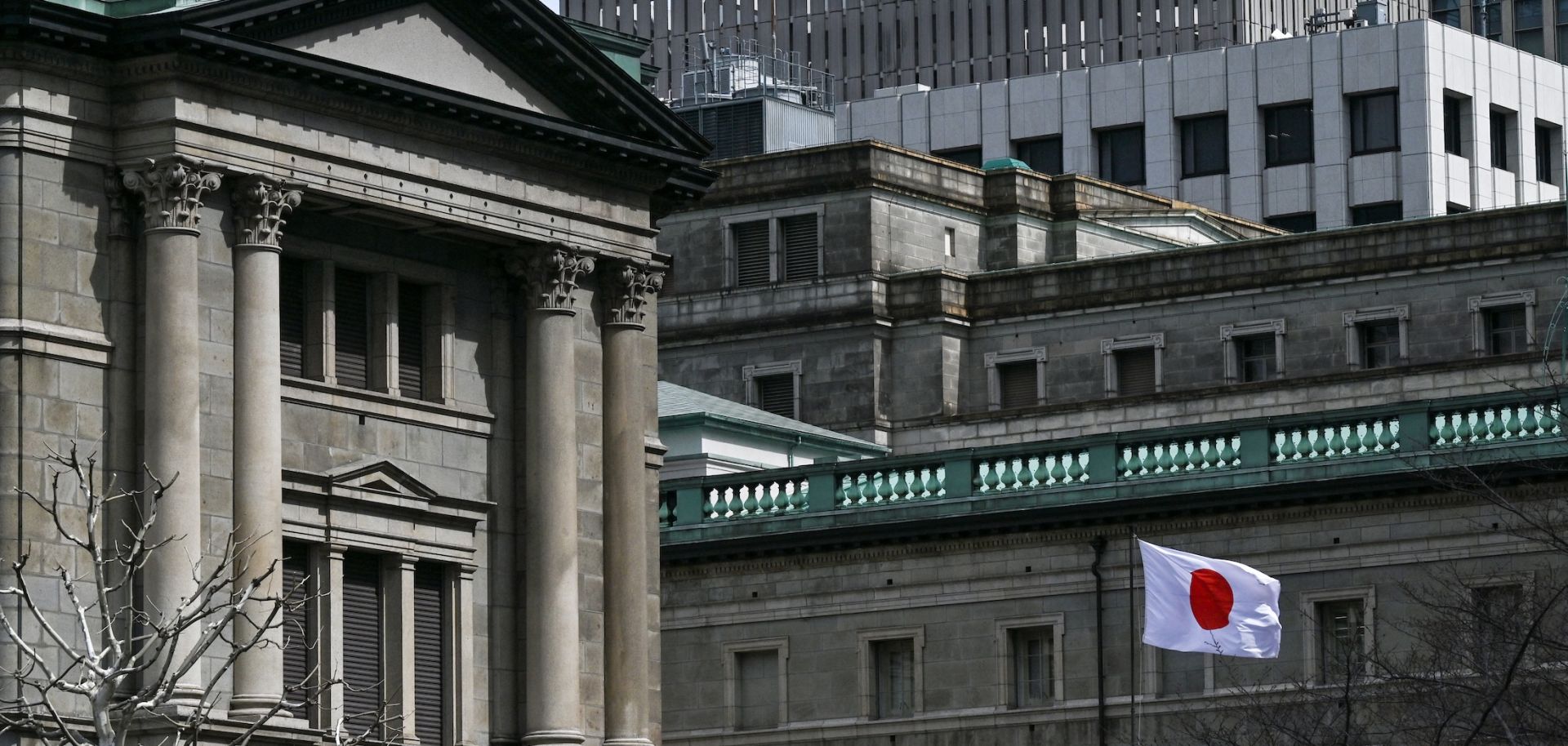
Although the Bank of Japan's monetary policy tightening will put upward pressure on both government interest payments and fiscal deficits, the impact on Japan's debt dynamics and ability to finance higher defense spending will remain manageable, as long as the central bank does not engage in large-scale sales of government bonds. The Bank of Japan will hold a monetary policy meeting on June 15-16, and financial markets are pricing in an 80% probability of a 25-basis-point rate increase following strong first-quarter annualized GDP growth of 2.1%. In the context of post-pandemic recovery and stronger wage growth, Japan's inflation consistently exceeded the central bank's 2% target every month from April 2022 through December 2025. The Bank of Japan initially responded by making the yield cap more flexible in late 2022, before abolishing the cap and ending its negative interest rate policy in March 2024. The bank has since gradually raised its interest rate to 0.75%, while 10-year yields hit a thirty-year peak of 2.55% in May. The bank has also reduced bond purchases (so-called tapering), but continues to acquire government bonds, which currently account for 80% of its total balance sheet.

- During much of the past decade and a half, Japanese interest rates were negative or close to zero. Between 2016 and 2024, the Bank of Japan maintained a negative interest rate of 0.1% on a portion of the excess reserves held by commercial banks. It also capped 10-year government bond yields at 0-0.25% by purchasing large amounts of Japanese government bonds. Nearly half of all outstanding Japanese government bonds are owned by the Bank of Japan. This so-called yield curve control policy helped limit the interest payments on the government's large debt, which exceeds 200% of GDP in gross and 100% of GDP in net terms.
Against the backdrop of high energy prices, rising inflation and a weakening currency, the Bank of Japan remains poised to further increase interest rates, despite a weaker growth outlook. At the last monetary policy meeting on April 28, the Bank of Japan decided to keep the policy rate unchanged at 0.75%. The decision was contested, with three of the nine committee members voting for a rate increase, suggesting a high likelihood of additional tightening during the upcoming June 15-16 meeting. A reacceleration of inflation, larger fiscal deficits due to Prime Minister Sanae Takaichi's commitment to raise spending (including on defense) and a weak yen will likely force the central bank's hand, despite the expected slowdown in economic growth due to high energy prices and weakening consumption. Pervasively high energy prices stemming from the Iran conflict will help maintain upward pressure on inflation in Japan and long-term bond yields. The Bank of Japan has raised its inflation forecast for FY2026 and FY2027 to 2.8% and 2.2%, up from 1.9% and 1.8% previously. Meanwhile, the International Monetary Fund estimates Japan's long-term equilibrium interest rate at 1.1%-2.5%, while the central bank anticipates the neutral long-term policy rate at 1.5%. This means that the present policy rate of 0.75% is significantly below the long-term equilibrium rate, suggesting further room for increases.
Although the Bank of Japan's interest rate normalization may raise nominal debt servicing costs, it is unlikely to significantly worsen Japan's long-term debt dynamics. Higher interest rates and yields will raise Japan's nominal debt servicing costs and fiscal deficits. However, Japan's debt dynamics and the debt-to-GDP ratio will worsen only if the real interest rate/real growth differential widens, which is unlikely. Real interest rates reflect the balance between savings and investment. Unless investment rises sharply or domestic savings fall significantly (neither of which is likely), real rates are unlikely to notably increase. Japan's demographic decline may gradually reduce savings as an aging population tends to consume a greater share of national income, but investment is unlikely to surge absent a major increase in government consumption. Even then, higher real interest rates would likely be offset by stronger real growth due to higher investment. Between 2010 and 2020, Japan's inflation averaged 0.5% while ten-year yields averaged slightly less, leaving real interest rates around zero. Assuming the Bank of Japan achieves its 2% inflation target and the neutral policy rate settles around 1.5%-1.8%, short-term real rates would remain negative. Adding a 20-40 basis point yield spread to short-term rates would leave the real (average) interest rate/real growth differential broadly unchanged from the pre-normalization period. Japan's debt dynamics could worsen if higher inflation increases spending faster than revenues, but this appears unlikely, as both should rise broadly in line with nominal GDP. Higher inflation could even reduce the non-interest deficit (or improve the primary balance), despite political pressure to increase spending in line with inflation. Even if expenditure outpaced revenues modestly, the impact on deficits would likely remain limited given that inflation will remain modest. A more serious risk would arise if the Bank of Japan were forced to sell large quantities of government bonds, potentially doubling the public's share of debt. However, such a scenario would likely require a sustained rise in inflation well above 2%, probably alongside significantly stronger economic growth, which would partly offset the impact of higher real interest on the interest rate/growth differential. Overall, the Bank of Japan's policy normalization is unlikely to materially worsen long-term debt dynamics unless it leads to a substantial rise in real interest rates or to major central bank bond sales.
To the extent that higher nominal interest rates leave underlying debt dynamics broadly unchanged, monetary tightening and higher long-term yields will have only a limited impact on the Japanese government's ability to finance higher spending compared to the low-inflation, low-rate environment of the past decade. While higher rates will increase nominal debt-servicing costs, they are unlikely to, on their own, fundamentally constrain the government's fiscal capacity so long as real interest rates remain low and the Bank of Japan does not engage in large-scale bond sales. However, Japan's fiscal space will remain constrained by a modest long-term growth outlook, already large deficits, and rising healthcare and pension costs. This means the government will still face difficult trade-offs between raising revenues, increasing defense spending and funding other priorities, whether structural (e.g., healthcare and pensions) or temporary (e.g., household support amid higher energy prices). In the short term, relatively loose fiscal constraints may enable the Takaichi government to expand both defense and non-defense spending. But over the long term, mounting budgetary pressures will likely force a prioritization, with right-wing governments more likely to favor defense over social spending.