
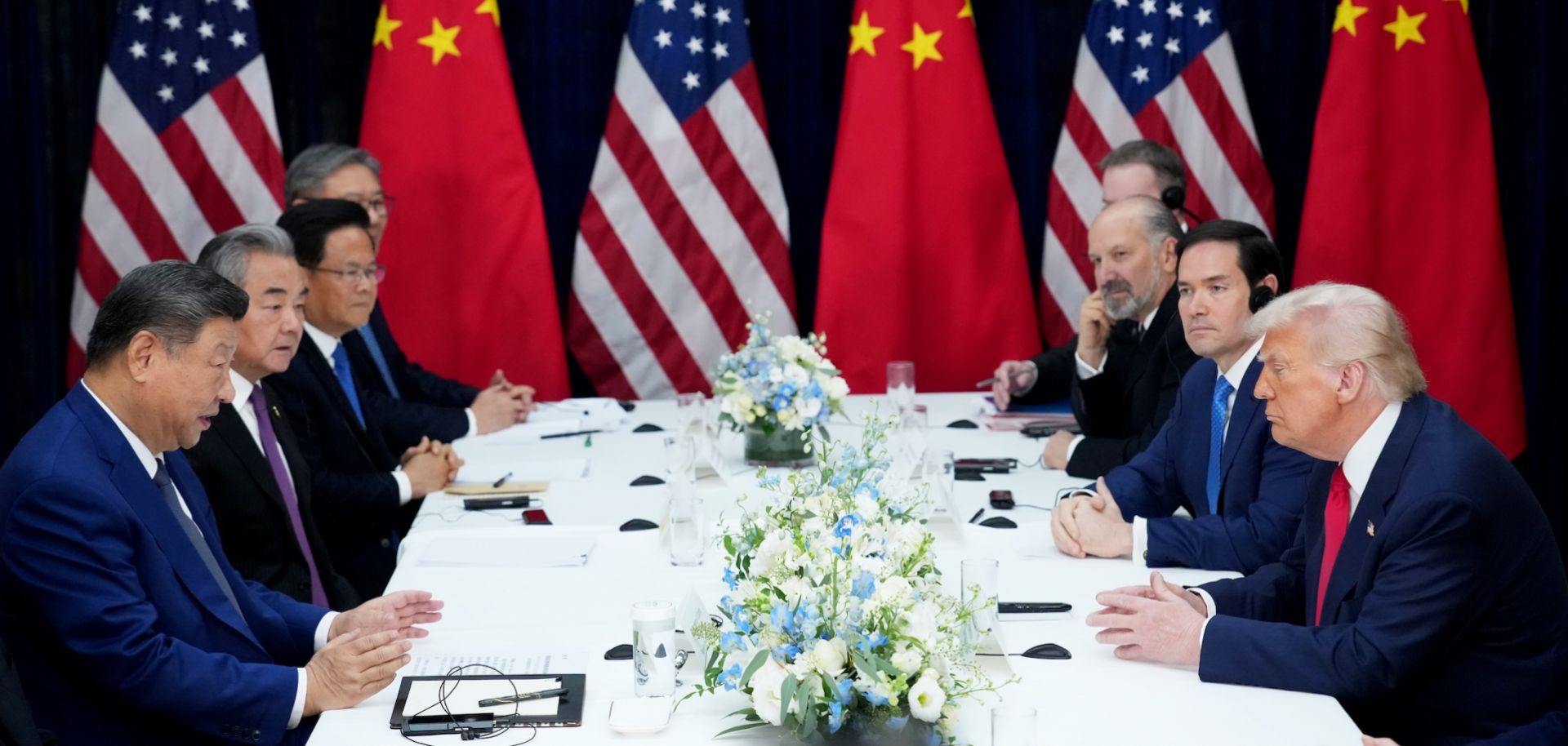
U.S. President Donald Trump (right) and Chinese President Xi Jinping attend a bilateral meeting in Busan, South Korea, on Oct. 30, 2025.
(Andrew Harnik/Getty Images)
U.S. President Donald Trump (right) and Chinese President Xi Jinping attend a bilateral meeting in Busan, South Korea, on Oct. 30, 2025.

The upcoming Trump-Xi summit will likely produce a limited extension of the current U.S.-China economic detente while leaving core strategic disputes over technology controls, Taiwan and Iran largely unresolved. U.S. President Donald Trump is scheduled to make a state visit to China May 13-15 at the invitation of Chinese President Xi Jinping, with the main Trump-Xi meetings set for May 14-15 in Beijing. The visit will be Trump's first trip to China since 2017 and the two leaders' first in-person meeting since their October 2025 meeting in Busan, South Korea. U.S. officials have said the summit agenda could include the establishment of Board of Investment and Board of Trade mechanisms; Chinese purchases of U.S. agricultural goods, energy and aircraft; the status of the two countries' 2025 rare earths understanding; possible channels on artificial intelligence risk management; nuclear arms issues; and broader contentious security concerns involving Taiwan, Iran and the Strait of Hormuz.

  • The meeting will take place after an escalation in the Iran war delayed an earlier Trump visit to China, initially planned for March 31-April 2.
  • The White House has invited the CEOs of prominent U.S. businesses to accompany Trump on his trip, reportedly including Elon Musk of Tesla and SpaceX, Tim Cook of Apple, David Solomon of Goldman Sachs, Stephen Schwarzman of Blackstone, Larry Fink of BlackRock and Jane Fraser of Citigroup, among others, highlighting the importance of the summit's commercial track.
  • Trump said on May 11 that he will discuss U.S. arms sales to Taiwan with Xi, though other U.S. officials have said Washington's policy toward Taipei has not changed. U.S. officials have also said Trump will press Xi over China's purchases of Iranian oil and Beijing's potential role in restoring safe passage through the Strait of Hormuz, as well as over jailed Hong Kong media tycoon Jimmy Lai and two U.S. citizens imprisoned in China for over a decade, adding human rights and prisoner cases to an already crowded summit agenda.

The meeting will take place after the 2025 Busan truce temporarily eased U.S.-China trade tensions without resolving core economic and geopolitical disputes. Under the truce reached in Busan, the United States reduced the combined tariff rate on Chinese imports from about 57% to 47%, though specific tariffs on fentanyl precursor flows and Trump's so-called Liberation Day tariffs have since expired. The United States also suspended higher tariffs on Chinese goods through Nov. 10, 2026, while keeping a 10% reciprocal tariff in place, and paused planned port fees on Chinese vessels for one year. In exchange, China agreed to delay by one year the enactment of rare earth export controls announced in October 2025. It also pledged to resume large-scale U.S. soybean purchases and take additional steps against fentanyl precursor flows. This arrangement pulled Washington and Beijing back from a sharper economic confrontation by averting Trump's threatened 100% tariff on Chinese goods and temporarily reduced pressure on U.S. farmers, shipping firms, automakers, defense manufacturers and electronics companies. However, it left the main structural disputes unresolved, including Washington's limits on sales of advanced chips and chipmaking tools to China (notably the affiliates rule, a provision that would have restricted sales to Chinese-owned overseas subsidiaries of U.S. chip firms, which the United States agreed to delay); Beijing's subsidies and regulatory support for favored Chinese firms; barriers facing foreign companies in China; Beijing's pressure on Taiwan; and China's export licensing system for rare earths and other critical minerals. The Iran war has since given the United States another reason to seek Chinese cooperation because China is the largest buyer of Iranian oil and has some degree of influence over Tehran. Beijing also wants safe passage restored through the Strait of Hormuz because a prolonged disruption would raise import costs, squeeze refiners and threaten the maritime routes that supply China's industrial economy. More broadly, compared with Trump's 2017 visit, China will enter this summit with significantly more economic leverage, reflecting its reinforced control of rare earths, clean tech supply chains and the continuing importance of Chinese market access for U.S. firms, with recent export data also showing a widened trade surplus with the United States of $87.7 billion year-to-date.

  • U.S. Treasury Secretary Scott Bessent has publicly urged China to "step up" diplomatically on the Strait of Hormuz, saying Beijing has leverage because of its Iranian energy purchases. China has called for restored safe passage but has also pushed back against U.S. sanctions targeting Chinese entities over Iranian oil. On April 24, the U.S. Treasury sanctioned Hengli Petrochemical's Dalian refinery and dozens of firms and vessels for allegedly helping Iran sell oil, and China later invoked its anti-sanctions law to counter U.S. blacklisting of Chinese refiners.
  • Trump's tariff leverage is also under legal pressure at home. A U.S. trade court ruled May 7 that his latest 10% temporary global duties were unjustified under a 1970s trade law, though the ruling left most of the levies in place during the appeals process.
  • Fentanyl cooperation could give both sides a low-cost deliverable. Chinese and U.S. drug enforcement authorities arrested five suspects in a joint drug smuggling investigation announced May 11, creating a timely example of operational cooperation.

The Trump-Xi summit is most likely to yield limited agreements that preserve the trade truce, add new purchase pledges and create working channels for disputes that neither side is ready to resolve. The most likely outcome is a set of announcements across agriculture, energy, aircraft and investment that leave the hardest disputes over technology, industrial policy, Taiwan and Iran largely untouched. Washington will likely seek an extension of the Busan framework, renewed Chinese commitments to increase purchases of U.S. goods, and language launching a Board of Trade and/or Board of Investment to manage commercial disputes. Such pledges would echo the 2020 Phase One trade deal, which relied heavily on Chinese purchase commitments but fell short of its targets, underscoring why implementation and verification will matter more than headline numbers. Beijing will likely try to keep the economic package focused on purchases and procedural commitments, giving Xi room to show progress on trade without changing China's industrial model, including state support for favored firms and strategic sectors. The commercial portion could include soybean volumes already outlined under the Busan truce and additional agricultural commodities like corn, incremental progress on U.S. beef and poultry access (such as new export approvals or eased regulatory barriers), language regarding Chinese purchase of U.S. energy products, and the announcement of a deal to sell Boeing aircraft to Chinese buyers. That would give Trump wins for U.S. farmers, energy producers, manufacturers and firms seeking steadier access to China, while also letting Xi show economic cooperation, even if Washington offers little movement on Beijing's harder asks, including relief from U.S. technology restrictions and stronger U.S. language against Taiwan independence. On rare earths, Beijing could extend or clarify current licensing arrangements, keeping permits available for approved U.S. buyers, while preserving its larger export control system — a point of leverage it can tighten in the future to slow shipments that U.S. defense, auto and electronics firms require for production. Additionally, Trump and Xi may agree to establish bilateral dialogue channels for AI and nuclear issues, though these would likely be confidence-building forums rather than serious governance or arms control frameworks. China could also respond to U.S. requests that it do more to pressure Iran to guarantee safer commercial transit through the Strait of Hormuz by issuing a statement to that effect, especially following a May 4 attack on a Chinese-owned tanker near the passageway. However, any such gesture would likely contain generic de-escalation and global shipping stability language, as Beijing will likely continue to avoid wording that could suggest it is acting at Washington's behest.

  • On May 10, U.S. officials said the 2025 rare earths deal remains in effect and that any extension will be announced "at the appropriate time." This suggests the upcoming summit could preserve the current flow of critical minerals without resolving the larger dispute over export controls.
  • The most sensitive summit issue regarding Taiwan will revolve around language. Beijing wants Washington to shift from saying it "does not support Taiwan independence" to stating that it "opposes Taiwan independence." However, such a change would be viewed by Taipei, U.S. allies and pro-Taiwan U.S. lawmakers as a weakening of formal U.S. neutrality on Taiwan's political status.
  • U.S. lawmakers in Congress may see the agreements reached at the summit as too soft on China if they include concessions on shipbuilding. On May 11, a bipartisan group of U.S. senators urged Trump to hold firm on trade remedies for Chinese shipbuilding dominance, maritime logistics and port infrastructure, raising the political cost of further concessions on port fees or shipping measures.

While less likely, Trump and Xi could also agree to more concrete actions on technology, Taiwan or the Strait of Hormuz, where even narrow concessions or wording shifts could have wider strategic effects. Less likely but consequential outcomes fall into four categories. Most plausibly, the summit could produce stronger optics than implementation. In this scenario, Trump and Xi announce trade pledges and process mechanisms, but the purchase commitments lack firm timelines, the trade and investment boards have unclear authority, rare earth licensing remains opaque and unevenly applied, and language on Taiwan creates competing interpretations in Beijing, Taipei and Washington. Markets might initially respond positively, but the lack of substance would leave U.S.-China relations exposed to renewed tension and trade escalation once the Busan truce expires in November, and would expose the limits of symbolic summit diplomacy more broadly. In a less likely but more impactful outcome, the summit could yield a larger technology accommodation (such as expanded U.S. licensing for certain advanced chip sales to China) or clearer, more durable Chinese commitments to maintain rare earth flows. This would likely support markets and reduce short-term supply chain risk, but it would also draw political scrutiny in Washington, where lawmakers view technology controls as central to long-term U.S. competition with China. Even less likely but carrying major regional implications, the United States could partially accept Beijing's request to alter its language on Taiwan to explicitly state that it "opposes" Taiwanese independence. Taiwan and regional U.S allies like Japan and the Philippines would likely, in turn, perceive that Trump is willing to trade Taiwan commitments for broader U.S.-China stability, even if officials subsequently insist U.S. policy has not changed. This could also prompt Taipei's other partners to more directly adjust their regional military planning in support of Taiwan and maintain deterrence. In the least likely scenario, the summit could yield explicit Chinese commitments to assume a more active role in the Strait of Hormuz crisis. In either official statements or bilateral communiques, China could urge relevant parties to provide clear assurances that commercial vessels will not be attacked, coordinate joint monitoring or reporting mechanisms for shipping, or publicly highlight specific measures to reduce congestion or risk along the strait. These outcomes would go beyond the base case of generic de-escalation language and indicate a more tangible Chinese role in stabilizing maritime traffic.

  • Taiwan's government has said it is confident in U.S. ties but hopes there are no "surprises" from the summit, underscoring that the exact wording of any readout could have major implications for U.S.-Taiwan relations. A Taiwan wording shift would also have spillover effects in the South China Sea, where the Philippines would likely read the perceived softening of U.S. resolve on Taiwan as relevant to its own disputes with Beijing.
  • China has publicly called for reopening the Strait of Hormuz and ensuring safe commercial shipping, most recently with Foreign Minister Wang Yi urging Tehran to allow passage. A meaningful deviation from the base case would be observable Iranian steps  — such as clearer transit rules or visible assurances for commercial shipping — following the summit.
RANE
SUBSCRIBERS ONLY

Expert analysis when it matters most.

Get access to RANE's decision-grade geopolitical intelligence.
