
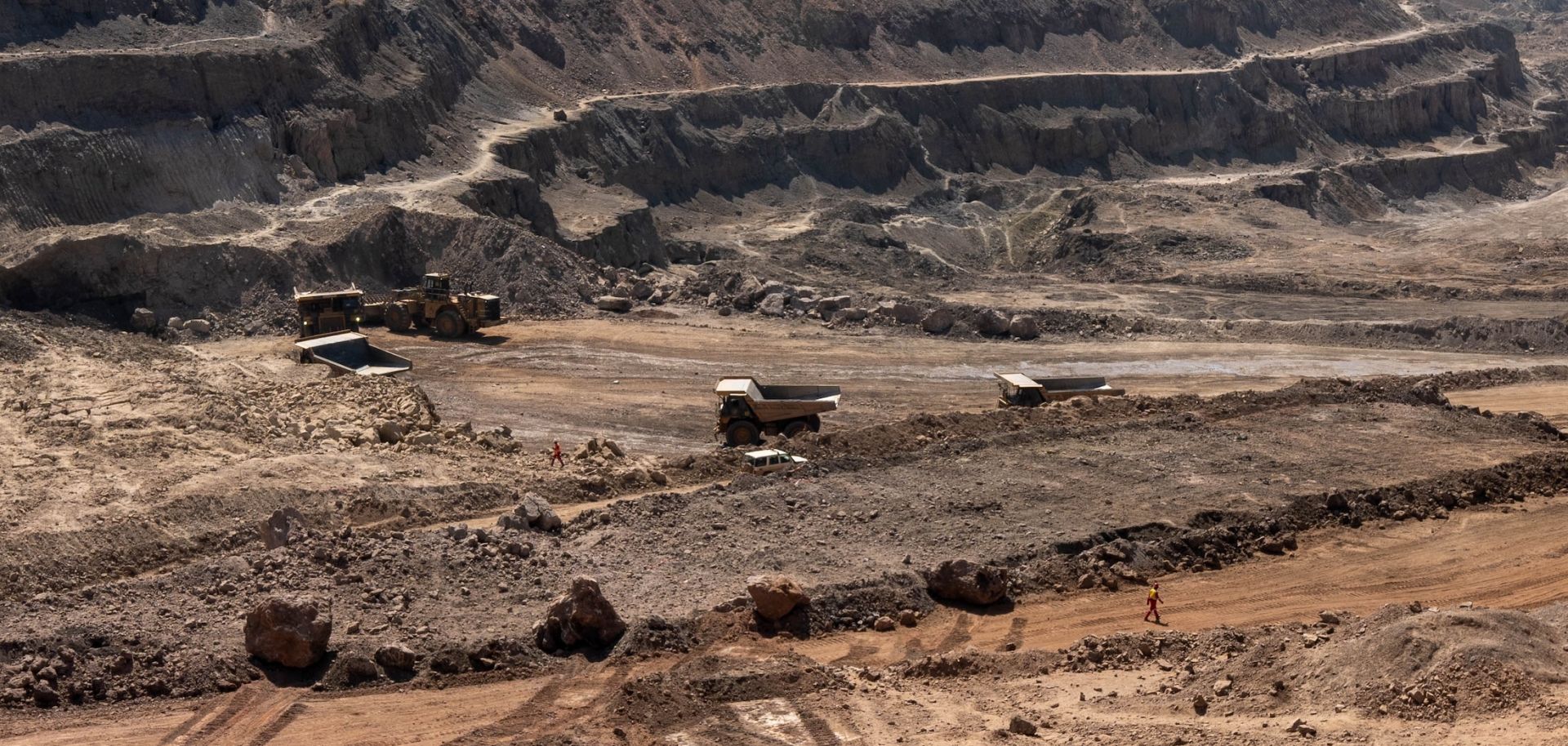
Growing mining sector cooperation between the Democratic Republic of the Congo and the United States will likely help improve Washington's security of supply of several critical minerals, but China's continued hold on global mineral processing in the country and a likely surge in political instability ahead of Congo's 2028 general elections will curtail the extent of these gains in the coming years. On March 27, U.S. mining company Virtus Minerals completed its $30 million acquisition of Congo-focused miner Chemaf and pledged to raise $720 million in financing to upgrade and develop its newly acquired mines and mining licenses. This came after the U.S.-linked Orion Critical Mineral Consortium and Switzerland-based commodity trading company Glencore announced on Feb. 3 their signing of a memorandum of understanding regarding the U.S. consortium's acquisition of a 40% stake in the commodity traders' assets in Congo at a cost of $9 billion. Meanwhile, Congolese state-owned miner Gecamines reportedly pledged to deliver 500,000 tonnes of copper to the United States as part of an offtake agreement with Washington. These developments come amid a broader surge in U.S.-linked investor interest in Congo's mining assets after Washington and Kinshasa signed a strategic mineral partnership in December 2025. The agreement notably involved Congo creating a Strategic Asset Reserve (SAR) that regroups mining assets for which U.S. persons are granted a right of first offer.

- The U.S.-Congo mineral partnership also foresees the Congolese government issuing a list of "Designated Strategic Projects" in energy, mining and infrastructure for which it will grant the right of first offer to "U.S. persons and aligned persons" when deemed "appropriate" by both parties. The United States and Congo held a ministerial meeting in early February, during which Congo presented the initial list of assets within the SAR, which includes the infamous Rubaya coltan mining complex in eastern Congo.
- The agreement between Orion Critical Mineral Consortium and Glencore centers on Glencore subsidiaries Mutanda Mining and Kamoto Copper Company, both of which produce copper and cobalt from a network of mines in southern Congo.
The United States is seeking to strengthen the security of its critical mineral supplies by deepening mining cooperation with Congo, while Kinshasa hopes closer ties with Washington will help deter encroachment by Rwandan proxies in its eastern regions. Driven by the global energy transition and the AI-fueled expansion of data centers, the accelerating pace of worldwide electrification is set to exert strong upward pressure on the demand for critical minerals for the foreseeable future. In this context, the Central African Copper Belt's vast cobalt reserves and high-grade copper deposits, which stretch hundreds of kilometers along the Congo-Zambia border, are world-class mining assets. However, several Western miners exited the region in the 2010s due to a challenging operating environment and a downturn in base metal prices. Meanwhile, Chinese miners have rapidly expanded their footprint in the area, leveraging their access to affordable financing provided by China's state-owned banks as part of Beijing's push to secure its critical mineral supplies. These developments have since heightened concerns in Western nations, particularly the United States, regarding the security of their own supplies. To mitigate reliance on supply chains dominated by China, then-U.S. President Joe Biden backed the Lobito Corridor initiative in 2022, which aims to incentivize Western mining investment in the Central African Copper Belt by lowering transportation costs through a series of rail upgrades connecting Congo's southern Katanga region and central Zambia to Angola's Lobito port. Separately, in early 2025, advances by the Rwanda-backed M23 rebel group in eastern Congo prompted Kinshasa to offer Washington preferential access to its mineral reserves in exchange for security assistance. This proposal aligned with U.S. President Donald Trump's efforts to further secure U.S. critical mineral supplies, highlighted by the $12 billion Project Vault launched in February 2026, with the White House ultimately mediating a peace deal between Congo and Rwanda in June 2025, which was thereafter signed by Rwandan President Paul Kagame and Congolese President Felix Tshisekedi in December 2025.
- In early February, the Trump administration announced the launch of the $12 billion Project Vault, which aims to establish a U.S. Strategic Critical Minerals Reserve to store 60 critical minerals across the United States, thereby providing a buffer for U.S. industries in the event of future global supply disruptions. The project is to be financed by a $10 billion loan from the United States' Exim Bank and $2 billion in private-sector investments.
- High-grade copper mines require less ore to be mined than low-grade copper mines to produce a similar quantity of industrial-grade copper. High-grade mines are thus on average less energy-intensive and cheaper to operate, making their profit margins more resilient to fluctuations in global market prices. But while the Central African Copper Belt hosts some of the world's largest high-purity copper deposits, high transport costs hinder its competitiveness compared to lower-grade copper mining regions, such as northern Chile.
- China and Congo struck a $6 billion deal in 2008 under which Kinshasa transferred long-term mining rights to vast copper and cobalt reserves to the Sino-Congolese joint venture Sicomine, in which Chinese investors hold a 68% interest. In exchange, Chinese entities agreed to construct roads, hospitals and other infrastructure projects, financed through loans that would be repaid with mining revenue. However, the deal has been marred by corruption scandals and controversy. Following several years of negotiations, Tshisekedi secured a 2024 revision to the agreement that increased long-term infrastructure commitments by Chinese entities and raised the Congolese state's expected share of profits.

Congo will likely gradually advance pro-market reforms amid U.S. pressure and secure more investments from U.S.-linked investors in its mining and power sectors in Katanga over the coming year, but most Western investors will likely refrain from expanding their operations in eastern Congo due to ongoing violence in the region. Despite preferential terms offered to U.S.-linked entities, Congo remains a highly challenging jurisdiction from an operational and legal standpoint. To encourage more miners from the United States and partner countries to expand their footprint in the country, the Trump administration will likely keep pressuring Kinshasa to adopt market-friendly reforms, such as improving the transparency in bidding processes and tackling child labor. Tshisekedi's drive to attract more Western investors and desire to maintain close ties with the United States indicate that his government is likely to advance more business-friendly reforms, especially as many align with Congo's support program with the International Monetary Fund. While enforcement is set to remain uneven given Congo's severe governance challenges, this still points to gradual improvements in the business environment for miners in the coming years. Moreover, the Lobito-Kolwezi rail corridor's growing transport capacity is set to significantly reduce miners' logistics costs and improve time predictability. These trends indicate that U.S.-linked investments in mining will likely grow quickly in the Katanga region over the next year, whether through the acquisition of already-operating mines, greenfield or brownfield projects. This is highly likely to also stimulate foreign investment in the region's power sector and water infrastructure, as miners' expanding operations will create a steady demand for water and electricity, helping projects become bankable. However, most Western investors will likely avoid projects in eastern Congo for the foreseeable future due to persisting clashes between pro-government forces and M23 rebels, despite the Congo-Rwanda peace deal. While the Trump administration secured an agreement by both parties to implement the deal in March, structural disagreements between the two nations suggest this momentum is likely to falter later in 2026. This indicates that only a few, more risk-tolerant, U.S.-linked investors will likely press ahead with significant investments in the region over the next year.
- The U.S.-Congo mineral deal explicitly lays out the Congolese government's need to advance market-friendly reforms to attract foreign investors. On March 14, Tshisekedi signed into law plans to establish an economic and financial tribunal to combat corruption and illicit enrichment. Tshisekedi's government has also publicly announced new and renegotiated contracts, such as the Kipushi mine contract, and Gecamines' audited 2023 financial statements were published in 2025. The government has also vowed to increase the autonomy of oversight institutions for the mining sector.
- Inadequate electricity and water supply remain major constraints for miners in Congo, often forcing them to build their own infrastructure and driving up costs. The likely expansion of power and water infrastructure in the medium term will help lower the bankability threshold for more mining projects, which could deliver a major boost to the region's critical mineral output over the coming decades.
- Lobito Atlantic Rail, the company that runs rail freight services along the Lobito Corridor, began shipping copper from Kolwezi to Lobito in August 2024. The new rail line reduces transport times to around 7-8 days, compared with around 25-30 days to South Africa's port of Durban or 15-20 days to Tanzania's Dar Es Salaam.The company currently runs 12 trains per week, a figure set to rise to 20 by 2027. It transported around 200,000 tonnes of goods — both minerals outward and supplies for miners inward — in 2025.
Deepening U.S.-Congo mining cooperation will likely help shore up the security of supplies of several critical minerals for strategic U.S. industries in the medium-term, but China's global dominance in mineral refining and the lengthy development timelines for greenfield projects will limit the scale of these gains through 2030. Greenfield mining projects often take more than 15 years from conception to commercial production, meaning that greenfield projects launched in 2026 or 2027 by U.S.-linked investors are highly unlikely to meaningfully improve the security of U.S. critical mineral supplies before the mid-2030s. However, the Congolese government will likely seek to expand Gecamines' copper offtake agreements with the United States to encourage the Trump administration to maintain a firm stance against Rwanda on the implementation of the 2025 peace deal. Gecamines may also leverage its stake in cobalt and zinc projects to sign similar offtake agreements with Washington for these minerals. Meanwhile, U.S.-linked companies' acquisition of mining assets currently in operation could rapidly reroute these mines' output to the United States and partner countries. In addition, brownfield projects — such as Virtus Mineral's acquisition of Chemaf's mines — could begin commercial production within a few years. These trends suggest that growing mining sector cooperation between Washington and Kinshasa will likely bolster U.S. supplies of copper — and potentially cobalt and zinc — in the medium term, either by supporting Project Vault or reducing the reliance of strategic U.S. industries, such as the defense and automotive sectors, on minerals produced by Chinese-operated mines. Nonetheless, these gains will be limited by contractual obligations and industrial realities. Much of Congo's cobalt output is produced by Chinese-operated mines and is bound to long-term supply contracts to Chinese cobalt refiners. Moreover, limited critical mineral refining capacity outside China means many industrial users will remain reliant on Beijing beyond 2030, especially for cobalt.
The potential stalling of the Congo-Rwanda peace deal's implementation and likely increase in political tensions ahead of Congo's next general elections could undermine the Trump administration's efforts to shore up U.S. critical mineral supplies. In a less-likely, higher-impact scenario, Congo may decide to slow-roll mining sector cooperation with the United States if it assesses that this partnership is not yielding tangible gains in ensuring Rwanda's compliance with the 2025 peace deal. While this would likely be temporary and aimed at pressuring Washington to increase economic costs on Kigali for its purported non-compliance with the deal, such moves would materially slow U.S. efforts to shore up the security of critical minerals sources from Katanga, such as copper and cobalt. The likely increase in political tensions surrounding Congo's upcoming 2028 presidential elections would further complicate U.S. mining ambitions. Congo's ruling Union for Democracy and Social Progress party, or UDPS, and several of its allies are advancing proposals to reform the constitution that have heightened fears that Tshisekedi is seeking to run for an unconstitutional third term. This will raise the risk of large opposition protests over the next two years, which, given Tshisekedi's low popularity in Katanga, could meaningfully disrupt the region's mining operations. Even if constitutional amendments are scrapped due to political backlash, Tshisekedi may still try to delay the elections, which would sustain the risk of unrest and associated disruptions to Washington's drive to secure minerals from Congo's Katanga region. Looking beyond Congo's next general elections, a political transition away from Tshisekedi — especially in the event of an opposition victory — could result in the new government seeking to renegotiate the critical mineral partnership with the United States, if not scrap the Gecamines' offtake agreement, if it veers toward greater resource nationalism. While the two countries may ultimately maintain close ties, potential reviews of mining contracts would dent confidence from U.S.-linked investors, potentially curbing the long-term increase in Katanga's critical mineral output.
- The United States imposed economic sanctions on the Rwandan military and President Joseph Kabila in March and April, respectively, due to their reported support for the M23 rebel group. Although U.S. sanctions on the Rwandan military raised concerns regarding the progress of liquefied natural gas initiatives in northern Mozambique, where Rwandan forces are stationed, the Trump administration subsequently issued a sanction waiver to permit enabling U.S. and foreign entities to work with Kigali in the area.
- Tshisekedi won Congo's 2023 presidential race with around 73% of the vote, but opposition leader Moise Katumbi won a majority of votes in all four provinces of the Katanga region. Tshisekedi is a member of the Luba ethnic group. Over the past century, many Luba have migrated to Katanga in search of economic opportunities. However, the region has faced recurring spats between Luba migrants and native Katangans, which resulted in thousands of Luba being killed in the early 1990s.