
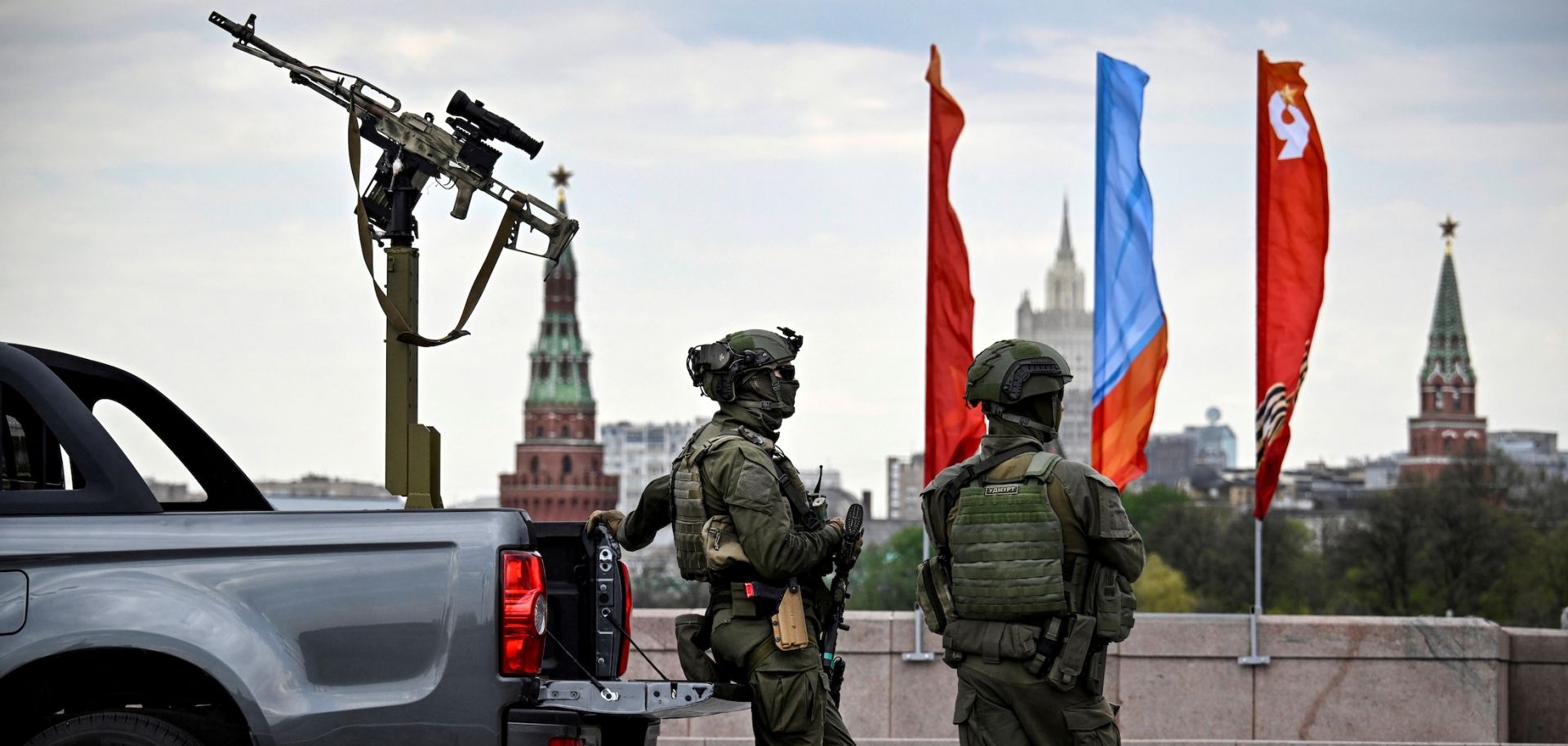
Russia will likely avoid a direct disruption of its May 9 Victory Day parade, but Ukraine's expanding long-range strike capabilities — while unlikely to threaten Moscow's regime stability or war strategy — will increasingly raise the political, economic and psychological costs of the war ahead of the September Duma elections. On May 6, Ukraine entered a unilateral ceasefire, pledging to respond only symmetrically to Russian aggression. Later the same day, Ukrainian President Volodymyr Zelensky said that Russian forces ignored the cessation, citing 1,820 strikes that Ukraine characterized as violations. This occurred despite Moscow's own proposal for a Victory Day truce on May 8-9, even as it threatened a "massive missile strike" on central Kyiv in the event of disruptions to commemorations. Russian President Vladimir Putin first floated a possible temporary ceasefire in his call with U.S. President Donald Trump on April 29. Russia's Defense Ministry later said the May 9 Victory Day parade in Moscow would proceed without heavy military equipment or the participation of military school cadets, citing the "current operational situation."

- On May 4, Russia's four biggest mobile network operators warned subscribers about mobile internet and SMS restrictions in Moscow, St. Petersburg and the Moscow region through May 9, saying that services like cashless payments, ATMs and geoservices may fail. On May 5, Russia's Digital Ministry confirmed that targeted shutdowns in Moscow were likely, adding that home broadband and Wi‑Fi were expected to keep working normally. The ramped-up restrictions come amid reportedly heightened security measures around Putin and senior officials since early March and following the start of the war in Iran.
- Slovak Prime Minister Robert Fico is expected to be in Moscow for the Victory Day celebrations, though reportedly not to attend the parade itself. The foreign guest list remains unclear but will likely be far smaller than in 2025, when nearly 30 foreign leaders attended the 80th anniversary Victory Day parade, featuring tanks, armored vehicles, Iskander-M systems, S-400 systems and foreign troops.
Russia is seeking a temporary truce to mitigate political and security vulnerabilities, as Ukraine's long-range strikes challenge Moscow's ability to project control at home. Moscow has proposed symbolic or holiday-linked pauses before, but this year's Victory Day ceasefire suggestion comes as Ukraine's expanding long-range strike campaign is creating new political, security and economic costs inside Russia. Since mid-2025, Ukrainian indigenous strike capacity has improved enough to threaten military and industrial facilities, energy infrastructure, logistics nodes and symbolic targets beyond the immediate theater of war. This has likely made the May 9 parade a sensitive security problem for the Kremlin, particularly because the event is designed to project military strength, state control and wartime resilience. The significance of the scaled-down parade is therefore not only that Russia is trying to protect its military hardware or avoid physical damage, but also that Ukraine's strikes are forcing Moscow to modify one of Putin's most important rituals of political legitimacy and to expand protective security measures around high-ranking officials. This is happening amid reports of infighting within Russia's military and intelligence services.
- Since March, Ukrainian forces have regularly struck Russian refineries, export terminals, pipeline infrastructure and military-logistics targets over 1,000 kilometers (roughly 620 miles) from the frontline. On May 4, a drone hit a Moscow residential building, exposing gaps in the capital's air defenses. On May 5, Ukraine launched six domestically produced FP-5 Flamingo cruise missiles, with one striking a military production facility in Cheboksary over 1,200 km from the frontline. Open-source analysis documented at least 23 FP-5 launches since mid-2025, with six reaching target areas and two confirmed direct hits, indicating limited but expanding operational use.
- Ukraine has also significantly expanded medium-range drone capabilities (30-150 km), increasingly targeting air defense systems, supply hubs and command posts across occupied territories and Russia's border regions.
- Russian investigative outlet iStories, citing a European intelligence source, reported that the Federal Protective Service, a state security body responsible for protecting the president and senior officials, has tightened security around Putin and senior military officials since March. These measures include restricting access to presidential sites, limiting Putin's travel and expanding protection for senior generals.
- Russia's recent defense sector arrests and military personnel changes point to widening blame games across the coercive apparatus, driven by corruption, purges of officials linked to former Defense Minister Sergei Shoigu, and operational failures exposed by Ukrainian strikes. On May 4, Putin replaced Aerospace Forces commander Viktor Afzalov after repeated Ukrainian attacks exposed vulnerabilities in Russia's air defenses; the same day, authorities detained the director of the Krasmash plant, which produces the Sarmat intercontinental ballistic missile. Earlier on March 5, Russian authorities charged Ruslan Tsalikov, a longtime Shoigu ally and former first deputy defense minister, with corruption-related offenses, marking the latest case against senior officials tied to Shoigu.
The Kremlin will likely avoid a major Victory Day parade disruption, but Ukraine's expanding ability to strike inside Russia will add to the war's accumulating toll, raising the domestic costs of fighting ahead of legislative elections. Russia will likely get through May 9 without a dramatic same-day disruption in central Moscow, as Kyiv is unlikely to risk a direct strike on Red Square that could cause civilian casualties and trigger a Russian retaliation (such as a massive barrage of ballistic Iskander-M-type and/or hypersonic Kinzhal missiles). However, as Ukraine further expands its drone and missile capabilities, it will force Moscow to devote more resources to homeland protection, making the war increasingly visible to ordinary Russians. These capabilities are unlikely to force Russia to end the war quickly, especially as Moscow capitalizes on elevated oil prices, which have generated a revenue surplus it is now using to rebuild financial buffers needed to sustain a long war. But by causing more frequent and prolonged mobile internet shutdowns, airport closures and disruptions to energy infrastructure, Ukraine's strikes will add to a wider set of recent public grievances, including a poor state response to deadly floods in Dagestan in early April, environmental disasters in the Black Sea from oil spills, the inadequate handling of an epizootic disease outbreak, neglected infrastructure, and restrictions on Telegram, which many Russians rely on for income. The Ukrainian attacks will contribute to the psychological and economic toll on the Russian public, creating a growing liability for a Kremlin seeking to project stability and control ahead of September's Duma elections. Although these elections will be neither free nor fair, they still require a minimum level of managed legitimacy, and a real decline in public support would increase the scale of fraud, coercion and administrative mobilization needed to deliver the desired result. Still, these pressures do not currently threaten regime stability because the Kremlin retains strong coercive capacity, a significant degree of elite cohesion, centralized control over media and political institutions, and sufficient financial resources to sustain the war effort despite the rising public inconveniences caused by Ukraine's actions.
- VTsIOM, Russia's state-owned pollster, did not publish its weekly Putin approval rating the week of April 27 after recording the sharpest decline in 8 years, with its approval measure falling 12.7 percentage points from 78.3% on May 9, 2025, to 65.6% in the week ending April 19, 2026. VTsIOM's separate open-ended trust indicator for Putin personally also fell to 29.5% in late March, its lowest level since the start of the Ukraine war, down from 48.8% in March 2024. While Russian state poll numbers are not a reliable measure of Putin's real popularity, the recent drop likely indicates that more respondents are becoming willing to express dissatisfaction despite the risks.
- According to the Kommersant newspaper, Moscow's four-hour internet shutdown on May 5 disrupted taxis, delivery, banking, card payments and wired-internet systems. Kommersant estimated that disruptions lasting five days in early March 2026 caused aggregate losses of 5 billion rubles ($66.4 million) for Moscow businesses.