
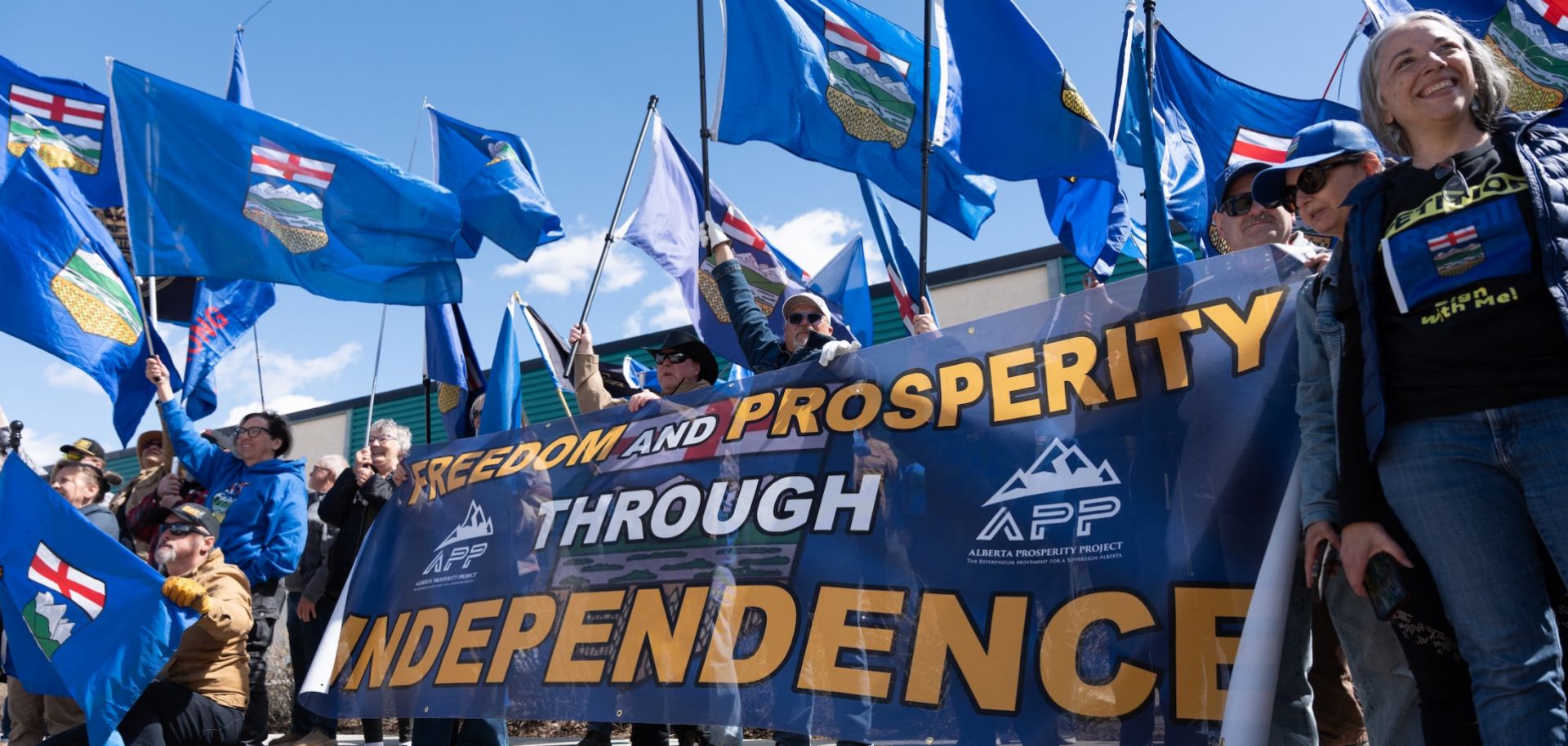
Alberta separatists gather during a rally in front of the Elections Alberta headquarters in Edmonton, Canada, on May 4, 2026.
(Henry MARKEN / AFP via Getty Images)
Alberta separatists gather during a rally in front of the Elections Alberta headquarters in Edmonton, Canada, on May 4, 2026.

In Canada, a renewed independence push in Alberta is highly unlikely to succeed, but Ottawa will still likely have to confront stronger secessionist pressures in Quebec after elections later this year. On May 4, Stay Free Alberta, a group pushing for the Canadian province of Alberta to secede, announced that it had formally submitted nearly 302,000 signatures, far more than the approximately 178,000 required, to try to trigger a referendum on Albertan independence. Albertan Premier Danielle Smith has previously said that she does not support such a move, but would put the question to a vote if campaigners received enough signatures. In December 2025, Elections Alberta verified over 404,000 signatures submitted by the pro-unity group Forever Canadian; the petition calls for a referendum to make it official provincial policy that Alberta remain part of Canada. If authorities verify that Stay Free Alberta has also met the signature threshold, Albertans could vote on potentially dueling referendums on Oct. 19, when the province is scheduled to hold a referendum on a number of other questions.

  • The process of verifying signatures is currently paused as a judge considers a legal challenge from a group of Indigenous Alberta First Nations who argue that an independence petition violates treaty rights. Even if the judge rules that the referendum is legal and that the signature verification process can proceed, Elections Alberta has said it will conduct an extra-detailed review after another separatist group posted a database containing Albertans' personal information, fueling speculation that some ostensible signatures may have been improperly gathered.
  • Under Canadian law, provinces have the right to conduct referendums independently. In 2025, Smith's government in Alberta reduced the number of signatures required for a petition to be considered during a referendum, while also changing how referendums work, to effectively give the provincial government more oversight, including the ultimate power to decide whether a petition results in a referendum. It remains unclear how Smith would reconcile two competing petitions over Albertan sovereignty if she adds a question to the existing referendum in October, and any petitions involving secession are not binding on the federal government but rather initiate a negotiation process.

Alberta has had a secessionist movement for many decades, but popular support for independence, which had accelerated in recent years, has declined since the 2025 national elections and amid ongoing U.S. pressure on Canada. As the center of Canada's oil and gas industry, Alberta has long had a tense relationship with the national government in Ottawa, primarily over energy and environmental regulations. Conservative parties have nearly continuously ruled the province since 1971, resulting in heightened friction with liberal national governments that have pursued stricter environmental agendas and limits on oil and gas production and exports. Relations hit a recent low point during the tenure of former center-left Liberal Party Prime Minister Justin Trudeau (2015-2025), as illustrated by Alberta passing the contentious Alberta Sovereignty within a United Canada Act in 2022, which gave the province a framework to challenge federal laws it deems unconstitutional. The current grassroots-led independence movement gained traction during this time and, following the Liberal Party's unprecedented come-from-behind victory in the April 2025 national elections, it was widely expected that Prime Minister Mark Carney would have a similarly adversarial relationship with Alberta. However, since taking office, Carney has shifted to the political center and forged a much closer relationship with Smith's provincial government. In November 2025, Carney went so far as to sign a high-profile memorandum of understanding to strengthen ties with Alberta, particularly to support its all-important energy sector. This rapprochement, combined with U.S. President Donald Trump's repeated rhetorical belittling of Canadian sovereignty and imposition of U.S. tariffs on the country, has added counter-pressure in favor of Alberta staying a part of Canada.

  • In late 2025 and early 2026, representatives from the Alberta Prosperity Project, the driving force behind the Stay Free Alberta campaign, met with members of the Trump administration to discuss how an independent Alberta could benefit the United States and how Washington could support Albertan secessionism. Albertan secessionists subsequently confirmed they were not seeking to become part of the United States, but public revelations about the meetings sparked some backlash, even within the pro-independence movement.
  • Polling data indicates that popular support for Albertan independence often rises when the Liberal Party holds power in Ottawa, particularly immediately following the party's electoral victories. This helps account for recent relative spikes in the late 2010s and early 2020s, when tensions between Edmonton and Ottawa were very high, and as recently as May 2025, just after federal elections brought Carney's government to power. Over the past year, however, support has remained relatively flat, with polls consistently showing that only about 25% to 33% of Albertans favor seceding from Canada. In recent years, support has also never come close to a majority, with trusted pollsters rarely finding more than 30% of Albertans backing independence. 

While Alberta is highly unlikely to secede anytime soon, the Canadian government will probably have to contend with stronger pro-independence pressure from Quebec after the province holds elections in October. Even if Stay Free Alberta overcomes the current legal challenge to its petition, Elections Canada validates its signatures and Smith agrees to hold a referendum later this fall (or potentially in 2027, when the province will hold general elections), several factors severely limit the likelihood of the province achieving independence. First, recent polling consistently shows that only a clear minority of Albertans would support independence, and even fewer portray themselves as truly committed, especially when asked to consider the economic consequences of secession. While the pro-independence movement argues that Alberta would gain economic benefits from not having to pay taxes to Ottawa or follow its rules, secession would impose substantial new costs. These include an expected loss of, or at least delays to, investment due to a surge in business uncertainty; the need to replace federal agencies and social programs with provincial ones; the lack of, at least initially, access to the U.S.-Canada-Mexico Agreement; and new challenges in exporting oil and gas, as landlocked Alberta would need to renegotiate pipeline access through Canada. Additionally, even if Albertans approve a pro-independence referendum, the province would still have to overcome major legal constraints to secede. Per Canadian law, the House of Commons would first have to confirm that the independence vote featured a "clear question" and received a "clear majority" of support. Alberta would then have to negotiate with the federal government and other parts of the country to pass a constitutional amendment — a process that could take years and still not necessarily yield approval for independence. Further complicating matters, Alberta's Indigenous groups would argue that secession violates the treaties they signed with the British Crown before Alberta became part of Canada. This would likely lead to further litigation and could potentially even prompt intervention from King Charles, who has reportedly voiced concerns about Alberta's independence movement after meeting with First Nations leaders in March. But regardless of what happens in Alberta, secessionist sentiment is reanimating in Quebec ahead of provincial elections scheduled for Oct. 5, in which the explicitly pro-independence Parti Quebecois party is currently polling strongly. A provincial government led by Parti Quebecois would undoubtedly worsen ties between Quebec City and Ottawa, as the party would likely push for expanded autonomy beyond Quebec's existing powers, even if it does not pursue another pledged independence referendum.

  • Even if Alberta's independence is unlikely, the mere threat could further incentivize Ottawa to sustain its rapprochement with the province, including by potentially loosening environmental rules and/or providing greater financial or other support for a new pipeline connecting Alberta to Canada's west coast — a key component of the November 2025 agreement. Both the Canadian federal government and the Ottawa provincial government have been pushing for private companies to take the lead in financing, but the initiative has failed to attract sufficient private-sector interest due to concerns about legal challenges and high costs. However, Carney could offer greater federal backing for private sector investment, not least by designating the pipeline as a major infrastructure project to expedite approvals and reduce regulatory obstacles. Alberta reportedly aims to submit the proposal for consideration by July 1.
  • In a study published on May 5, a group of digital watchdogs released findings showing that foreign actors have been exploiting Alberta's secessionist debate to weaken Canadian societal cohesion and undermine trust in the country's institutions. According to the researchers, the threat actors comprise three main groups: covert Russian online influence operations, overt messaging by Trump administration-aligned media outlets and influencers, and financially-motivated threat actors leveraging artificial intelligence.
  • Quebec has held two failed independence referendums, in 1980 and 1995, with the latter losing by barely over 50%. Parti Quebecois leader Paul St-Pierre Plamondon has vowed to hold a third if he is elected.
RANE
SUBSCRIBERS ONLY

Expert analysis when it matters most.

Get access to RANE's decision-grade geopolitical intelligence.