
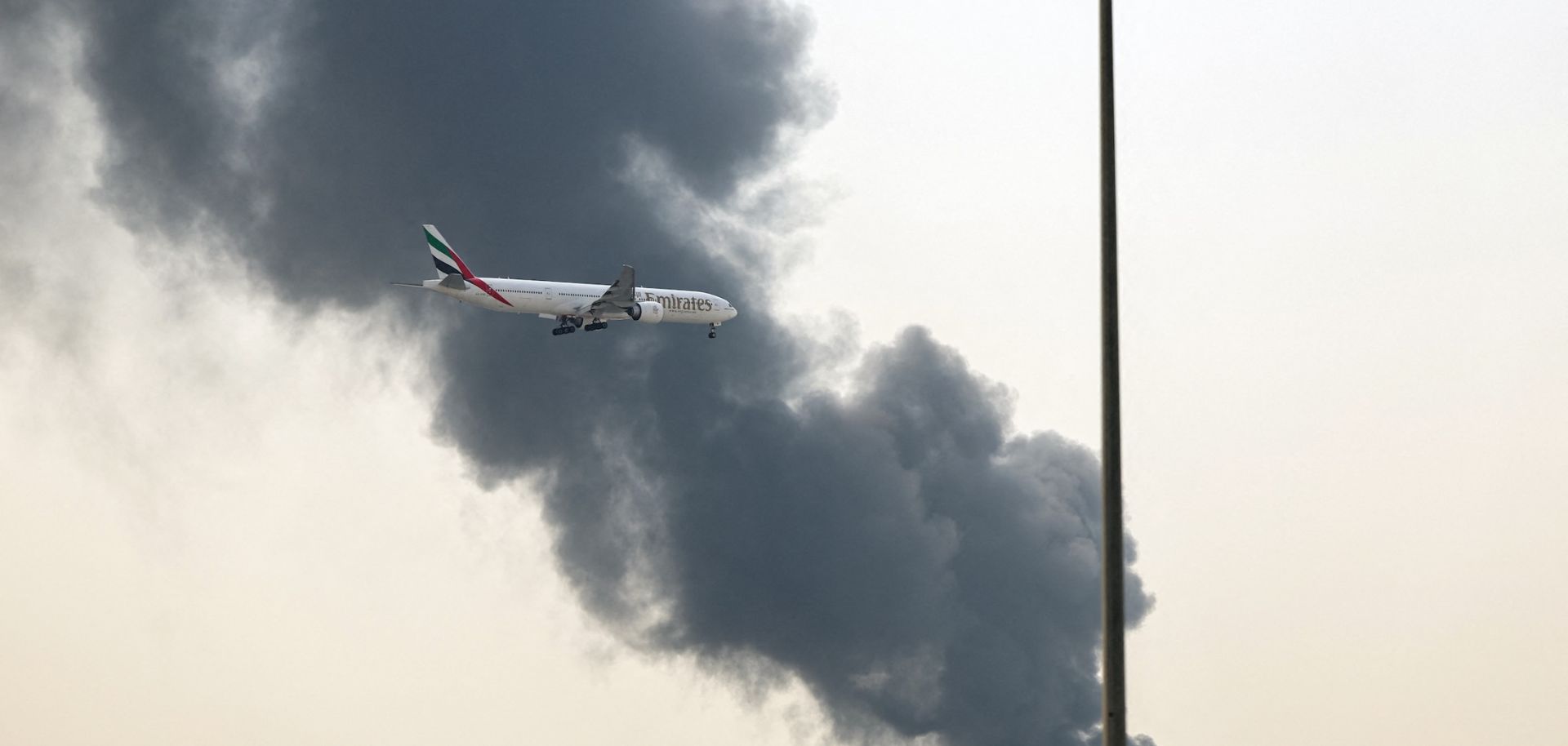
Iran's attacks on the United Arab Emirates and shipping in and around the Strait of Hormuz will significantly stress the fragile U.S.-Iranian ceasefire, increasing the risk of renewed direct hostilities that would likely include the tit-for-tat targeting of regional critical energy and civilian infrastructure. The United Arab Emirates' Ministry of Defense said on May 4 that the country had come under attack by Iranian drones and missiles, with Emirati air defenses actively engaging incoming threats. Iranian projectiles appear to have triggered a fire at an oil facility in Fujairah, while multiple commercial vessels were also targeted, including a South Korean-operated ship that reportedly suffered a fire and explosion. Separately, U.S. Admiral Brad Cooper told reporters that several U.S. destroyers had transited the Strait of Hormuz and were operating inside the Persian Gulf. Cooper added that Iranian forces opened fire on U.S. warships and commercial vessels, prompting the U.S. military to sink seven Iranian small boats that were allegedly targeting vessels in and around the Strait of Hormuz.

- U.S. President Donald Trump warned on May 4 in a Truth Social post that Iranian forces would be "blown off the face of the earth" if they targeted U.S. vessels guiding ships through the Strait of Hormuz.
Iran's latest attacks are intended to challenge the United States' effort to guide ships through the Strait of Hormuz, preserve Tehran's leverage and signal that Gulf states enabling the U.S.-Israel campaign remain exposed to direct retaliation. Iran's May 4 attacks came a day after Trump announced a new effort, Operation Project Freedom, to incentivize ships to pass through the Strait of Hormuz, suggesting Tehran intended to respond directly to the United States' attempt to break the maritime deadlock. Trump's move was designed to increase pressure on Iran without immediately moving to broader military escalation: by incentivizing and guiding commercial vessels to pass through Hormuz, Washington would seek to strip Tehran of one of its most important bargaining chips and force it to either tolerate the loss of leverage and concede in negotiations, or retaliate and risk being blamed for re-escalation. Operation Project Freedom also came as Iran had reportedly recently offered the White House a two-phase framework for peace talks, with an initial month focused on negotiations to end the war and reopen the Strait of Hormuz, followed by a second phase addressing Iran's nuclear program. But Trump viewed this proposal as unacceptable. Operation Project Freedom effectively seeks to bypass that sequencing by stripping Iran of the Hormuz card upfront. The Islamic Revolutionary Guard Corps (IRGC) appears to have calculated that retaliation was necessary to signal defiance and preserve deterrence. Iran's May 4 attacks on Fujairah mark the first Iranian strikes on the United Arab Emirates in nearly a month and signal that Tehran is again willing to pressure Gulf energy and maritime infrastructure to raise the costs of the U.S.-led campaign. Iran's decision to single out the United Arab Emirates also carried symbolic value: The Emirati government has been among the most hawkish Gulf actors toward Iran during the conflict and has reportedly hosted Israeli military personnel for defensive operations, making it a useful target for Iran to signal that Gulf states enabling the U.S.-Israel campaign will continue to face direct costs.
- The IRGC's navy issued a new map on May 4 showing a large area of the Strait of Hormuz it claims is under its control. The map stretches from a line between Qeshm Island and the United Arab Emirates' Umm al-Quwain in the west toward a line between Iran's Mount Mobarak and Fujairah in the east. This reinforces that Iran views U.S.-guided shipping movements as a direct challenge to its claimed operational authority over the strait, making future incidents more likely if U.S. destroyers, commercial vessels or Gulf-linked ships transit without Iranian coordination.
The May 4 escalation places significant stress on the U.S.-Iran ceasefire and increases the risk of renewed direct hostilities, particularly if Iranian attacks on Emirati infrastructure trigger U.S., Israeli or Emirati retaliation against Iranian assets. In the coming days, there will be a high likelihood of additional incidents, including potential intermittent attacks on Emirati energy infrastructure, Iranian attacks on commercial tankers or vessels near the Strait of Hormuz and U.S. naval responses that destroy Iranian small boats, drones, missiles or coastal assets. These incidents, combined with the stalling negotiations, will significantly increase the risk of a broader collapse of the already fragile ceasefire. As of May 4, Emirati officials were reportedly already assessing a high likelihood of U.S. or Israeli strikes on Iran within the next 24 hours. Any attack on Iranian missile sites, naval infrastructure, or coastal launch positions would likely prompt an Iranian retaliation. This would create an escalation ladder in which U.S. threats, Iran's likely refusal to capitulate and repeated maritime or energy-sector attacks could shift the conflict from a fragile ceasefire and limited incidents back to open hostilities, including tit-for-tat attacks on regional energy and critical infrastructure, civilian and critical infrastructure in Iran, U.S. regional bases and Israel.
- Trump is more likely to pursue progressive escalation than immediately authorize high-risk ground operations, as Washington appears to believe Iran is now more vulnerable to compellence through blockade pressure and renewed airstrikes. The U.S. naval blockade and Operation Project Freedom give Trump a way to increase economic and military pressure on Tehran while avoiding the political and operational risks of a ground campaign. If Iran continues to resist concessions, Trump is more likely to expand strikes on Iranian naval, missile, air-defense and critical infrastructure targets in phases, calculating that cumulative costs could eventually force Tehran back to negotiations on less favorable terms. This approach would allow Washington to preserve escalation dominance without immediately committing to a higher-risk operation that could trigger a prolonged war or domestic backlash.
- The United States retains the option to escalate further, including through limited ground operations, if renewed strikes fail to produce Iranian concessions. The continued deployment of U.S. forces, including amphibious assets and units that could support ground operations, gives Washington additional escalation options beyond air and maritime strikes. While ground operations remain a higher-risk and less likely scenario for now, the likelihood would increase if resumed hostilities and expanded attacks on Iranian military sites harden Tehran's position rather than force a negotiating breakthrough. In that scenario, Trump may come under pressure to demonstrate that U.S. escalation can still change Iran's calculus, particularly if Iran continues targeting Gulf infrastructure, U.S. vessels or regional partners.
Alternatively, the United States may choose to use expanded airstrikes, announce victory and withdraw from the war with Iran. If domestic or allied political pressure on Trump to de-escalate grows, or if Iran offers limited concessions that Trump can frame as a win, Washington may conduct a broader round of strikes and then pause rather than risk being pulled into a ground campaign. This would allow Trump to claim that military pressure brought the United States a win in the conflict, forced Iranian concessions and achieved U.S. objectives on Iran's nuclear program, while avoiding the political and operational costs of a prolonged conflict or occupation-style quagmire.