
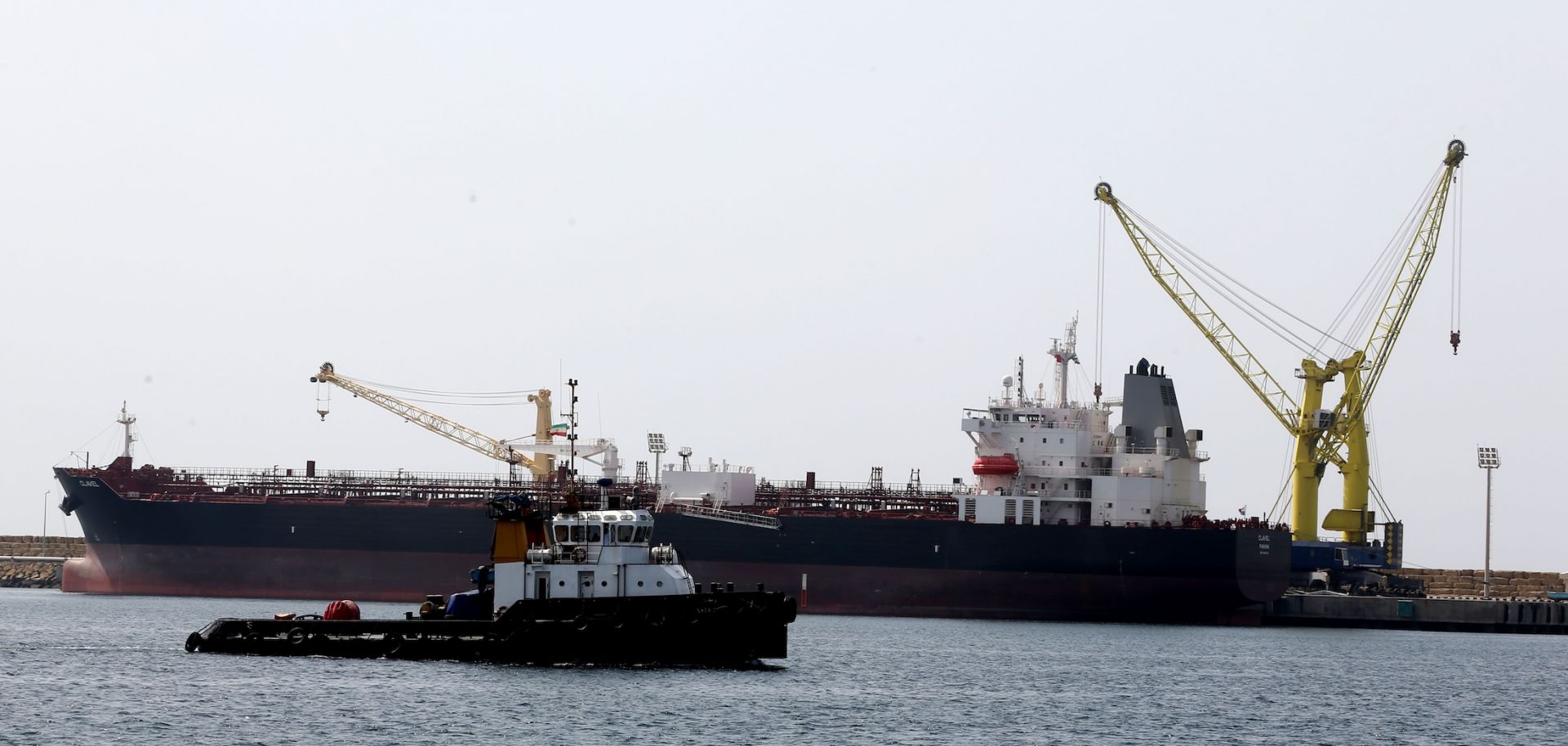
The expiration of the U.S. sanctions waiver for Iran's Chabahar Port is unlikely to force India out of the project but will constrain its development, leaving the strategic port operational but not commercially scalable. The U.S. sanctions waiver that has allowed India to develop and operate Iran's Chabahar Port since 2018 expired on April 26. The measure had provided a legal exemption for India's involvement in the port for trade and connectivity purposes, despite broader U.S. sanctions on Iran. But its expiration has removed that protected status, casting doubt on the continuation of Indian operations and investments there. Indian officials have since indicated that they are in talks with both the United States and Iran, but the spokesperson for India's Ministry of External Affairs cited the ongoing Middle East conflict as a "complicating factor."
India sees Chabahar Port as a long-term strategic asset because it offers a direct route to Afghanistan and Central Asia without relying on Pakistan, while also strengthening New Delhi's regional connectivity and geopolitical influence. Operational disruptions at the port would likely have a minimal direct impact on India's trade, as Chabahar currently handles only 0.1-0.2% of the country's total cargo volumes. But for India, the port remains strategically significant because it provides maritime access to Iran and limits road-based connectivity to Afghanistan. New Delhi also sees Chabahar as a vital geopolitical counterweight to China's Belt and Road Initiative (BRI), which has drawn in several of India's neighbors, including Pakistan, Sri Lanka, Nepal, the Maldives and Myanmar. Of particular concern to New Delhi is the China-Pakistan Economic Corridor (CPEC), a flagship BRI project that traverses the disputed region of Gilgit-Baltistan. Additionally, India perceives China's growing presence across the Indian Ocean — e.g., in the Pakistani port city of Gwadar — as a threat to its strategic influence. In this context, Chabahar provides India with an alternative corridor and an independent maritime-to-land access point into the same strategic neighborhood, thereby reducing the sense that it is being boxed in by China. Furthermore, the port provides India with a critical foothold in Iran, located just 170 kilometers from Gwadar, enabling it to maintain a competing presence along key regional trade corridors. But Chabahar's greater long-term value lies in its potential to serve as a direct trade corridor to Central Asia once key rail infrastructure — particularly the Chabahar-Zahedan link — becomes operational, which will expand India's geopolitical footprint in a region where overland access is otherwise constrained.
- India's trade with Central Asia — comprising $744 million in exports and $278 million in imports — is currently dwarfed by China's $100 billion-plus trade volume. The Chabahar Port is designed to address the structural barriers India faces in accessing Central Asian markets by establishing a direct corridor for future trade, particularly for importing oil and gas from Kazakhstan, Turkmenistan, and Uzbekistan.
The ebb and flow of U.S. sanctions, however, has repeatedly complicated the port's development. Discussions on developing the port began in 2003, but progress stalled for over a decade due to U.S.-led sanctions on Iran. Momentum resumed after the 2015 Iran nuclear deal eased sanctions, with India, Iran and Afghanistan signing a trilateral agreement committing $500 million to develop the port and associated transit corridor in 2016. In 2018, the United States withdrew from the nuclear deal and reimposed sanctions on Iran as part of then-President Donald Trump's "maximum pressure" campaign. But the Trump administration granted India a sanctions waiver for Chabahar because the port was seen as a vital economic and humanitarian lifeline for Afghanistan, reducing its historical dependence on Pakistan for transit routes. This made the project acceptable under U.S. sanctions policy at the time, as it was framed not only as advancing Afghan stability and self-sufficiency but also as supporting the broader U.S.-India strategic partnership. In 2024, India signed a 10-year agreement with Iran's Ports and Maritime Organization to expand its role at the port as a trade gateway to Afghanistan and Central Asia, offering India an alternative sea-land trade corridor via Iran that bypasses Pakistan's restricted overland transit routes. However, as U.S. policy toward Iran hardened and the strategic rationale tied to Afghanistan diminished following the U.S. military withdrawal from the country, Washington moved to revoke the sanctions waiver in 2025. India secured a temporary exemption from secondary U.S. sanctions targeting foreign entities engaged in Iran's port and shipping sectors. But that waiver expired on April 26, leaving New Delhi's 2024 agreement to operate and expand Chabahar Port without legal protection from those penalties.
- In May 2024, India Ports Global Limited signed a 10-year agreement with Iran's Ports and Maritime Organization to operate and equip the Shahid Beheshti Terminal, which forms the core of Phase 1 of Chabahar's development and is currently fully operational, handling commercial cargo with rising vessel and container traffic in recent years. The broader five-phase expansion plan, however, remains incomplete. Phase 2, intended to expand container capacity and improve throughput, has been delayed amid sanctions uncertainty and the reported withdrawal of Indian technical personnel ahead of the April 26 waiver deadline.
With the prospect of a renewed U.S. sanctions waiver uncertain, India will likely negotiate an interim operational agreement with Iran to keep Chabahar functional. Indian officials expected the sanctions waiver to be extended, but ongoing U.S.-Iran tensions and the absence of a peace deal have cast doubt on Washington's willingness to provide further exemptions. Although the expiration does not ban India from using Chabahar, it removes the legal protections that ensured the port's commercial viability, which is why India is now in talks with Iran and the United States to mitigate potential financial restrictions and sanctions risks. Reports indicate that India Ports Global Limited (IPGL) — which has managed Chabahar Port since 2024 — may channel operations through a local Iranian entity and the Iranian ports authority, with provisions that would allow India to regain control of the port if and when sanctions conditions ease. This strategy would likely confine day-to-day activities within Iran, thereby minimizing India's direct operational presence; however, the port would remain susceptible to U.S. secondary sanctions directed at Iran's shipping and maritime sectors. As a result, Indian banks, insurers and logistics firms would still encounter substantial sanctions-related constraints that could restrict financing, insurance coverage and participation in cargo flows. But despite these challenges, India is moving forward with the deal to prevent alternative management structures from taking root, which would make it significantly more difficult for New Delhi to reassert its influence over Chabahar in the future.
- Iran will likely support an interim management framework for Chabahar because, even with U.S. sanctions pressure, the port still generates revenue, sustains limited trade flows and preserves Iran's role as a non-Chinese regional connectivity hub. As Iran's only major deep-sea port outside the Persian Gulf, Chabahar also provides a critical maritime backup and trade channel that enhances Iran's resilience against Gulf disruptions. For Tehran, keeping the port operational is thus preferable to partial inactivity under sanctions constraints.
Rather than push India to exit the project, the expiration of the U.S. sanctions waiver for Chabahar will likely incentivize strategic hedging, with New Delhi diversifying and strengthening parallel connectivity corridors. New Delhi will likely maintain a limited state-backed presence at the port while avoiding deeper commercial exposure that could trigger secondary sanctions. This means greater caution in direct engagement with Iran and a heavier reliance on government-managed rather than private-sector participation. To mitigate reliance on a single sanctions-prone route, India will likely also increasingly focus on developing parallel connectivity options, including other segments of the International North-South Transport Corridor, deeper trade integration through the United Arab Emirates and Saudi Arabia, and expanded maritime partnerships with Oman's Duqm Port and Central Asian transit networks. Ultimately, Chabahar is poised to transition from an ambitious commercial venture into a symbolic strategic asset — a "holding position" that ensures India maintains long-term regional influence and access until sanctions conditions become clearer.
The Chabahar Port will likely continue operating as a state-supported strategic hub, but its commercial growth will be stalled by U.S. sanctions that limit private-sector involvement, which could strengthen perceptions of China's regional connectivity advantage and undermine confidence in India's ability to sustain projects under sanctions pressure. Cargo volumes are likely to level off rather than increase significantly, because sanctions make it difficult to fully connect the port to global shipping and financial systems. Some government-to-government shipments, such as humanitarian aid to Afghanistan, will likely continue, but plans to turn Chabahar into a major regional trade hub are effectively stalled for now. This will slow expansion at the Shahid Beheshti Terminal, even though basic infrastructure built by India Ports Global Limited will keep the port functional. Additionally, without strong private-sector trade, there is little justification for major upgrades or rapid expansion. If Chabahar's development stalls, it could gradually shift perceptions of regional connectivity in China's favor by reinforcing the visibility and relative reliability of China-linked infrastructure across Pakistan and parts of Central Asia. For India, the main risk is not a broad loss of credibility as an infrastructure partner, but a more limited one in sanctions-constrained environments, where its ability to sustain and scale long-term projects may appear more vulnerable to external legal and financial pressures despite strong initial commitments. In terms of India-U.S. relations, the issue is likely to generate only marginal friction because of broader strategic convergence on supply chain resilience, diversified regional connectivity and the need to balance China's expanding infrastructural influence.
