
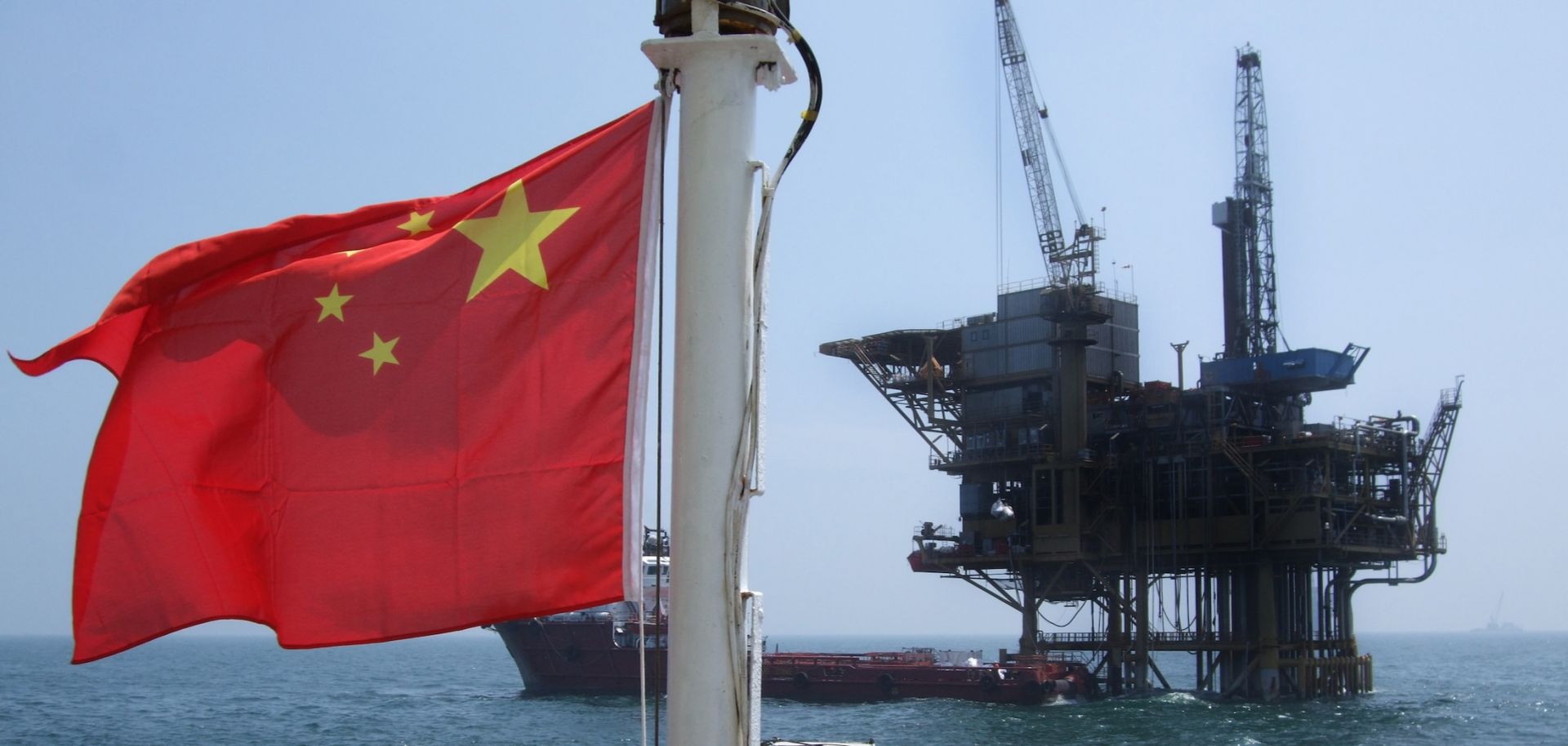
A Chinese vessel participates in oil exploration.
(Getty Images)
A Chinese vessel participates in oil exploration.

China's strong recent industrial data underscores that Beijing has contained the Iran war shock so far, but prolonged shipping disruptions through the Strait of Hormuz would test the country's energy buffers and push policymakers toward more defensive support for growth, supply security and export competitiveness. China's industrial profits rose 15.8% year-over-year in March, the fastest pace in six months, after a 15.2% rise in January-February. First-quarter profits rose 15.5% as the broader economy expanded 5%. The gains were strongest in strategic sectors, as equipment manufacturing profits rose 21%, high-tech manufacturing profits jumped 47.4%, electronics profits surged 124.5% and railway, shipbuilding and aerospace manufacturing profits rose 16.7%. Raw materials producers also saw profits rise 77.9%, while mining profits increased 16.2% and manufacturing profits rose 19.1%; this suggests parts of China's industrial base benefited from stronger prices, pockets of demand and specific industry tailwinds, even as energy and input costs rose. April factory surveys also reinforced the picture of short-term industrial resilience, with China's official manufacturing Purchasing Managers' Index remaining in expansion at 50.3 and the S&P Global manufacturing survey rising to 52.2, its strongest reading since 2020. China is also poised to resume refined fuel exports in May after sharply curbing shipments in April. Nonetheless, policymakers are preparing for the risk of a more impactful slowdown in the coming months as disruptions to the Strait of Hormuz continue. On April 28, China's Politburo urged officials to implement more proactive fiscal policy and appropriately loose monetary policy, strengthen energy and resource security, support domestic demand and business confidence, promote artificial intelligence adoption and deepen industrial chain control while also maintaining Beijing's medium-term focus on curbing excessive price competition (more challenging in the short term given higher energy prices will likely drive higher prices broadly).

  • On April 6, President Xi Jinping called for faster construction of a "new energy system," reinforcing Beijing's push to reduce exposure to external energy shocks by keeping domestic coal power widely available to stabilize electricity supply while aggressively expanding renewables, hydropower, nuclear power, storage and strategic energy infrastructure.
  • Since the Iran war began in late February, Beijing has relied mainly on defensive supply management. This has involved restricting refined fuel exports, tightening fertilizer export controls and allowing state refiners to tap commercial oil reserves. China is also now considering May export permits for jet fuel, diesel and gasoline after refined fuel exports roughly halved from nearly 800,000 barrels per day before the war.
  • China's electricity system is structurally less exposed to supply shocks because oil and gas play more limited roles in power generation (around 3% combined), while coal and clean power dominate the mix. According to 2025 electricity mix data from energy think tank Ember, coal supplied about 55% of China's electricity, while low carbon sources supplied about 42%, including hydropower (14%), solar (11%), wind (11%) and nuclear (5%). By contrast, Japan and South Korea rely on gas for 29% and 24% of their electricity generation, respectively, making them more exposed to disruptions in the supply of liquified natural gas through the Strait of Hormuz.

China has been relatively insulated from the impact of the Iran war because it has substantial oil buffers, a power grid less reliant on crude, and enough state control to quickly redirect supply. China buys around 80% of Iran's oil exports and is the world's largest buyer of crude shipped through the Strait of Hormuz more broadly. However, the short-term shock has been cushioned by reserves, alternative supply, domestic energy capacity and administrative control. China entered the war with strategic reserves estimated at roughly 78 days of normal crude import volumes, and there are no confirmed reports that Beijing has tapped into these supplies during the crisis. The U.S. Energy Information Administration separately estimated that China's broader strategic oil inventories stood at nearly 1.4 billion barrels in December 2025, giving Beijing a larger practical cushion compared to regional peers when combined with commercial inventories, domestic production and state-directed fuel allocation. China also imported heavily from Iran and Russia before Strait of Hormuz traffic became severely disrupted, and, in March, China added 40 million barrels of crude to reserves while refineries processed about 1 million fewer barrels per day, suggesting Beijing was building a larger supply cushion. Moreover, China's power grid remains relatively insulated from global oil shocks because the government has reinforced domestic coal as a reliability backstop while rapidly expanding renewables, hydropower and nuclear capacity, thereby limiting the impact of imported crude disruptions on electricity generation. But while the fallout from the Iran war has not caused major energy or industrial disruptions in China, it has forced Beijing to more actively manage crude procurement, refinery operations and fuel exports, as Middle East crude flows have become less reliable and sanctioned Iranian crude has lost some of its cost advantage. Consequently, in March, refinery throughput fell 2.2% year-over-year and refinery capacity utilization also dropped around 4% from February. At the same time, China's likely resumption of refined fuel exports in May fits its managed approach in that Beijing restricted shipments at the start of the war to protect domestic supply but now appears confident enough in domestic fuel stability to use selective exports to support regional markets.

  • China's diplomatic position on the Iran war has centered on protecting energy flows. Beijing has called for a ceasefire, negotiations and open navigation through the Strait of Hormuz, while preserving working ties with Iran and Gulf producers and opposing further U.S. military pressure or sanctions escalation.
  • Roughly 10% of China's crude oil and natural gas supplies pass through the Strait of Hormuz, but regional peers like Japan and South Korea rely more heavily on Middle Eastern crude and have fewer domestic energy buffers. Some regional economies, like the Philippines and Australia, have faced national or local emergency declarations and broader fuel shortages due the ongoing shipping disruptions. China's likely restart of refined fuel exports in May would also make it a stabilizing supplier for buyers including Australia, Japan, Vietnam, the Philippines and Bangladesh.
  • The drop in refinery throughput shows that Chinese refiners processed less crude even as headline industrial profits improved. That divergence suggests China's profit growth in March was driven by higher prices and specific sector tailwinds (e.g., increased electric vehicle demand ahead of consumer subsidy expirations), rather than a broader strengthening in domestic demand, with the Iran-war energy shock remaining concentrated in crude supply, refinery margins and fuel-market management.
  • Growing U.S. sanctions pressure could eventually make it harder for China to access discounted Iranian oil. On April 24, the U.S. Treasury sanctioned Hengli Petrochemical's Dalian private refinery unit over alleged purchases of billions of dollars' worth of Iranian crude. On April 28, the Treasury then warned that Chinese independent refiners risk being blacklisted and urged financial institutions to avoid transactions with refiners that may process Iranian oil. 

If the Iran war drags on, China will face rising pressure on refining, industrial costs and exports, but Beijing will likely respond with targeted support for energy security and strategic industries that cushion the economy while keeping Chinese firms competitive enough to intensify trade friction with the United States and Europe. The Iran conflict is a net risk for China, but it also creates selective upside. For example, the country's clean tech companies can benefit from stronger demand for energy alternatives, and renewed refined fuel exports could turn China's spare supply capacity into a regional influence tool. If shipping disruptions in the Strait of Hormuz are limited to the next three months, China's economic outlook will likely remain stable. A medium-term disruption lasting between three and six months would still be manageable, but the squeeze would become more visible in refining, manufacturing costs and exports. Refiners would face a harder choice between drawing down inventories, paying more for replacement crude or keeping operating rates lower, while manufacturers would face higher energy, freight and raw material costs, especially in lower-margin sectors. Exporters would also face weaker global demand, just as strong profits and state support give Chinese firms room to compete aggressively abroad. Beijing would likely respond by lowering borrowing costs to ease bank lending for companies and local governments. The government would likely also increase spending on infrastructure and industrial upgrading, tighten direction of fuel supplies and refinery operations, consumer subsidies or property sector support, and strengthen oversight of key inputs, logistics networks and high-tech supply chains. Such measures would likely be targeted, with priority given to energy supply, advanced manufacturing, clean technology and other strategically important export sectors. In this scenario, China would provide support to industry more aggressively at home (i.e., through credit, subsidies, procurement, energy allocation and infrastructure spending), which would likely invite more trade scrutiny from the United States and the European Union, which already view Chinese industrial policy, overcapacity and export strength as threats to their manufacturers. However, given Washington's likely desire to avoid escalating trade tensions with Beijing, any U.S. retaliation would probably focus on narrower pressure against specific companies, products and supply chains, rather than sweeping new tariffs. However, if the Strait of Hormuz shipping disruptions persist for another six to 12 months, the mounting refinery and cost pressures — combined with potential wider U.S. sanctions — could begin to more severely impact China's industrial output, export margins and broader economic growth. 

  • China's clean tech exporters have benefited from the Iran war energy shock, with March battery and solar export receipts up 30% from February and 52% year-over-year as global buyers sought alternatives to oil and gas. 
  • The European Union imposed tariffs on Chinese electric vehicles following an anti-subsidy investigation; however, these vehicles remain competitive in Europe, keeping it a key market for Chinese automakers. 
  • The United States is moving toward trade law tools focused on manufacturing overcapacity and forced labor after the curtailment of International Emergency Economic Powers Act tariff authority, likely broadening the legal pathways for new trade pressure on China.
  • In March, China's exports slowed as the Iran war weighed on global demand, but industrial profits stayed strong in strategic sectors. This mismatch means Chinese firms may still have the capacity and policy support to compete aggressively abroad, even if external demand weakens.
RANE
SUBSCRIBERS ONLY

Expert analysis when it matters most.

Get access to RANE's decision-grade geopolitical intelligence.