
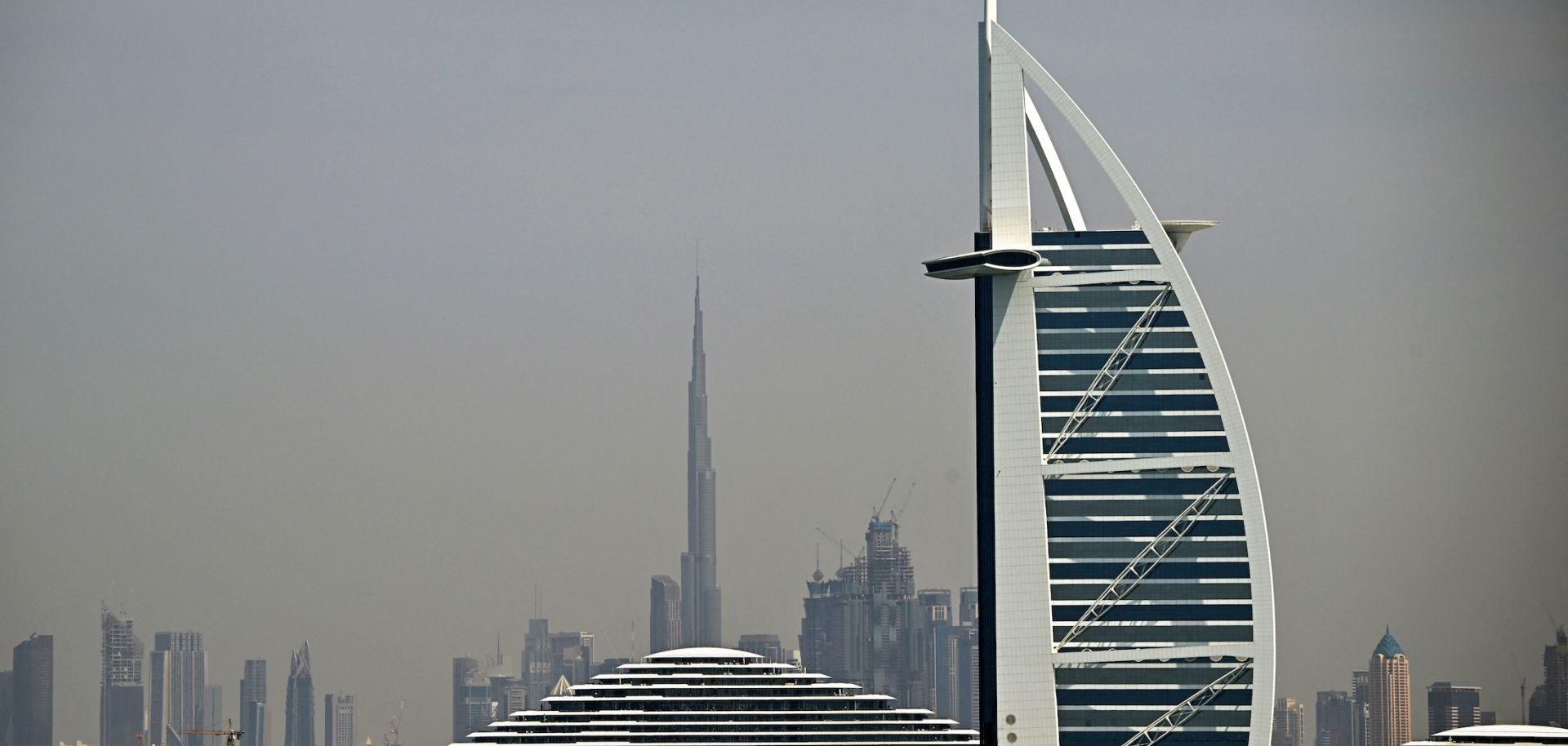
The skyline of Dubai is seen on March 11, 2026.
(Giuseppe CACACE / AFP via Getty Images)
The skyline of Dubai is seen on March 11, 2026.

The United Arab Emirates' exit from OPEC will enable the country to more quickly boost production once shipping through the Strait of Hormuz returns to near-normal levels, while weakening OPEC's relevance in setting oil production quotas and influencing prices. On April 28, the United Arab Emirates announced that it will exit OPEC effective May 1, 2026, ending its membership, which began in 1967. As OPEC's third-largest producer by capacity (behind Saudi Arabia and Iraq), the United Arab Emirates accounted for roughly 12% of the oil cartel's output in February 2026 — the final full month of production before the Iran war began disrupting shipping through the Strait of Hormuz in March. The UAE energy ministry noted that the decision reflected the country's "long-term strategic and economic vision and evolving energy profile, including accelerated investment in domestic energy production." As part of the move, the United Arab Emirates will also exit OPEC+, the grouping formed in 2016 that includes Russia and several other oil producers.

  • Tensions between the United Arab Emirates and OPEC have been high since 2021, when Abu Dhabi blocked a deal to extend OPEC production cuts, arguing that its baseline production level (used to calculate the cuts) was set too low. In recent years, the Gulf country has also frequently exceeded its OPEC production quota, forcing it to agree to additional output cuts to offset prior overproduction. Against this backdrop, leaks emerged in 2023 that the United Arab Emirates was considering exiting the oil cartel altogether. 
  • Over the last five years, the United Arab Emirates has significantly increased production capacity, aiming to reach 5 million barrels per day by 2027 — a goal originally set for 2030. By 2024, UAE officials claimed that capacity had already reached 4.85 million barrels per day. But the reference production capacity cited by OPEC prior to the United Arab Emirates' announcement of its exit was only 4.3 million barrels per day. The country also only produced 3.64 million barrels per day in February (and 2.37 million barrels per day in March).

The decision was primarily driven by the United Arab Emirates' structural disagreements with OPEC over production policy, operational pressures stemming from the Strait of Hormuz crisis and growing tensions with Saudi Arabia. For years, the United Arab Emirates has argued that hydrocarbon exporters should maximize short-term production to fund economic diversification programs, in contrast to the more conservative, market-management approaches of Saudi Arabia and Kuwait. As part of this aggressive strategy, the United Arab Emirates has sought to substantially increase production capacity and secure higher production quotas from OPEC. This has inevitably fueled tensions within OPEC, as other major producers would have to absorb deeper production cuts if the United Arab Emirates' output quota were increased. With a production capacity that significantly exceeds its current OPEC-mandated quota, the United Arab Emirates also clearly wants to rapidly increase oil exports once shipping through the Strait of Hormuz stabilizes, in order to recoup revenue losses and fund reconstruction efforts following the Iran war. Other Gulf producers, such as Iraq and Kuwait, may similarly seek to ramp up production after the strait reopens. But OPEC's de facto leader, Saudi Arabia — having already diverted most of its oil exports to the Red Sea — will likely favor a more managed approach to returning Gulf oil to the market, seeking to prevent a sharp decline in global prices. Relatedly, the United Arab Emirates' exit from OPEC was likely also influenced by its escalating regional rivalry with Saudi Arabia, which is set to intensify in the coming years as both nations vie for investments in technology and other innovative sectors to drive their respective economic transformation programs. Additionally, the United Arab Emirates has a more hawkish stance toward Iran than other Gulf countries, which likely factored into its decision as well, given that Iran is a formal OPEC member. 

  • While the UAE-Saudi tensions temporarily subsided following the outbreak of the Iran war, divisions between the two countries have resurfaced as the conflict continues. A key flashpoint occurred in early April, when the United Arab Emirates demanded that Pakistan immediately repay a $3.5 billion loan originally due in 2027, reportedly over frustration that Islamabad was playing a mediating role with Iran. This forced Saudi Arabia to provide $3 billion to help shore up Pakistani finances. 

The United Arab Emirates' departure will weaken OPEC's influence over global oil markets, in turn resulting in lower future oil prices once regional shipping stabilizes. The United Arab Emirates' impending departure will remove over 10% of OPEC's production and its second-largest source of spare capacity. This will further impede OPEC's (and OPEC+'s) ability to manage global oil markets, which is already strained by rising production from non-member nations such as Argentina, Brazil, Guyana and the United States. There is also the risk of a "contagion effect," as other members with similar grievances about production capacity, such as Iraq and Kazakhstan, may now consider leaving the cartel too. Additionally, the United Arab Emirates maintained substantial political influence within OPEC as the primary check on Saudi Arabia's leadership. With its departure, Saudi Arabia will transition from de facto to a de jure leader, as no remaining member has the political heft to challenge the kingdom's agenda without also leaving the alliance. The United Arab Emirates's exit — particularly if other members follow suit — will force Saudi Arabia to collaborate with non-OPEC nations to oversee the market, further reducing the cartel's relevance. But perhaps most importantly, this loss of influence and market share will impair OPEC's capacity to support oil prices, ultimately benefiting oil-consuming countries while hindering the cartel's ability to establish price floors and regulate price declines once shipping normalizes through the Strait of Hormuz. This means future oil prices will be lower than they otherwise would have been, had the United Arab Emirates remained in OPEC.

  • While global oil prices are unlikely to quickly fall anytime soon due to the Iran war, without the United Arab Emirates willing to cut production in tandem with other Gulf countries, remaining OPEC+ members — specifically Saudi Arabia, Kuwait, Iraq and Russia — will eventually need to shoulder a greater share of output cuts to maintain a price floor of approximately $60 per barrel. 
RANE
SUBSCRIBERS ONLY

Expert analysis when it matters most.

Get access to RANE's decision-grade geopolitical intelligence.
