
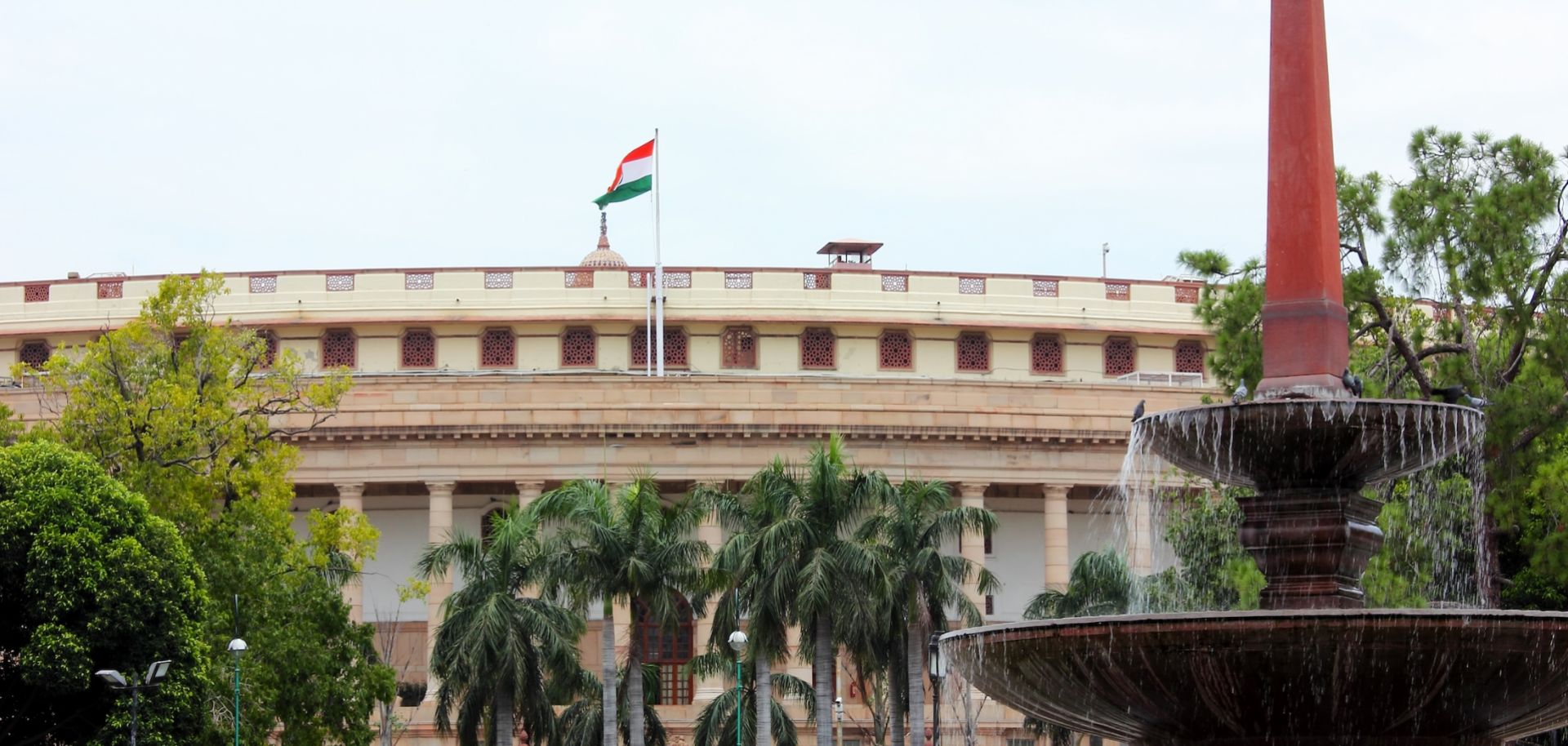
Parliament House is seen in New Delhi, India.
(Getty Images)
Parliament House is seen in New Delhi, India.

The Indian government's failed parliamentary reform will force the ruling Bharatiya Janata Party (BJP) to choose between a contentious, population-based expansion of Parliament that risks a north-south regional crisis or a simplified, standalone quota for women that would trigger intra-party competition and incumbent displacement before the 2029 general elections. On April 16, during a special session in Parliament, the BJP introduced a constitutional amendment in the lower house, the Lok Sabha, to redraw electoral constituencies, expand the lower house size from 543 to 850 members and reserve one-third of the seats for women. However, on April 17, the bill failed to secure the required two-thirds majority in the Lok Sabha, as opposition parties — while supporting women's quotas — opposed linking the measure to a large-scale redrawing of constituency boundaries, arguing it could shift political representation and give the BJP an electoral advantage. This defeat marked the first time in the 12 years since Indian Prime Minister Narendra Modi took office that his party failed to pass a constitutional amendment.

  • The bill received 298 votes in favor and 230 against in the lower house of Parliament, 54 short of the 352 needed to pass. While the BJP-led National Democratic Alliance backed the bill, the government's failure underscores its reliance on opposition support to reach the two-thirds threshold.
  • Women currently hold about 13-14% of seats in the Lok Sabha (75 of 543), below the proposed one-third quota. Achieving that threshold would require increasing female representation to about 181 seats, adding roughly 100 more women to the legislature.
  • The 18th Lok Sabha began its five-year term in June 2024. India's next national legislative election is expected to be held by April 2029.

The proposed constitutional reform has emerged as a polarizing issue in India, pitting the BJP's drive to consolidate power against opposition concerns over shifting influence dynamics between northern and southern states. India's parliamentary seat distribution across the country's states has been frozen since the 1970s, with current allocations based on the 1971 Census. This freeze was originally introduced to avoid penalizing states that implemented population control measures by reducing their share of seats. As a result, state representation in Parliament has not been adjusted to reflect the population changes over the past several decades. The BJP has proposed that, after India completes its next census — currently expected around 2027 — the lower house should be expanded and electoral boundaries redrawn (a process known as delimitation) to reallocate seats based on the current population. The ruling party argues that these changes would increase overall representation and ensure it is more evenly distributed across states, thereby providing the structural basis to enact reforms such as reserving one-third of legislative seats for women. However, opposition parties argue that increasing the seats in the lower house will strengthen the BJP's position and widen disparities between northern and southern states. Southern states, which are predominantly governed by opposition parties and are already considered underrepresented due to their smaller populations, fear the changes could further reduce their share of seats in the lower house and weaken their influence in federal decision-making. On the other hand, more populous northern states — many of which are governed by the BJP — would see an increase in representation if the proposal were approved. Opposition groups also argue that basing representation primarily on population could reduce the relative influence of more economically developed states with slower population growth and reshape how resources and policy priorities are determined.

  • In September 2023, the Indian government passed the Women's Reservation Act, which reserves one-third of seats for women in the lower house and state legislative assemblies. However, its implementation is contingent on a new census and subsequent redrawing of electoral boundaries (delimitation) based on updated population data. The last census was completed in 2011. The next round was originally scheduled for 2021, but was delayed due to the COVID-19 pandemic and administrative constraints. On April 1, the government officially launched the process for the next census, which will be conducted in phases over an extended period and is expected to take until around 2027 to complete, with final results and data processing requiring additional time afterward. 
  • To accelerate implementation of the Women's Reservation Act, the BJP's Constitution (131st Amendment) Bill proposed using 2011 Census data to redraw electoral boundaries, which opponents saw as an effort to ensure new seat distribution before the 2029 elections. However, because the amendment did not pass, the implementation of the Women's Reservation Act remains tied to the original requirement of conducting a fresh census followed by delimitation.

Despite the recent setback, the BJP will continue to seek to approve quotas for women in Parliament, either as a standalone law or, less likely, as a part of a broader reform package. The BJP has indicated that it will continue pursuing women's reservation, for which it has two main options. The first is to preserve the link between women's reservation, delimitation and the lower house expansion, allowing the redistribution of seats to be absorbed more gradually and reducing immediate disruption for sitting members of parliament. However, this approach would require an agreement with opposition parties, making it less likely in the near term. Alternatively, the BJP could try to implement the 33% quota within the existing 543-seat lower house. This approach would allow for faster and more straightforward legal implementation, but it would also have political consequences, as the women's reservation framework is tied to delimitation, which requires redrawing constituencies and reallocating seats based on population data, paving the way for a broader restructuring of representation across states. Additionally, more women in the lower house could significantly constrain the re-election prospects for a large number of incumbent male lawmakers, as they would no longer be eligible to contest in those reserved constituencies for women. Such a shift would likely generate substantial internal pressure within political parties, given the scale of potential incumbent displacement and intensified competition for the remaining unreserved seats. 

  • Passing a reform package that covers delimitation, women's reservation and expansion of the lower house would require a two-thirds majority in both houses of India's Parliament, since the measures would involve constitutional amendments. While the BJP may manage to pass such amendments in the lower house, the party and its allies lack the necessary seats (approximately 164) in the upper house to do so without opposition support. Such a reform package is thus unlikely to be approved in the near term due to opposition parties' resistance. 
  • If the 33% women's quota is implemented, but the size of the Lok Sabha is not expanded beyond its current structure, the impact would depend on how seats are redistributed during delimitation, since the quota would be layered onto a newly redrawn electoral map without increasing the total number of seats. This could intensify intra-party competition, as fewer "open" (non-reserved) seats would remain, placing greater pressure on incumbents in affected constituencies. At the party level, it would also require rapid adjustments to candidate selection processes. However, without an expansion of the lower house, the overall party representation for the BJP and its allies would likely remain broadly stable, even as women's representation increases. Politically, this would also allow the BJP to claim delivery on its flagship reform, even if broader structural changes are deferred.

If the reforms remain stalled, it would temporarily ease tensions between the federal government and southern states, but disputes over legislative representation — especially concerning women's reservation — would intensify over the long term. If the current gridlock persists, it would sustain the current status quo, with delimitation indefinitely delayed, the lower house remaining capped at 543 seats and women's reservation effectively frozen. This would temporarily ease tensions between the federal government and southern states, as their proportional representation in Parliament would remain unchanged. It would also prevent any potential shift in relative seat share that could advantage the BJP through population-driven gains in the faster-growing northern states, thereby limiting future changes in the balance of legislative power. In practice, the lack of population-updated seat allocations has not translated into a sustained, organized political movement in northern states pushing for greater parliamentary representation, but it has become a recurring concern in policy debates about electoral fairness. If left unaddressed, the imbalance could sharpen regional political narratives — particularly as delimitation returns to the agenda — by fueling competing claims of underrepresentation in the north and potential loss of influence in the south, thereby making future reforms more contentious. For the BJP, failure to implement women's reservation would also represent a short-term setback to its broader gender-empowerment narrative. However, the party would likely continue to argue that opposition resistance is responsible for blocking the reform's passage, thereby transforming legislative gridlock into an ongoing electoral narrative.

If fully implemented, the reform package would significantly expand and redraw India's legislature, increase women's representation and shift political power toward more populated northern states, likely intensifying regional contestation and strengthening the central government's ability to pass major constitutional and policy changes. If the government eventually succeeds in enacting its full vision — i.e., redrawing constituencies based on fresh census data, expanding the lower house to 850 or more seats, and implementing the women's quota within that larger structure — it would fundamentally reshape India's political landscape by changing representation and the distribution of political power among states. In practical terms, this would mean a larger and more demographically updated legislature, new constituencies and a significant influx of first-time women representatives, all of which would reset electoral competition and party strategies. For internal party dynamics, expanding the lower house would ease the impact of the women's quota by allowing parties to nominate a large number of new female candidates without displacing as many incumbent male lawmakers, thereby enabling a more gradual internal transition. However, political power would shift more decisively toward the Hindi heartland, as faster-growing northern states would gain a substantial number of additional seats in the lower house. This could reduce the relative influence of southern states and reshape the balance of power in national decision-making. While state governments would still be able to implement welfare policies, greater national representation for the Hindi Heartland would strengthen its influence over central fiscal transfers, national welfare schemes and budget priorities, areas that have more influence on resource allocation than state-level actions alone. This may, in turn, lead to sharper regional political contestation, with southern parties more likely to mobilize around issues of federal fairness and fiscal allocation across states. As a result, perceptions of regional imbalances could deepen, fueling more assertive state-level politics and triggering political unrest at the regional level. In the medium term, these shifts could also make it easier for parties with strong support in northern states — namely, the BJP — to secure larger parliamentary majorities, facilitating constitutional amendments and giving them more control over national policy, taxation and resource distribution. This centralization of political power may reduce the need for cross-regional negotiation, leading to increased political polarization and heightened concerns among opposition-ruled states about their reduced bargaining power in federal negotiations.

  • While the reform package's passage would not automatically trigger an early national election, the BJP might consider calling one to capitalize on any perceived political advantage from implementing major institutional change. However, holding an election immediately after controversial reforms could also backfire, with the BJP potentially losing seats rather than gaining them.
  • The Hindi heartland is an informal term used in Indian politics and media to refer to a group of northern and central states where Hindi and related dialects are widely spoken and which play a particularly influential role in national electoral politics.
RANE
SUBSCRIBERS ONLY

Expert analysis when it matters most.

Get access to RANE's decision-grade geopolitical intelligence.