
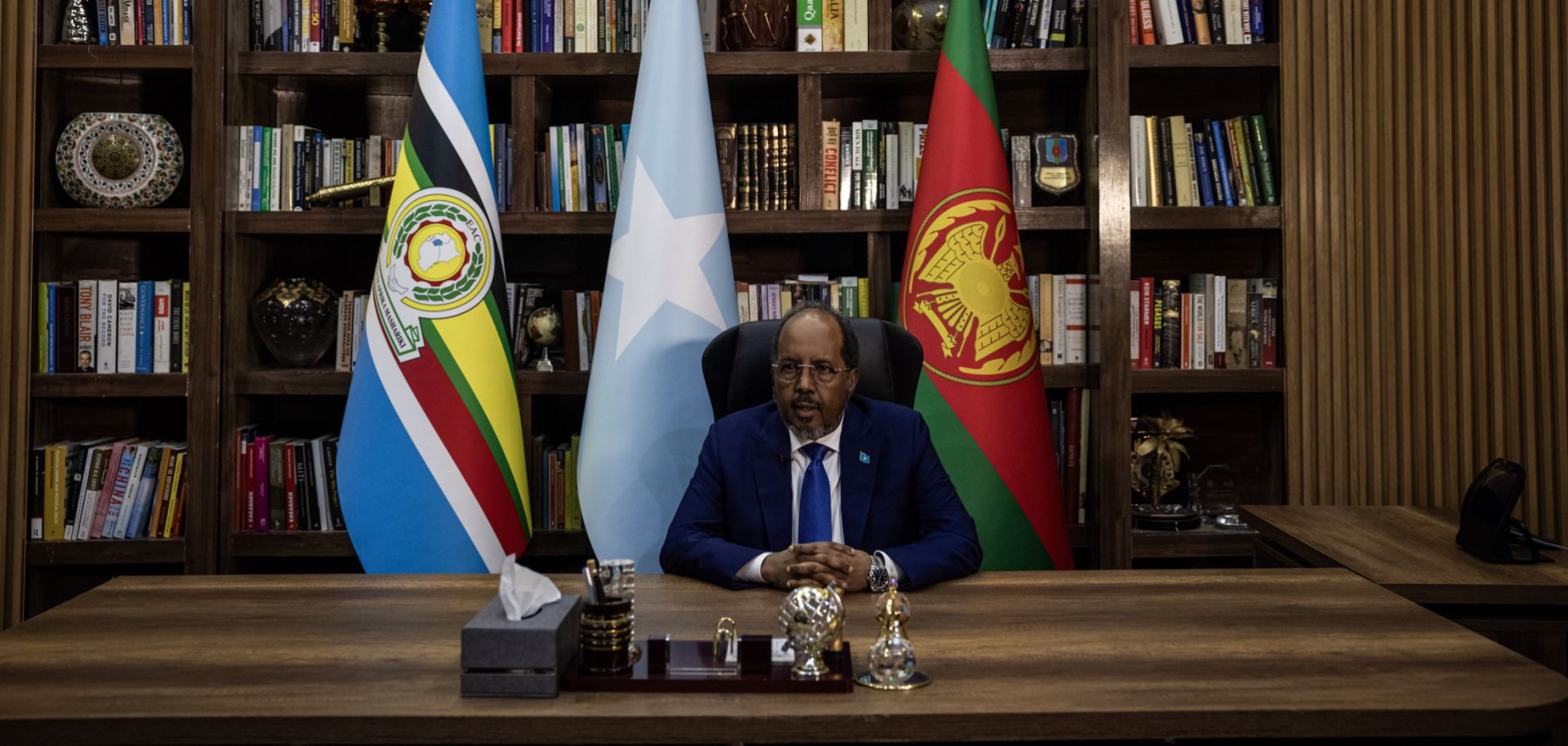
Somali President Hassan Sheikh Mohamud sits in his office as he speaks to journalists at Villa Somalia, the palace and principal workplace of the president, on April 22, 2025, in central Mogadishu, Somalia.
(Ed Ram/Getty Images)
Somali President Hassan Sheikh Mohamud sits in his office as he speaks to journalists at Villa Somalia, the palace and principal workplace of the president, on April 22, 2025, in central Mogadishu, Somalia.

Somalia will likely face a constitutional crisis due to disagreements surrounding the length of President Hassan Sheikh Mohamud's term, which will increase the likelihood of Mogadishu launching a military intervention in Jubaland and likely create a new flashpoint for power competition in the broader Red Sea region. On April 14, Somalia's federal government informed foreign diplomats that the term of the country's parliament and President Mohamud had been extended by one year in line with recent constitutional reform. This came as former Somali presidents Sheikh Sharif Ahmed and Mohamed Abdullahi Farmaajo — both of whom are politically active — said on the same day that the term of Somalia's parliament had ended on April 14 and that Mohamud's term would end on May 15. Echoing this position was the opposition Somali Future Council coalition, or SFC, which regroups the state governments of Puntland and Jubaland. Despite this, Mohamud and his allies show little sign of backing down, with Somali Defense Minister Ahmed Moalim Fiqqi warning that the federal government could use force against federal states challenging its authority. Meanwhile, Mohamud met with Turkish President Recep Tayyip Erdogan on April 16, during which both leaders pledged to reinforce bilateral ties. 

  • Mohamud previously served as president between 2012 and 2017 but failed to secure reelection against Farmaajo, who was in office from 2017 to 2022. However, Mohamud was reelected in 2022 after defeating Farmaajo.

The constitutional amendments, which transition Somalia's voting system to universal suffrage and extend presidential terms by one year, have sparked major pushback from the opposition and fit within a broader push by successive administrations to consolidate the federal government's authority over the country. Somalia's federal government has been operating under a provisional constitution since its refoundation in 2012, with key provisions including a federal and parliamentary form of government with a politically influential prime minister. This setting has witnessed constant political scheming over the past decade, with periodic bouts of severe instability. In 2021, Farmajo pushed through a two-year extension of his term, which was due to end that year, under the guise of transitioning the country's electoral system from clan-based voting to a one-person, one-vote system. Farmajo ultimately backtracked amid international pressure and clashes between clan-based factions in Mogadishu, after which he lost the 2022 presidential election to Mohamud. Once in office, Mohamud advanced plans to finalize Somalia's constitution in line with campaign pledges, including proposals to transition Somalia's electoral system to universal suffrage. As in 2021, this triggered significant backlash, with Puntland and later Jubaland opposing these plans amid concerns that Mohamud was seeking to centralize power and weaken federal states by reducing the relative influence of regional elites in electing the president. Despite this opposition, Somalia's parliament adopted the constitutional changes on March 5, which also extended the terms of lawmakers and the president from four to five years. However, the SFC and leading opposition figures have rejected these changes, arguing that the federal government failed to adequately consult with stakeholders nationwide, and tensions between the two have been further inflamed by Mohamud's supporters. The change in term durations take effect immediately. Amid mounting backlash, South West state President Abdiaziz Hassan Mohamed Laftagareen began tilting closer to the SFC in mid-March. While this drove divisions within Mohamud's ruling Justice and Solidarity party, or JSP, the federal government swiftly reasserted its authority by dispatching forces that quickly took over Baidoa on March 30, effectively forcing Laftagareen out of office. 

  • Puntland announced that it no longer recognized the sitting federal government in March 2024 due to the dispute surrounding constitutional changes. Jubaland withdrew from consultations with the federal government in October 2024 and held indirect state elections the following month, in which Jubaland President Ahmed Madobe was reelected, but the election was not recognized by the federal government. Jubaland thereafter suspended cooperation with the federal government. Jubaland and Puntland, along with other opposition parties, formed the SFC in October 2025. 

Mohamud's apparent decision to remain in office beyond May 15 increases the likelihood of opposition forces establishing a parallel administration and of a military intervention by the federal government in Jubaland. Despite the potential for fresh talks with the opposition in the coming weeks, Mohamud currently stands unlikely to reverse the one-year extension of his term as he stands emboldened following his toppling of Laftagareen in South West state. Against this backdrop, the opposition coalition is slated to hold a "national salvation" conference in the coming weeks, during which it could announce plans to set up a parallel administration once Mohamud's term purportedly ends on May 15. Even if the SFC does not establish a parallel administration, Jubaland and Puntland will likely stop recognizing Mohamud as Somalia's legitimate president after May 15, exacerbating political tensions and straining the country's federal model of government. In response, Mohamud would likely seek to assert federal authority by coercing both states. This is especially likely in Jubaland, which has somewhat less-structured forces than Puntland and where pro-Mogadishu groups already control some areas. If Jubaland maintains its opposition to Mohamud's term extension, the federal government would likely deploy additional troops near the region and leverage local allies to pressure Jubaland President Ahmed Madobe into striking a deal. This could prompt Jubaland's government to reach a compromise with Mohamud, but the absence of such an agreement would increase the likelihood of a full-scale federal intervention in Jubaland to remove Madobe. 

  • Pro-Mogadishu forces control parts of Jubaland's northern Gedo region, where violent clashes occurred with Madobe loyalists in July 2025. Mohamud's government threatened to establish a parallel Jubaland government in Gedo in October 2025. 

A constitutional crisis in Somalia would likely create a new flashpoint for tensions between Middle Eastern powers looking to project influence in the Red Sea region, especially if the United Arab Emirates backs a parallel opposition administration. Mohamud's rupture of ties with the United Arab Emirates in January suggests that Abu Dhabi may tacitly back the SFC or other opposition leaders in forming a parallel administration through financial and/or logistical support. This is especially probable given that Mohamud's efforts to exert influence over Puntland and Jubaland — regions with which the Emirati government maintains close economic and security ties — could undermine Abu Dhabi's interests in the Horn of Africa. However, the potential and scope for Emirati support will likely be constrained so long as heightened tensions with Iran persist over freedom of navigation through the Strait of Hormuz. Even if the SFC does not immediately form a parallel administration, perhaps due to Abu Dhabi's pressure on the coalition to postpone such a move until after a deescalation of the Iran war, the deepening of Somalia's constitutional crisis would create a new flashpoint for tension between Red Sea powers due to escalating tensions between the SFC and Mohamud, which are tied to rival regional alignments. In turn, the likelihood of involvement by outside powers will gradually increase in the absence of a political settlement, and even limited Emirati support for this parallel administration would likely strain Abu Dhabi's ties with Turkey and Saudi Arabia — both of whom have close ties to Mohamud.

  • On Jan. 12, Somalia's federal government announced that it had canceled all port, security and commercial agreements with the United Arab Emirates. This came after reports that the United Arab Emirates had exfiltrated the leader of Yemen's Southern Transition Council to the breakaway region of Somaliland. 

Mohamud's launch of a military intervention in Jubaland would likely succeed in asserting federal authority in the absence of external intervention, but Kenya and Ethiopia's potential attempt to shield Madobe could prompt Mogadishu to pause the operation and lead to clashes with Ethiopian and/or Kenyan peacekeepers. The lifting of the United Nations' arms embargo on Somalia in 2023 has enabled the federal government to meaningfully strengthen its defense capabilities in recent years. This, combined with the relative weakness of Jubaland's forces and the federal government's ability to co-opt local commanders, suggests that a federal military intervention to assert authority over the state would likely succeed in the absence of external intervention. However, such an operation would divert resources from counterterrorism efforts against al Qaeda affiliate al-Shabaab, potentially enabling the jihadists to expand their hold in southern Somalia's rural areas. This would also deepen Kenya and Ethiopia's mistrust of the federal Somali government, especially if it tries to forcefully remove Madobe from power, as both countries maintain close counterterrorism cooperation with his administration. The Ethiopian and Kenyan governments' deployment of peacekeepers in Jubaland also means that either or both may attempt to shield Madobe from a federal intervention, for example, by positioning their troops as a blocking force. While this could prompt Mohamud to halt plans to forcibly remove Madobe from office, it may alternatively result in pro-Mogadishu forces clashing with Ethiopian and/or Kenyan troops in a less likely but higher-impact scenario. Nonetheless, Ethiopia will be constrained from taking such a proactive stance, as this could prompt Mogadishu to tilt more forcefully toward Egypt, its regional rival. Kenya will also face constraints, as the government grapples with surging socioeconomic grievances from the Kenyan public stemming from the Iran war. Moreover, any clashes are unlikely to escalate into a broader inter-state military confrontation because all three parties are constrained by domestic imperatives and want to avoid creating a major opening for al-Shabaab to consolidate its position. 

  • Kenya has deployed about 1,400 troops to Somalia as part of the African Union's latest peacekeeping mission. Ethiopia has 2,500 peacekeepers deployed in Somalia as part of the African Union mission, along with several thousand more under bilateral agreements. 
  • Ethiopian security forces clashed with pro-Mogadishu forces in July 2025 when the latter sought to expand their hold in the Gedo region at Madobe's expense. 
RANE
SUBSCRIBERS ONLY

Expert analysis when it matters most.

Get access to RANE's decision-grade geopolitical intelligence.