
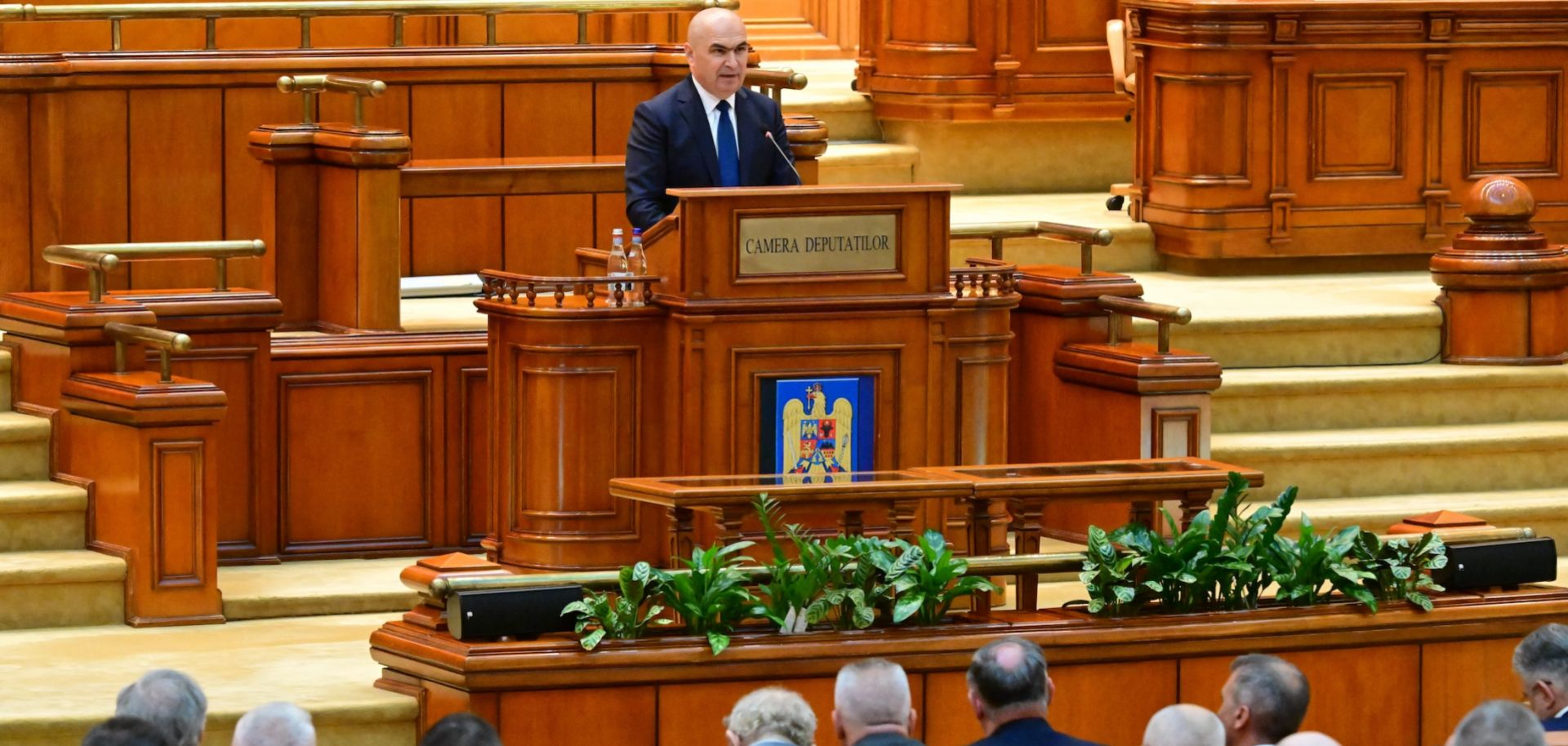
Romania's latest government crisis will likely weaken fiscal consolidation, prolong political instability and create favorable conditions for a surge in far-right and eurosceptic forces, potentially reversing Bucharest's EU alignment and harming its economic credibility. On April 21, Romanian Prime Minister Ilie Bolojan of the center-right National Liberal Party (PNL) announced that he would remain in office despite the formal withdrawal of support by the center-left Social Democratic Party (PSD), which had been the largest partner in the governing coalition. Bolojan denounced the PSD's decision as "completely wrong and irresponsible," warning that it risked triggering institutional paralysis at a time of heightened fiscal and political fragility. The PSD's move followed an internal party vote and included a commitment to withdraw its ministers from government, effectively depriving the coalition of its parliamentary majority and, in practice, transforming the executive into a minority administration. On April 21, Romanian President Nicusor Dan summoned the leaders of the country's main political parties for consultations on how to solve the crisis; the meetings will start on April 22.

- Romania's December 2024 general election resulted in a fragmented parliament, with no party gaining enough seats to govern alone. Against the backdrop of rising anti-establishment sentiment (the pro-Russian, far-right candidate Calin Georgescu had performed strongly in the November 2024 presidential election, and the far-right Alliance for the Union of Romanians had ended in the second position in the general election), the PSD, the PNL and the Democratic Union of Hungarians in Romania (UDMR/RMDSZ) formed a coalition with the goal of protecting "Romania's European and Euro-Atlantic values." From the start, this broad coalition was marked by internal distrust and ideological divergence.
- Adding to Romania's political turbulence, the country's Constitutional Court annulled the 2024 presidential election, citing alleged Russian meddling in favor of Georgescu. This intervention further undermined already weak public trust in Romania's democratic institutions and intensified the anti-establishment grievances that continue to drive the current surge in far-right polling. Following the annulment, a new presidential election was held in May of 2025, which saw the independent pro-European candidate Nicusor Dan defeat the Alliance for the Union of Romanians leader George Simion in a second-round runoff.
The immediate cause of the rupture between the PNL and the PSD was disagreement over fiscal consolidation measures aimed at addressing Romania's deteriorating public finances. The country's budget deficit reached approximately 7.6% of GDP in 2025, lower than the 8.6% registered in 2024 but still among the worst performers in the European Union and well above the 3% threshold required under EU fiscal rules. As a result, the European Commission is threatening to withhold EU structural and cohesion funds for Romania. The PNL had pushed for a package of corrective measures — including expenditure restraint, limits on public sector wage growth, tax base expansion and efficiency reforms in public administration — to put Romania back on a sustainable fiscal path and avoid penalties under the European Union's Excessive Deficit Procedure. However, these measures proved politically costly, particularly for the PSD, which has historically relied on strong support from public sector workers and lower-income constituencies most affected by austerity-style policies. Facing declining approval ratings and intensified competition from nationalist and far-right parties, the PSD leadership recalibrated its position, concluding that continued association with unpopular fiscal tightening would accelerate electoral erosion. This shift occurred against a broader backdrop of rising borrowing costs, increased scrutiny from credit rating agencies and growing concerns over Romania's medium-term debt trajectory, all of which heightened the urgency of fiscal adjustment while simultaneously reducing its political feasibility.
- Since 2020, Romania's fiscal position has deteriorated, with the budget deficit widening from pandemic-era highs and remaining persistently elevated in the post-COVID period. The deficit peaked at around 9% of GDP in 2020 due to emergency spending during the pandemic, then narrowed slightly in 2021–2023, before widening again to roughly 8.6 of GDP in 2024 amid rising public expenditure and electoral-driven fiscal loosening. Over the same period, public debt has risen from just under 50% of GDP in 2020 to around 59% by the end of 2025, reflecting sustained primary deficits and higher borrowing needs.
- In recent months, credit rating agencies have repeatedly warned that Romania's fiscal position is deteriorating amid large and persistent deficits and rising political instability. Fitch and Moody's both maintain Romania at the lowest investment-grade level with a negative outlook, highlighting risks that delayed fiscal consolidation and coalition fragmentation could undermine debt stabilization efforts. The rating agencies caution that failure to implement credible deficit-reduction measures could lead to a downgrade, which would increase borrowing costs and tighten external financing conditions.
Romania's current political crisis leaves a limited set of unstable governance pathways, all of which carry significant risks for political cohesion, fiscal consolidation and EU-level policymaking. Looking ahead, Romania faces a narrow and politically constrained set of scenarios, each carrying significant risks for governance and economic stability. One possibility is that Bolojan attempts to govern as a minority prime minister, relying on issue-by-issue support from opposition or dissident lawmakers. However, such an arrangement would likely be unstable, highly reactive and vulnerable to collapse through a no-confidence vote or legislative gridlock. A second scenario would involve renewed negotiations between the PNL and PSD, potentially resulting in a reconfigured coalition, but only if one side is willing to make concessions on fiscal policy (such as softening deficit reduction targets) or leadership arrangements (such as replacing the prime minister with a different political figure or even a technocrat who would lower the political costs of austerity). The main driver for both of these scenarios would be mainstream parties' reluctance to trigger a snap general election where anti-establishment forces are expected to perform strongly. A third scenario is an early general election, particularly if governance becomes unmanageable. In such a case, current polling trends suggest that anti-establishment, eurosceptic and far-right parties could significantly increase their representation. The entry of the nationalist and far-right bloc into government would risk shifting Romania's foreign policy agenda away from pro-EU and -NATO alignment toward more sovereigntist positions, increasing friction with EU institutions and further complicating the bloc's policies on issues ranging from Russia to Ukraine. This could also heighten policy uncertainty for investors and weaken support for austerity or reform measures, further complicating efforts to stabilize the deficit and maintain access to EU funding streams. Regardless, all three of these scenarios portend a period of prolonged instability that would directly threaten Romania's ability to implement the fiscal consolidation required to maintain access to conditional EU funding under the NextGenerationEU framework. Delays or failure in meeting reform benchmarks would not only weaken investor confidence and raise sovereign borrowing costs, but could also create a reinforcing cycle in which political fragmentation undermines fiscal credibility, which in turn further constrains policy options and deepens instability.
- According to an opinion poll conducted by the Political Rating Agency (ARP) between April 1 and 10, if there were a general election, the Alliance for the Union of Romanians would finish in first place with 35.8% of the vote, up from 18% in the 2024 general election. An opinion poll conducted by Inscop Research between April 1 and 7 also found that the Alliance for the Union of Romanians would win the election, with 37% of the vote. The same polls have the PSD securing between 17% and 20% of the vote, and the PNL securing between 14% and 15%.
- The Romanian right-wing landscape is currently fractured into several distinct camps regarding international alliances. The Alliance for the Union of Romanians advocates for a "Europe of Nations," in which Romania remains an EU member but aggressively asserts its sovereignty against Brussels' centralism, while maintaining NATO membership as a necessary security shield. In contrast, Georgescu and his supporters lean toward a "neutrality" model that frames the European Union and NATO as burdens on Romanian independence and suggests a pivot toward non-alignment. Finally, the small S.O.S. Romania party (which is polling between 3-6%) wants to exit both the European Union and NATO, and favors a geopolitical shift toward the East.