
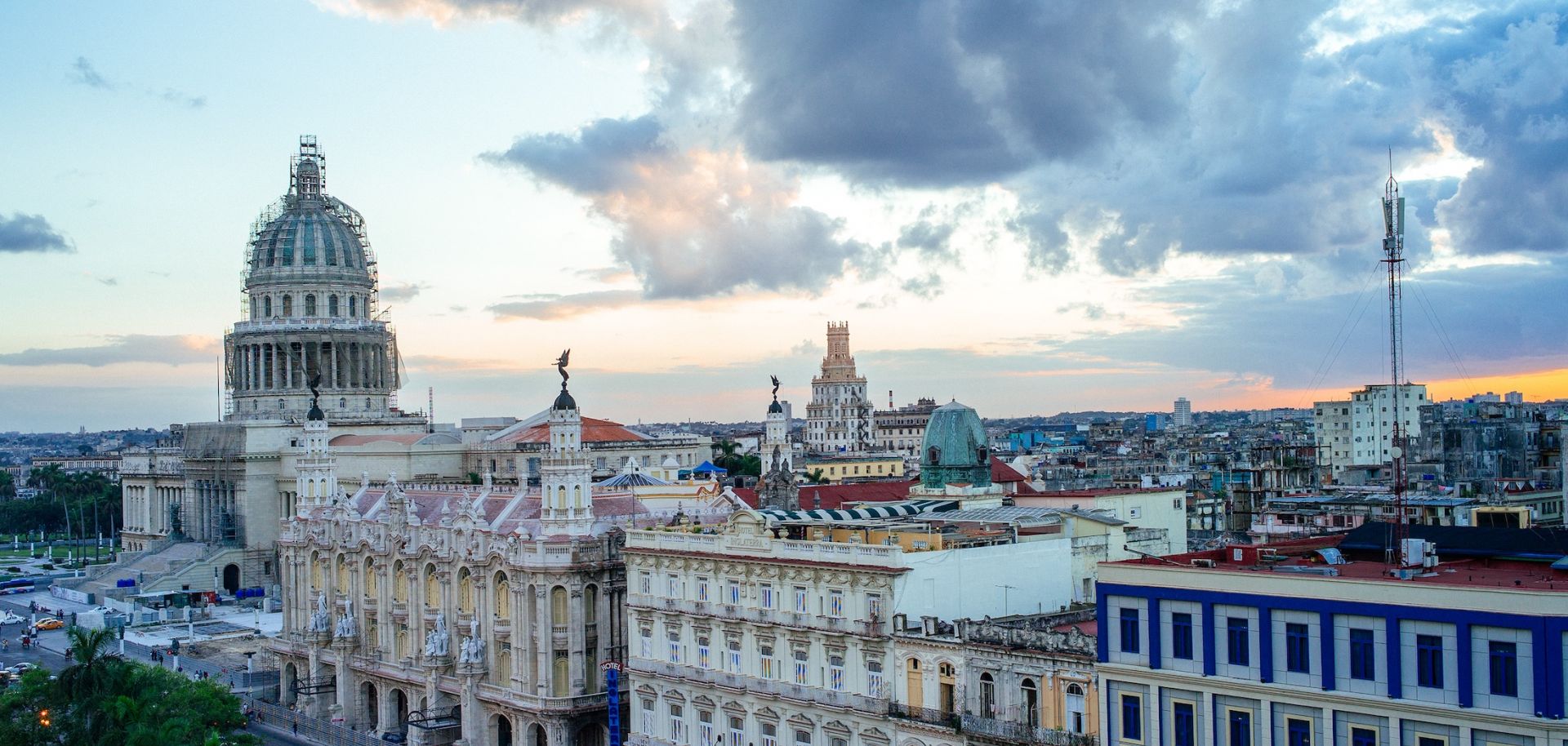
A general view of El Capitolio and the Havana skyline on December 16, 2014, in Havana, Cuba.
(Ben Pruchnie/Getty Images)
A general view of El Capitolio and the Havana skyline on December 16, 2014, in Havana, Cuba.

A recent unannounced U.S. diplomatic visit to Cuba suggests the potential for a near-term deal that reduces tensions, though a U.S. military and/or law enforcement operation remains possible as Washington sustains pressure on Havana amid ongoing divergences in negotiations. On April 17, Axios reported that U.S. State Department personnel traveled to Havana on April 10 for previously unannounced talks with central Cuban political figures, marking the first time a U.S. government plane landed in Cuba since 2016. During the talks, U.S. officials reportedly said that the White House was open to a diplomatic solution to ease bilateral tensions, but warned it would not tolerate resistance to its demands. According to Axios and other media outlets, those demands include compensating U.S. residents and corporations whose assets were confiscated after the 1959 Revolution, releasing political prisoners and granting the Cuban population greater political freedoms. USA Today also reported on April 20, citing an unnamed source familiar with the discussion, that U.S. officials gave the Cuban government a two-week deadline to release high-profile political prisoners as a good-faith gesture for negotiations, though the report did not specify what would happen should the deadline not be met. U.S. officials apparently raised concerns about the presence of "foreign intelligence, military, and terror groups" within Cuba as well.

  • The Cuban government issued a statement on April 20 confirming that it met with U.S. officials earlier in April, with the deputy director general in charge of U.S. affairs at the Cuban Ministry of Foreign Affairs, Alejandro Garcia del Toro, confirming that the U.S. delegation included assistant secretaries of state, and the Cuban delegation included deputy foreign ministers. Additionally, both Axios and USA Today reported that Raul Guillermo Rodriguez Castro (nicknamed "Raulito"), the grandson of former Cuban President Raul Castro (2006-2018), participated in at least one meeting. Prior reporting on U.S.-Cuba negotiations had also named Raulito as a main point of contact. 
  • This is the first time that compensation for property nationalized during the 1959 Cuban Revolution was officially reported as a key part of recent formal U.S.-Cuba discussions. The issue is a long-standing grievance among the Cuban diaspora in the United States and corporations that were operating in the country prior to the rise of Fidel Castro's regime. Nationalized assets include agricultural land and facilities, oil refineries, mines and financial institutions.

The visit comes as the United States has been ramping up pressure on Cuba, including through a fuel blockade and repeated threats of military action, despite ongoing talks and minor Cuban concessions. The United States, under President Donald Trump, has blocked almost all fuel tankers from entering Cuba since February 2026, which has led to severe shortages, widespread power outages and depleted food supplies across the island. The blockade is intended to pressure Cuba into accepting U.S. demands on economic liberalization and political freedoms as part of the White House's broader campaign to expand U.S. influence across the Western Hemisphere; this campaign has also included the Jan. 3 U.S. operation in Venezuela to arrest then-President Nicolas Maduro, repeated strikes on alleged drug trafficking vessels in the Caribbean Sea and eastern Pacific Ocean, and threats of U.S. strikes against criminal groups on land in Colombia, Mexico and elsewhere. Moreover, the focus on Cuba specifically aligns with long-standing U.S. right-wing opposition to left-wing authoritarian governments in the region, including Maduro's in Venezuela. U.S.-Cuba negotiations to lift the blockade remain ongoing, with U.S. Secretary of State Marco Rubio — himself the son of Cuban immigrants known for his hard-line stance toward the regime in Havana — driving the talks. Cuba has already acquiesced to some U.S. demands, announcing new regulations in March to allow expatriates to own businesses in Cuba and releasing 2,000 prisoners in April. However, these have done little to appease the White House, with Trump himself repeatedly making comments that Cuba is "next" for a military operation and, as recently as April 17, warned there would be a "new dawn" for the country. Such comments have been made even as the United States remains engulfed in a major conflict with Iran, underscoring the Trump administration's continued high focus on Cuba. 

  • Venezuela and, to a lesser extent, Mexico previously supplied Cuba with fuel, but both have stopped amid U.S. pressure. On March 30, the United States allowed a Russian tanker to dock in Cuba, delivering 100,000 tons of crude oil, in the first shipment of fuel to the island in over a month. Regarding the shipment, Trump said, "If ​a country wants to ​send some oil ⁠into Cuba right now, I have no problem with that, whether it's Russia or not." 
  • USA Today reported on April 16 that the Pentagon was planning a possible military operation in Cuba, though the Pentagon said that it regularly plans for a range of contingencies in the event that the president orders an operation. 

The White House's pressure campaign is more likely than not to eventually yield a deal, as Cuban leaders prioritize regime survival and seek to avoid U.S. kinetic operations. The coming weeks will be critical for the outlook of U.S.-Cuba negotiations. Washington's two-week deadline for Havana to release political prisoners ends on April 24. If the Middle East crisis de-escalates under the fragile U.S.-Iran ceasefire, it could also give the Trump administration more bandwidth to refocus on issues in Latin America. Cuban leaders have so far resisted more significant U.S. demands that would threaten their control of the regime and financial assets. However, they will likely calculate that acquiescing to some U.S. demands is still preferable to facing potential U.S. military or law enforcement action that could lead to their arrest or assassination (similar to operations against Maduro) — especially if leaders in Havana believe they can slow-walk implementation without incurring U.S. use of force. This means that a deal remains more likely than not, with the potential for negotiations to make significant progress in the next month. Such a deal would provide economic opportunities for U.S. companies, most immediately through the opening of the island's tourism sector and, in the longer term, the potential for broader investment in the island. However, Cuba has comparatively few valuable natural resources in comparison to Venezuela, meaning that the main benefit for the Trump administration would likely be securing a domestic political win for the Cuban diaspora in South Florida, a key support base, ahead of U.S. midterm elections in November, in which the White House is increasingly concerned about blowback from the Iran war. 

Still, a U.S. military and/or law enforcement operation against the country remains possible amid significant differences in negotiating positions and potential political calculations in the White House. Despite the seeming desire for a diplomatic solution on both sides, there remain significant sticking points that could prevent a deal and lead to U.S. kinetic action against Cuba. First, though Cuban authorities may be willing to release some political prisoners, the government will likely view others as too dangerous to the regime. Second, the demand for compensation for properties nationalized during the revolution may prove infeasible, as estimated claims certified by the U.S. government range between $9 billion and $10 billion, according to the Assembly of the Cuban Resistance, an anti-Cuban government group operating both within and outside the country. This is a scale of funds the Cuban government cannot easily pay, particularly amid worsened economic conditions, and the severe debt to the United States necessary to pay it would also be prohibitive. Third, U.S. demands for specific Cuban political leaders to leave office, not least President Miguel Diaz-Canel, may hinder a deal, even if some members of the regime are willing to step down or push others to do so. Finally, political calculus may lead the Trump administration to seek to unite its supporters, who are split over the Iran war, by pursuing a comparatively "easy" military win in Cuba, betting that the island's weakened state and geographic proximity would aid any U.S. operations. This option may be particularly attractive since the South Florida Cuban diaspora broadly supports military action against the island. Still, such an operation would risk creating political chaos and worsening already poor humanitarian conditions in Cuba, a development that could trigger a surge in migration from the island, with Florida bearing the brunt of migrant flows. 

  • A Miami Herald poll published on April 16 found that 79% of Cubans and Cuban Americans in South Florida support some form of U.S. military intervention in Cuba, with 74% saying they support military intervention to remove the Cuban government. 
  • Unlike in the operation to capture Maduro, in which the U.S. military built up its presence near Venezuela over many months, kinetic action against Cuba could likely be achieved solely with military assets based in the United States, meaning it could come about much more suddenly. The Justice Department is also reportedly weighing criminal investigations against Cuban leaders, a development that would likely precede any U.S. operation on the island to provide a law enforcement justification, similar to the indictment against Maduro.
  • U.S. kinetic operations against Cuba could take a range of forms, including a quick incursion, like that in Venezuela in January, to capture top leaders, such as Diaz-Canel; a larger air campaign targeting key military and government sites; or a full ground invasion to formally take control of Cuba and forcibly install a governing body friendlier to the United States.
RANE
SUBSCRIBERS ONLY

Expert analysis when it matters most.

Get access to RANE's decision-grade geopolitical intelligence.