
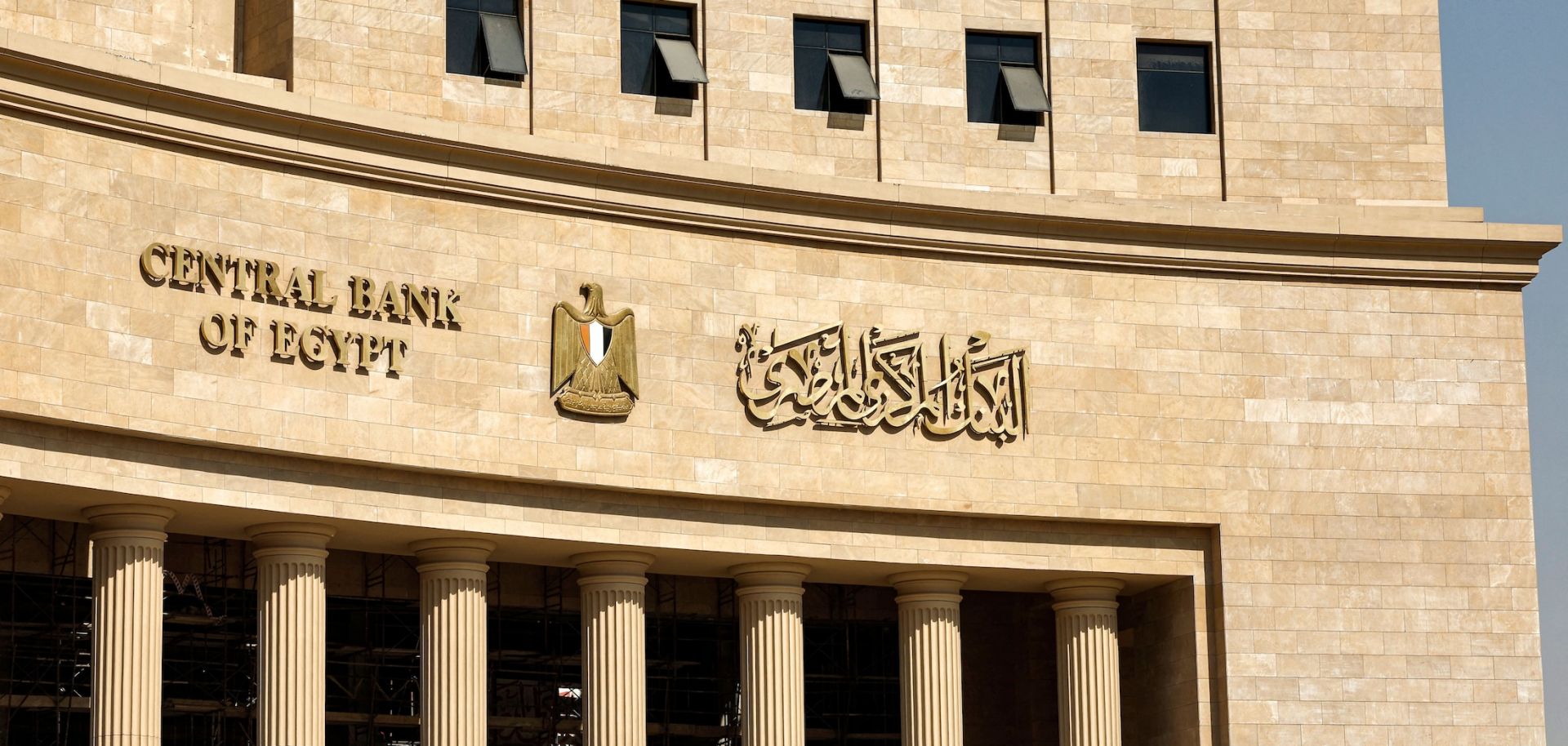
The exterior facade of the new headquarters of Egypt's central bank is seen at the New Administrative Capital megaproject about 45 kilometers east of the current capital, Cairo, on Aug. 1, 2023.
(KHALED DESOUKI/AFP via Getty Images)
The exterior facade of the new headquarters of Egypt's central bank is seen at the New Administrative Capital megaproject about 45 kilometers east of the current capital, Cairo, on Aug. 1, 2023.

Egypt will likely try to avoid submitting to another International Monetary Fund loan program, but increasing economic strain may eventually necessitate one, which would likely lead to domestically unpopular austerity measures and privatization efforts. Egyptian news outlet Al Manassa reported on April 9 that Egypt is considering seeking a $1.5 billion-$3 billion emergency loan program from the International Monetary Fund due to the economic impact of the Iran war. The media report, which cited unnamed Cabinet and finance ministry officials, came days after Egyptian President Abdel Fattah al-Sisi met with Prime Minister Mustafa Madbouly and Central Bank of Egypt Gov. Hassan Abdalla on April 6 to discuss Egypt's economy. During the meeting, Abdalla said Cairo had sufficient foreign exchange reserves to cover Egypt's import bill for at least four months, accounting for cost increases due to the global economic shock and shipping disruptions linked to the Iran war.

  • In December 2022, Egypt and the IMF reached an agreement on a $3 billion Extended Fund Facility program to address Egypt's balance of payments crisis, which had worsened due to reduced foreign investment and an increased import bill after the Russian invasion of Ukraine earlier that year. The IMF later expanded the loan in 2024 to $8 billion due to the economic spillover effects from the Israel-Hamas war. Egypt's seventh IMF review is expected in mid-June, and the eighth is scheduled for November. 
  • On April 9, IMF Managing Director Kristalina Georgieva said near-term demand for IMF financial support was expected to increase by between $20 billion and $50 billion due to the economic shock from the Iran war, though she did not specify which countries are likely to request support. On April 16, Georgieva said Egypt was in a "better position" to face external shocks and that there were no current discussions to expand Egypt's loan program. 

Despite Egypt's macroeconomic improvements over the past few years, the spillover effects of the Iran war have strained Egypt's economy, leading to capital flight, surging inflation and government-imposed measures to conserve energy. Prior to the start of the Iran war, Egypt's macroeconomic improvements, including rising foreign exchange reserves, repayments of outstanding international oil and gas arrears and increased foreign investment, signaled that the country would not need to seek another IMF loan after its current $8 billion program ends in December. However, the war's spillover effects have since strained Egypt's economy. According to an April report by Moody's Ratings, a financial credit rating agency, foreign investors have withdrawn around $8 billion from Egypt since the start of the Iran conflict in late February due to wider regional uncertainty, while the Egyptian pound has depreciated by around 10%. Furthermore, the conflict disrupted Egypt's key sources of energy imports — natural gas from Israel, liquefied natural gas (LNG) from Qatar and crude oil from Kuwait — forcing Egypt to seek alternative energy supplies. Even so, Egypt's acquisition of alternatives has come amid elevated global energy prices due to Iran's closure of the Strait of Hormuz, through which around 20% of global oil and LNG exports pass. In order to mitigate the effects of the energy shock and subsequent hikes to the import bill, Egypt imposed business curfews at 9 p.m., dimmed street lights, encouraged remote work to conserve fuel and, controversially, increased fuel prices in March by up to 17%. Taken together, the depreciated Egyptian pound, increased import bill and fuel price hike have led the annualized inflation rate to reach 15.2% in March, a jump from 13.4% in February, according to Egypt's Central Agency for Public Mobilization and Statistics. The economic impacts have pushed the IMF to revise its forecast for Egypt's 2026 GDP growth to 4.2%, down from 4.7% in January.

  • The March fuel price increase came despite the Egyptian government's promise to freeze fuel prices for one year after implementing a 10%-13% hike in October 2025, aligning with IMF fiscal consolidation recommendations. Madbouly justified the March price hike by citing "exceptional circumstances" and said the decision could be revisited when the Iran conflict de-escalated. 
  • Due to security risks, Israel's energy minister ordered Israel's Leviathan gas field to suspend operations early in the Iran conflict, cutting Israel's gas exports to Egypt. However, Israeli gas exports to Egypt have since resumed and reached prewar levels. Israel supplies around 20% of Egypt's total gas consumption. 
  • In January, Egypt signed a contract to import up to 24 LNG cargoes from Qatar, especially to meet its growing summer demand, but Iranian attacks have since forced QatarEnergy to declare force majeure. Meanwhile, Egypt has historically imported 1 million-2 million barrels of crude oil per month from Kuwait, but disruptions have forced Cairo to pivot to Libya after signing a deal in late March to import just over 1 million barrels per month. 
  • On April 9, Madbouly announced that Egypt was relaxing some energy-saving measures, including moving the business curfew from 11 p.m. to 9 p.m. through April 27. Madbouly said the relaxed measures were the result of lower global fuel prices that followed the announcement of the two-week U.S.-Iran ceasefire. 

Egypt will likely try to resist entering another IMF loan program to avoid implementing additional unpopular austerity requirements, but protracted economic strains from the war will increase pressure on Cairo to reach an agreement on an emergency loan. Egypt's increased foreign currency reserves and flexible exchange rate have better positioned the country to absorb economic shocks linked to the Iran war than those that followed the 2022 Russian invasion of Ukraine. However, a protracted conflict and long-term disruptions to Gulf supply chains through the Strait of Hormuz would likely impose significant economic strain on Egypt over the next several months due to rising import costs. Any new disruptions to Israeli natural gas exports to Egypt would only add to Egypt's challenges and likely force Cairo to seek additional LNG cargoes at elevated prices ahead of increased summertime electricity demands, especially since Qatari LNG exports to Egypt will resume no earlier than the third quarter of 2026, after peak demand. High prices may compel Cairo to implement politically unpopular energy-saving measures, such as extending the business curfew and imposing power cuts, though the government would prioritize power supplies to urban areas and tourist destinations. Egypt will likely adopt additional unpopular measures, such as further raising fuel and electricity costs or increasing the prices of services like public transportation. To avoid another IMF loan program, which would require Egypt to make domestically unpopular reforms, Egypt will likely also look to Gulf Arab countries for support. However, the Gulf's own economic pressures related to the Iran war and the trend of decreasing Gulf foreign investment will likely limit their willingness and ability to provide sufficient economic support to fully meet Egypt's needs. As a result, mounting economic strain could eventually force Egypt to reach an emergency agreement with the IMF to provide more economic flexibility. If Cairo secures a new loan program, the IMF would likely intensify demands for further fiscal consolidation, including deeper subsidy cuts. However, such austerity measures would risk drawing public backlash by raising the cost of living. Furthermore, the IMF would likely push for additional divestment from state-owned enterprises, a process that Egypt has slow-walked in recent months. But even if Cairo accelerates these privatization efforts — despite likely resistance from Egypt's military, which controls many state-owned firms — success may initially be limited due to decreased foreign investment interest resulting from the Iran conflict. 

  • In recent reviews, the IMF has pressured Egypt to further privatize state-owned enterprises. In response, Cairo is expected to release a revised state ownership policy in May to encourage private sector engagement. Companies set for divestment are expected to be merged with others in the same sector to make foreign investment more appealing. 
  • Egypt's current account deficit decreased by 13.6% to $9.5 billion from July 2025 to December 2025. According to the central bank, the country's foreign currency reserves also remained stable at approximately $52.8 billion between February 2026 and March 2026, despite the start of the Iran conflict on Feb. 28. However, elevated import prices stemming from the Iran war will likely gradually widen Egypt's current account deficit and deplete its currency reserves. Furthermore, Egypt has substantial debt servicing obligations, totaling about $30 billion (including outstanding oil and gas arrears), which account for over half of its foreign exchange reserves.
  • Senior Egyptian officials have attributed recent price hikes and austerity measures to external circumstances related to the Iran war, suggesting they may be reviewed once the conflict de-escalates. Nevertheless, if the government imposes further price hikes on energy and services, the subsequent worsening of economic and living conditions would raise the risk of domestic unrest. However, Egyptian authorities would likely quickly crack down on any protests, preventing them from escalating into a mass movement.
RANE
SUBSCRIBERS ONLY

Expert analysis when it matters most.

Get access to RANE's decision-grade geopolitical intelligence.