
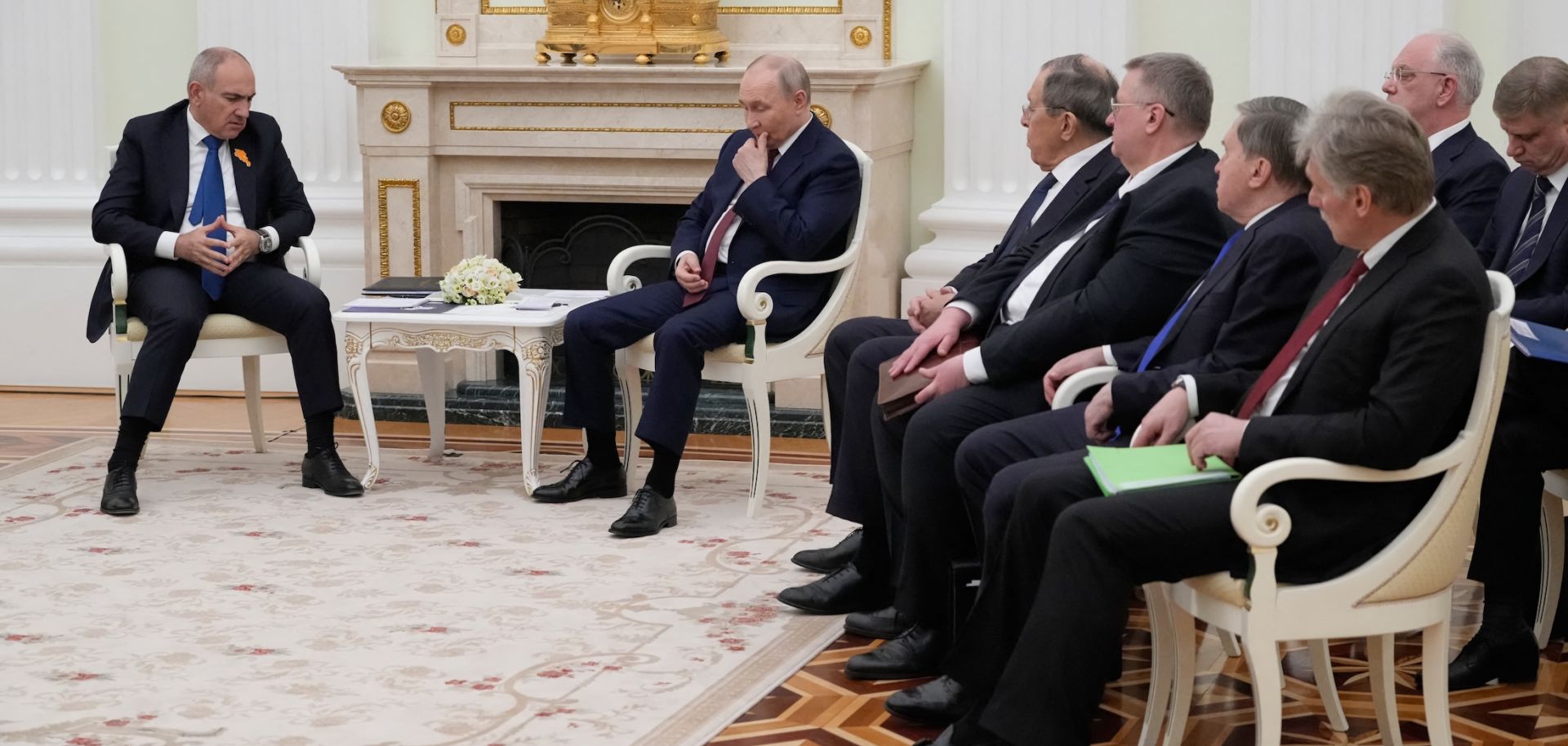
Russian President Vladimir Putin (center) and Armenian Prime Minister Nikol Pashinyan (left) hold talks at the Kremlin in Moscow on April 1, 2026.
(Pavel Bednyakov / POOL / AFP via Getty Images)
Russian President Vladimir Putin (center) and Armenian Prime Minister Nikol Pashinyan (left) hold talks at the Kremlin in Moscow on April 1, 2026.

Russia will seek to calibrate pressure on Armenia to block its pro-EU course while trying to avoid blowback that pushes Yerevan further away from Moscow, as prolonged instability in the Middle East will limit near-term progress on regional trade corridors backed by Armenia. Russian President Vladimir Putin and Armenian Prime Minister Nikol Pashinyan met in Moscow on April 1, during which both leaders openly aired their core disagreements in unusually direct terms. In public comments, Putin warned that Armenia could not be a member of both the Russia-led Eurasian Economic Union, or EAEU, and the European Union. He also pointed to the lower gas prices Russia charges Armenia compared with prices in Europe, suggesting that Armenia could lose access to discounted Russian gas if it moves closer to the European Union. Speaking about Armenia's upcoming June 7 parliamentary elections, Putin said Moscow expected pro-Russian groups to be allowed to participate fully, including individuals now under detention and those holding Russian citizenship. Pashinyan, in turn, revived a lingering grievance in Armenia over why the Russia-led Collective Security Treaty Organization, or CSTO, failed to respond to Azerbaijani attacks on Armenia's internationally recognized territory in September 2022.

  • Since 2015, Armenia has been a member of the EAEU, which also includes Belarus, Kazakhstan and Kyrgyzstan. In 2025, Armenia's National Assembly adopted a law declaring the "start of a process of Armenia's accession to the European Union," although Yerevan has yet to submit a full EU membership application. 
  • Armenia is highly dependent on imported natural gas, mostly from Russia, and natural gas made up 72.7% of all energy imports in the country's 2024 official energy balance. Russia sells gas to Armenia at $177.5 per 1,000 cubic meters, while prices in Europe exceed $600 for the same amount.
  • Putin's comments about participation in upcoming Armenian elections likely referred to Samvel Karapetyan, a Russian-Armenian billionaire under house arrest in Armenia and facing criminal charges, including for alleged calls to seize power. Karapetyan owned Electric Networks of Armenia, the national power distribution company, which Armenian authorities nationalized after his arrest in 2025 following a dispute with Pashinyan over Karapetyan's backing of the country's Apostolic Church in an ongoing feud with the prime minister
  • A newly formed coalition of opposition parties called Strong Armenia With Samvel Karapetyan named Karapetyan as its prime ministerial candidate. However, under Armenia's Constitution, Karapetyan is ineligible to run for parliament or become prime minister because he holds Russian and Cypriot citizenship (in addition to Armenian). 

The confrontation came amid Yerevan's growing concern about Russian control of its rail infrastructure as it seeks to integrate into regional connectivity plans to support the peace agreement with Azerbaijan. Amid years of tense ties, the main purpose of Pashinyan's visit to Moscow appears to have been the thorny issue of Russian control over Armenia's railways, which Yerevan sees as critical infrastructure. Pashinyan has previously stated that Russian Railways' concession over Armenia's rail network is undermining the country's competitiveness by discouraging outside actors from routing traffic through Armenian territory. That concern has become more pressing as Armenia pursues transit opportunities stemming from the U.S.-backed Trump Route for International Peace and Prosperity corridor, or TRIPP, which connects Azerbaijan with its Naxcivan exclave, and related regional opening, such as the full opening of borders with Azerbaijan and Turkey; but generating benefits for Armenia would be harder if the rail system remains under the control of a Russian state company. Yerevan appears to have a plausible contractual basis to seek early termination of the concession if it can show that the Russian operator has failed to meet key obligations, including its investment commitments under the 2008 agreement. For now, Armenia has pushed a friendly buyout alternative under which Russian Railways would sell or transfer its concession rights to a third country, acceptable to both sides. Moscow has so far rejected that proposal, warning that the dispute could spill over into the wider bilateral economic relationship, and doubled down on its threats to use trade, nuclear energy, business access and other economic levers against Armenia. 

  • Since 2022, Pashinyan has steadily shifted Armenia away from Russia following Moscow's failure to respond to Azerbaijani incursions, freezing participation in the CSTO and pursuing a U.S.-mediated peace process with Azerbaijan. He has also accelerated Armenia's pro-European turn by formally committing to EU accession through legislation while deepening trade ties with Europe.
  • The 2008 concession agreement between Armenia and Russian Railways transferred management of the Armenian railway system to the South Caucasus Railway, a 100% subsidiary of Russian Railways, for a 30-year term (expiring in 2038), with a 10-year extension option.
  • In late 2025, Pashinyan asked Putin to push Russian Railways to invest in new infrastructure, including the restoration of the Yeraskh-Sadarak section linking Armenia to Naxcivan (1.6 kilometers, or 1 mile, long) and the reopening of the Gyumri-Kars line to Turkey (about 13 kilometers, or 8 miles, long). Armenia considers these two Soviet-era links important to any broader reopening of regional transit. Meanwhile, Russian Railways posted roughly $51 billion in debt in 2025. 

Russia will likely continue looking for ways to pressure Armenia without accelerating Yerevan's push for greater autonomy. The Kremlin is unlikely to surrender the railway concessions, as it would mean relinquishing its embedded role in Armenia's strategic infrastructure and in the connectivity architecture Yerevan is trying to build to reduce its dependence on Russia. Instead, Moscow will likely try to defend that position through other means. Moscow retains multiple levers to use against Yerevan, and its pressure on the Azerbaijani diaspora and business networks in Russia following a dispute with Baku in 2025 showed that it is prepared to use market access, law enforcement and administrative controls when relations deteriorate. The scope and timing of any Russian response will likely depend in part on what Armenia secures at the inaugural EU-Armenia summit in Yerevan on May 4-5, especially if Brussels offers concrete support on connectivity, energy or broader political ties ahead of June elections. Generally, the more firmly the European Union backs Armenia's pro-European course, the more likely the Kremlin will conclude that it needs to act. In the near term, the most effective measures would likely be trade and customs restrictions, which would quickly hit Armenian exporters while still allowing the Kremlin to calibrate the damage without the visibility of a formal rupture. Russia could also raise the price of its gas exports or revise supply terms. Additionally, Moscow could extend the confrontation into other sectors through Russian-controlled strategic infrastructure assets in Armenia, including the Metsamor nuclear power plant, as well as through its military presence at the Gyumri base. Russia could also target remittances or access to the Russian labor market, which would be painful for Armenia, but would also risk alienating the wider Armenian public. But these and other moves speak to the Kremlin's likely efforts to proceed selectively, as such coercive action risks fueling anti-Russia sentiment ahead of Armenia's parliamentary elections, and could accelerate Yerevan's longer-term efforts to dilute Russian control over its transport, energy and other strategic sectors. 

  • In December 2025, Armenia and the European Union adopted a new EU-Armenia Strategic Agenda that expands cooperation into security, defense and economic diversification. While Yerevan will likely continue pursuing EU membership, deeper integration tools such as a Deep and Comprehensive Free Trade Area (DCFTA), let alone EU candidacy status, remain unlikely for the foreseeable future, given Armenia's EAEU membership. 
  • Although bilateral trade between Armenia and Russia fell sharply from $11.5 billion in 2024 to $6.4 billion in 2025, Armenia remains deeply tied to the Russian market, which still buys about 90% of its agricultural exports.
  • Ahead of Armenia's parliamentary elections, Russia will likely increase support for pro-Russian forces in the country, including through hybrid interference and information operations, although the Kremlin appears to recognize the extent to which the opposition remains organizationally fragmented. Gallup International polling in early April showed Pashinyan's Civil Contract leading with 24.3%, followed by two pro-Russian parties: Samvel Karapetyan's Strong Armenia at 13.4% and Prosperous Armenia at 7.9%.
  • If Pashinyan loses the June election, the peace process with Azerbaijan would likely stall, increasing the risk of renewed tensions or localized flare-ups along the border. In that scenario, a future Armenian government could seek to restore closer ties with Moscow, potentially reversing recent efforts to diversify Armenia's external alignments and returning more firmly to Russia's orbit.

Instability in the Middle East will likely delay TRIPP implementation in the near term, but it could also strengthen the longer-term strategic case for non-Russian corridors across the South Caucasus and Central Asia. Persistently elevated geopolitical risk in the Middle East over the coming months will likely slow progress on TRIPP, as Western partners reassess the viability of investing along the Armenia-Iran border. This will also delay the creation of the U.S.-backed entity that would develop and operate the route, as the small group of U.S. officials and commercial backers driving the project will likely remain preoccupied elsewhere. Any TRIPP setback could sap momentum from the Armenia-Azerbaijan peace process by postponing one of its main economic incentives. But if the war in Iran transforms into a prolonged, low-intensity conflict or if disruptions continue to limit Azerbaijan's access to its exclave in Naxcivan via Iran, Baku would face growing urgency to develop alternative routes through Armenia, strengthening both the commercial case and the political logic for TRIPP. In that environment, regional solutions — primarily those tied to the Middle Corridor, a trade route comprising rail, road and maritime links connecting China to Europe — would likely gain traction as demand for more secure east-west links across the South Caucasus increases. This would not guarantee Armenia a clean break from Russian influence, but it would expand its room to maneuver by embedding the country more firmly in a regional connectivity framework that is less dependent on Moscow. 

  • Yerevan is reportedly considering transferring concession rights over to the Middle Corridor Multimodal Ltd.m, a joint venture established in 2023 by the national railways of Kazakhstan, Azerbaijan and Georgia to streamline freight transport along the Middle Corridor. Based in the Astana International Financial Centre (Kazakhstan), the company provides services for container traffic from China to Europe.
RANE
SUBSCRIBERS ONLY

Expert analysis when it matters most.

Get access to RANE's decision-grade geopolitical intelligence.