
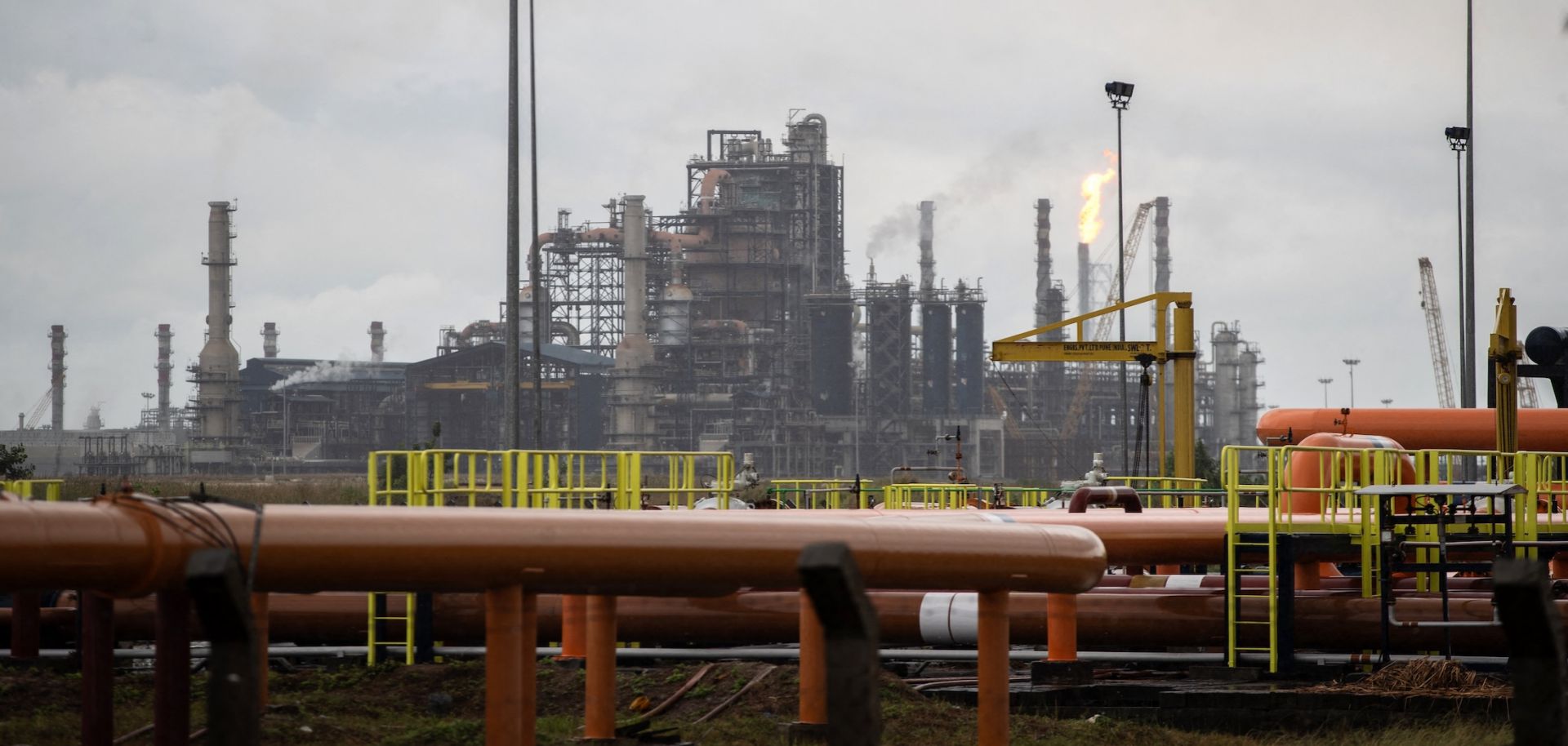
The Dangote petroleum refinery plant is seen in Lagos, Nigeria, on April 6, 2026.
(TOYIN ADEDOKUN / AFP via Getty Images)
The Dangote petroleum refinery plant is seen in Lagos, Nigeria, on April 6, 2026.

Nigeria will likely enjoy a short-term revenue boost from elevated oil prices, but the potential for renewed instability in the Niger Delta could undermine efforts to increase oil production, while rising inflationary pressure will increase the risk of social unrest that could threaten President Bola Tinubu's reelection bid in January 2027. On March 31, Nigerian lawmakers approved a 68.3 trillion naira ($49.4 billion) budget for 2026, marking a 17% increase over the initial version presented by Tinubu to parliament in December 2025. While the majority of new spending is scheduled to be financed through additional external borrowing, lawmakers also approved a $10 increase in the country's oil price benchmark from $65 to $75 per barrel. This move comes as the Iran war and disruptions to shipping through the Strait of Hormuz have pushed Brent oil prices to around $100 a barrel, with physical barrels trading over $140 per unit in certain geographies. Seizing upon this opportunity, the Nigerian Upstream Petroleum Regulatory Commission, or NUPRC, has fast-tracked the reviving of idle wells, with NUPRC CEO Oritsemeyiwa Eyesan announcing on April 2 that the country's total petroleum output, which includes both crude oil and condensates, had risen to around 1.84 million barrels per day, up from an average of 1.62 million barrels per day in January. However, the Iran war has also hit Nigerian households and businesses, with gasoline prices rising by 65% between late February and late March. Meanwhile, Abuja's drive to boost oil production comes amid growing controversy in the oil-rich Niger Delta surrounding the future of pipeline protection contracts, with former militant leader Government Ekpemupolo, known as Tompolo, and his allies looking to maintain their control over the latter, while a number of local youth groups and former Tompolo allies are pressing for a decentralization of the protection contracts. 

  • According to Reuters, the final version of the budget would bring Nigeria's fiscal deficit for the upcoming fiscal year to around 6% of GDP, up from 3.1% in 2025. However, this would be contingent on Nigeria meeting its planned capital expenditure, which is rarely the case due to intra-agency disputes over the allocation and spending of funds, as well as other execution challenges, meaning the final figure is likely to be lower than 6%, especially given high oil prices. 
  • Nigeria's budget foresees oil production averaging 1.84 million barrels per day in the coming fiscal year, and the government has set oil production targets for 2026 at 2.06 million barrels per day. 

The rise in global oil prices comes as Nigeria has advanced a series of initiatives that have reversed a decade-long decline in oil output, while the country remains reliant on crude oil imports due to upstream energy companies' reluctance to supply Nigerian refineries. Since the 1990s, Nigeria's oil sector has been plagued by recurring vandalism targeting oil infrastructure in the Niger Delta, where virtually all of the country's oil output is produced. Attacks on oil infrastructure have been driven by local groups seeking a share of the rent from oil production, such as the Movement for the Emancipation of the Niger Delta (MEND), of which Tompolo was a key leader in the 2000s and early 2010s. The federal government eventually struck a series of deals with MEND between 2009 and 2011 that granted amnesty to the militants and gave Tompolo responsibility for securing oil pipelines in the Niger Delta. However, oil theft continued at scale in the region, sustaining downward pressure on oil output. More importantly, Nigeria's legal frameworks created severe political and regulatory uncertainty for energy companies by granting the government significant discretionary power over key issues, such as licensing. This further deterred new investments, especially in capital-intensive deepwater projects, which, together with oil theft and declining output from maturing fields and poor infrastructure maintenance, cut Nigeria's total oil output to 1.2 million barrels per day in 2022, down from over 2.5 million in the mid-2000s. Accounting for oil companies' concerns, then-President Muhammad Buhari oversaw the adoption of the long-debated Petroleum Industry Act in 2021, which provided a clearer legal framework by reducing government powers and influence over licenses and regulators, improving transparency and reestablishing the state-owned Nigerian National Petroleum Corporation, or NNPC, on a commercial, profit-making mandate. Together with more recent regulatory reforms advanced by Tinubu and increased security deployments in the Niger Delta, this has enabled a gradual increase in Nigeria's oil output in recent years. Further supporting Nigeria has been the early 2024 completion of the privately owned Dangote refinery, which has a capacity of 650,000 barrels per day and prioritizes deliveries to the domestic fuel market. Despite this achievement, Nigeria continues to import large volumes of crude oil, as upstream energy companies operating in the country often prefer to sell their output abroad, given better pricing and their preference to be paid in U.S. dollars rather than naira. 

  • A key provision of the Petroleum Industry Act was the establishment of the Host Community Development Fund, which aims to support economic development in the Niger Delta. The fund is financed by oil companies, which are mandated to contribute 3% of their operating expenditure to it. 
  • In October 2024, the Nigerian government introduced the "naira-for-crude" policy to rationalize the country's fuel supply chains and ensure that the Dangote refinery could source its feedstock domestically. However, the Dangote refinery said in early March that the NNPC had procured only 5 of the 13 supply cargoes needed to meet Nigeria's domestic demand, with the remainder (about 60%) imported from abroad. However, the refinery's owner, Aliko Dangote, said on April 6 that the state-owned company had sold the refinery a total of 10 cargoes in March, four of which were reportedly sold in dollars.

The Iran war's inflationary impact exposes Nigeria to mounting socioeconomic grievances that could trigger unrest, but the rise in energy prices is set to deliver a windfall in revenue to the government for the coming months, which it will likely utilize to advance limited relief measures as Tinubu looks to secure reelection in 2027. Despite the Dangote refinery sourcing much of its feedstock abroad, Nigeria's status as a net energy exporter will shield the country's balance of payments and currency from significant pressure caused by the fallout from the Iran war. However, Nigeria remains exposed to a protracted rise in fuel prices so long as uncertainty over the freedom of navigation through the Strait of Hormuz persists, given that Dangote's pricing is broadly aligned with global benchmarks. Moreover, the Iran war exposes Nigeria to additional drivers that could further increase inflationary pressures. While the country produces the bulk of its fertilizer domestically, Nigeria remains reliant on imported fertilizer feedstocks, such as ammonium sulfate, exposing it to disruptions to global fertilizer supply chains stemming from the Iran conflict. Taken together, this portends rising inflationary pressures, which, given already elevated socioeconomic grievances, could trigger unrest, especially among young Nigerians. For Tinubu, a major protest movement would challenge his reelection bid in Nigeria's January 2027 general elections by potentially mobilizing the opposition. However, the Nigerian government will likely enjoy a significant windfall in revenue amid high oil prices, which are likely to remain above the $75 oil benchmark for the next few months despite the April 8 ceasefire between the United States and Iran due to persisting disruptions to maritime traffic through the Strait of Hormuz, curbs to Middle Eastern oil production and lingering concerns of renewed conflict. Although the size of the windfall will be mitigated by the fact that a significant portion of Nigeria's oil output is tied up in forward sales agreements and the repayment of oil-backed loans, Tinubu's reelection bid suggests that the federal government is likely to use part of the additional revenue to advance relief measures, such as tax breaks or targeted support to lower-income households. However, Tinubu appears unlikely to press ahead with a broad-based reestablishment of fuel subsidies without a major protest movement, given the opposition's current weakness and his government's efforts to maintain relative fiscal discipline. 

Tinubu will likely maintain a pipeline protection mechanism broadly favorable to Tompolo, given recent successes in curbing oil theft, but he may extend patronage funding to rival groups, as maintaining the status quo could trigger a new rent-seeking rebellion in the Niger Delta. In its current form, the pipeline protection program effectively reduces opportunities for younger generations from the Niger Delta without connections to Tompolo to access the region's patronage system, which is a catalyst for new rent-seeking rebellions from upstart youths. Further heightening the program's instability are grievances from many former MEND commanders, who believe the current setting disproportionately favors Tompolo, as well as from local ethnic groups that have long been at odds with Tompolo's Ijaw community. While this creates strong incentives to shift to a more inclusive pipeline protection mechanism, such as decentralizing protection contracts, doing so would also prove destabilizing for the region, as it would run counter to vested interests seeking to preserve the status quo. This leaves the Nigerian government facing a difficult tradeoff, but Tinubu currently appears likely to maintain a pipeline protection program that is broadly favorable to Tompolo, given recent successes in curbing oil theft in the Niger Delta. However, meaningful adjustments to the pipeline surveillance contracts are possible, as Tinubu may seek to shift toward a more inclusive — and therefore sustainable — framework. These could, for example, require Tompolo's company to hire and/or train youths from communities in the immediate vicinity of oil infrastructure, or see some of Tompolo's rivals from MEND gain greater responsibility for protecting oil infrastructure within their communities in coordination with Tompolo. However, Tompolo would likely initially resist such a proposal, arguing that it would undermine the effectiveness of the pipeline protection program. Alternatively, Tompolo's rivals could be given greater responsibility for patrolling rivers and creeks in the Delta. The ensuing bargaining process could prompt local youths to attack oil infrastructure, with the tacit blessing of Tompolo's rivals, to pressure the federal government to grant them a greater share of patronage funding. In the absence of meaningful changes to security contracts, Tinubu may leverage higher oil prices to extend development initiatives in the Niger Delta or accelerate the implementation of development projects under the Petroleum Industry Act's host community fund to appease local youths. However, maintaining the status quo would threaten to trigger a new rent-seeking rebellion in the Niger Delta, especially given the increase in socioeconomic grievances linked to the Iran war. 

  • Former MEND commanders who have criticized the current pipeline protection framework include Asari-Dokubo and Ebikabowei Victor-Ben, known as Boyloaf. These actors have likely established ties with aggrieved youth groups to increase pressure on the federal government to decentralize the pipeline protection contracts.

The Iran war increases the likelihood of a modest boost to Nigeria's oil output in the coming years by driving up prices, which will incentivize investments in the country's onshore fields, though these potential gains will remain vulnerable to renewed instability in the Niger Delta. Although the Iran war will increase the risk profile of Middle Eastern hydrocarbon assets for investors, this is unlikely to boost Nigeria's appeal to Western majors, as these companies remain highly hesitant or uninterested in returning to the country's onshore fields. This will, in turn, leave Nigeria to compete for Western majors' investments with other deepwater producers — a sector dominated by non-Middle Eastern countries like Brazil, Guyana and Angola. Nonetheless, perceptions that Iran's behavior could trigger new supply shocks over the coming year will raise the premium on non-Middle Eastern oil and gas assets. This will likely incentivize smaller, more risk-tolerant investors, such as Nigeria's indigenous energy companies, to expand their operations in the Niger Delta. As a result, more brownfield projects in the Delta could be returned to commercial operations or receive fresh investments that boost output, thereby supporting Tinubu's efforts to grow the country's oil production. However, these efforts will be constrained by decades of underinvestment in the country's aging onshore oil infrastructure, which is becoming increasingly prone to leaks and breakdowns. Furthermore, a resurgence of instability in the Niger Delta — such as attacks on oil infrastructure — could hinder production gains by deterring necessary investments. In a less likely but higher-impact scenario, a new rent-seeking rebellion in the region could result in a meaningful downturn in Nigeria's total output. However, Western majors' large deepwater projects are less likely to be affected by any renewed instability in the Niger Delta, given their distance from the coast, with many of these projects expected to begin production from around 2030 onward.

RANE
SUBSCRIBERS ONLY

Expert analysis when it matters most.

Get access to RANE's decision-grade geopolitical intelligence.