
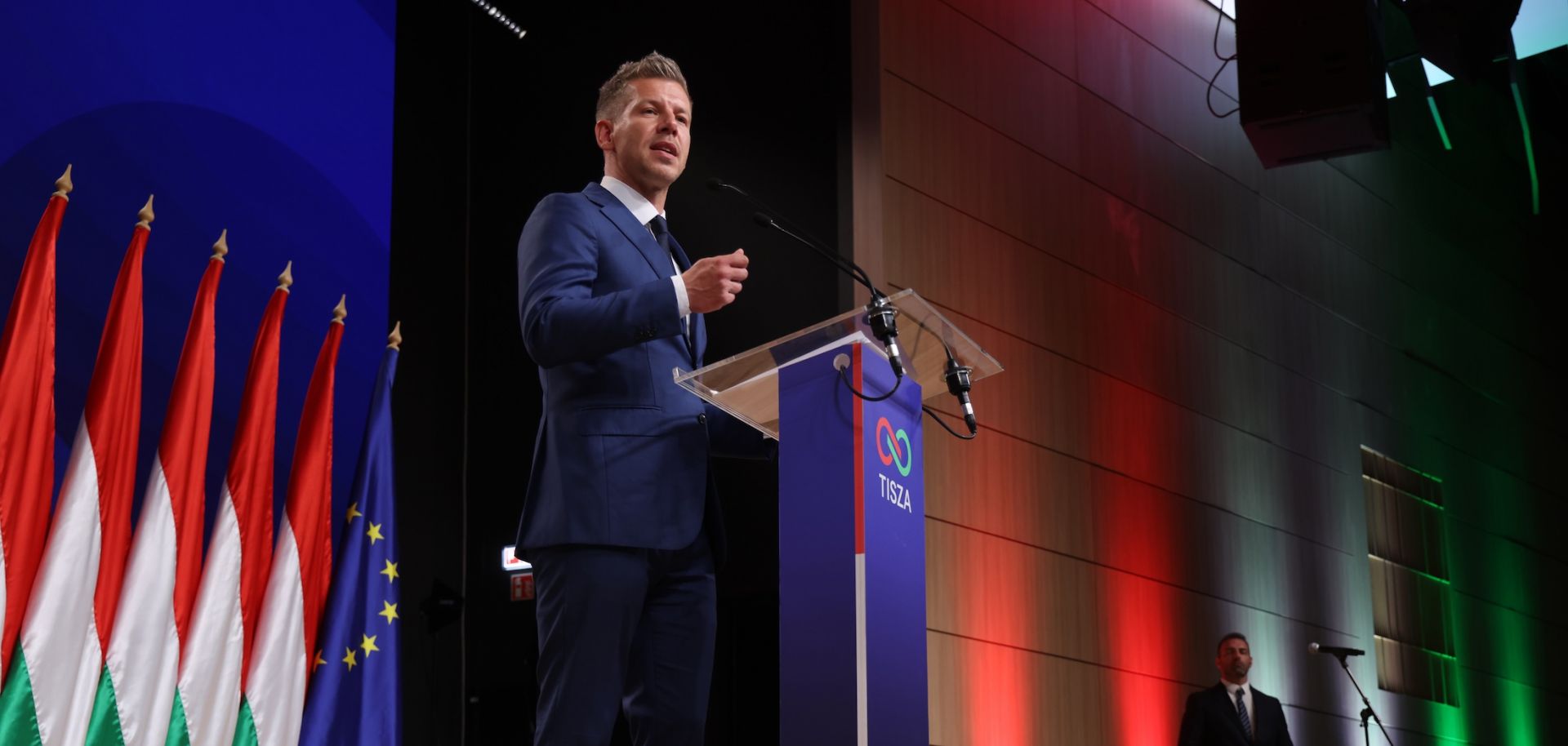
Peter Magyar, lead candidate of the Tisza party, speaks to reporters in Budapest on April 13, 2026, after his party's sweeping victory in Hungary's parliamentary elections.
(Sean Gallup/Getty Images)
Peter Magyar, lead candidate of the Tisza party, speaks to reporters in Budapest on April 13, 2026, after his party's sweeping victory in Hungary's parliamentary elections.

In Hungary, a landslide opposition victory will enable rule-of-law reforms and a shift back toward the European mainstream after 16 years of illiberal, eurosceptic governance, unlocking frozen EU funds and restoring constructive EU engagement; however, the new government will only gradually reduce dependence on Russian energy and converge selectively with Brussels on Ukraine policy, while facing significant fiscal constraints. Hungary's opposition leader Peter Magyar secured a decisive victory in the April 12 parliamentary elections, defeating Prime Minister Viktor Orban with a two-thirds supermajority that grants the incoming government the ability to amend the constitution and pursue sweeping institutional reforms. Propelled by a record-high voter turnout of 79.5%, Magyar's Tisza Party won 53.6% of the vote and 138 of 199 seats, while Orban's Fidesz secured only 37.9% and 55 seats. Orban conceded after it appeared the margin had become insurmountable, easing earlier concerns over a potential contested outcome. In his victory speech, Magyar — a center-right former Fidesz insider turned pro-European reformist — pledged to restore Hungary as "a strong ally" in the European Union and NATO, and to reinstate the rule of law in the country. Markets have reacted positively to the election results, with the local forint currency strengthening and Hungarian bonds and stocks rallying. Under Hungarian law, the new parliament must convene within 30 days, during which the outgoing majority will retain full legislative authority and Fidesz-appointed officials will continue to represent Hungary at EU meetings. Magyar thus called on President Tamas Sulyok and other Fidesz-appointed officials — including the chief prosecutor and top justices — to resign, while urging Orban to refrain from making any binding decisions during the transition.

  • Magyar's victory ends 16 years of Orban's self-described "illiberal" rule, during which his Fidesz party centralized and consolidated power through successive parliamentary supermajorities, enabling constitutional changes that significantly weakened institutional checks and balances and triggered prolonged rule-of-law disputes with Brussels. Orban's systemic divergence from EU positions on Russia, China and Ukraine deepened Hungary's isolation within the bloc, while inflation, corruption scandals and anti-government protests eroded domestic support for this government in recent years.
  • After defecting from Fidesz in 2024, Magyar rapidly emerged as a challenger to Orban. He gained support by capitalizing on growing voter dissatisfaction, uniting a diverse electorate on a platform of anti-corruption and governance reform, and promising to rebuild relations with the European Union while reducing ties with Russia. To preserve this coalition, he deliberately avoided taking firm positions on divisive sociopolitical issues such as LGBTQ+ rights and NGO independence. Founded in 2020 and led by Magyar since 2024, the Tisza party won nearly 30% of the vote in the June 2024 European Parliament elections, outperforming both Fidesz and traditional opposition parties in urban areas, thereby establishing itself as the main challenger. Positioned as a centrist, pro-European reform movement, Tisza draws support from disillusioned conservatives, moderate urban voters and parts of the fragmented liberal opposition.
  • During the transition period before the new parliament convenes, the outgoing legislature — where Fidesz retains a supermajority — could, in theory, pass last-minute constitutional amendments to constrain the incoming government, including expanding the scope of key laws requiring qualified majorities or strengthening presidential veto powers through loyalist appointments. Such steps, however, would be highly controversial and likely trigger social unrest, market volatility and institutional pushback, while sharply escalating tensions with the European Union.

The two-thirds supermajority will fundamentally enhance the incoming government's ability to dismantle Fidesz's deeply entrenched institutional and economic influence, as well as reset EU relations on a much firmer footing. A simple majority would have still allowed the Tisza party to govern, but it would have left the legal and institutional framework constructed over the past decade and a half under Fidesz largely intact. Orban could then have decided to simply "wait out" Magyar's term, temporarily retreating to the opposition and betting on institutional inertia and internal ideological divisions within a constrained coalition; a similar dynamic is currently playing out in Poland, where the pro-EU government's lack of a constitutional majority has significantly slowed and complicated its efforts to undo the reforms implemented by its euroskeptic predecessor. Instead, the scale of Tisza's victory marks a genuine inflection point that opens the door to structural, systemic reform rather than just incremental adjustment. A two-thirds supermajority in parliament will enable the incoming government to unilaterally amend the constitution, overhaul the electoral system and rewrite the "cardinal laws" that have locked in Fidesz-era control over the judiciary, media and key oversight bodies — all areas that were deliberately shielded by supermajority requirements to block future reform. The government will, in turn, be able to replace senior officials appointed under Orban, including Constitutional Court judges, the Prosecutor General and heads of regulatory bodies, gradually reshaping the institutional landscape. Crucially, this strengthened mandate will also improve Budapest's ability to meet the European Union's rule-of-law benchmarks to unlock roughly 18 billion euros ($21 billion) in frozen cohesion and recovery funds through judicial reform, anti-corruption measures and closer cooperation with Brussels. 

  • In his victory speech, Magyar emphasized that the two-thirds majority will enable constitutional amendments to restore checks and balances, including Hungary's accession to the European Public Prosecutor's Office and the strengthening of independent democratic institutions. He pledged to prevent any future excessive concentration of power, stating that Hungary would no longer be "held captive" or drift away from its EU commitments. On the campaign trail, Magyar also proposed introducing a two-term limit for prime ministers, which would effectively bar Orban from returning to office, having already served four mandates.
  • The Financial Times reported on April 13, citing EU officials, that the European Commission has already initiated immediate engagement with Magyar, focusing on a conditional pathway to unlock frozen EU funds in exchange for Hungary lifting vetoes on Ukraine- and Russia-related sanctions and committing to a structured rule-of-law reform program.

Renewed inflows of EU funds will help revive growth, restore policy predictability and ease budgetary pressures. But the new government will face significant fiscal constraints inherited from its predecessor, while the coalition's ideological diversity could test its stability over time. The likely unfreezing of billions in EU funds will help revive an economy that has stagnated for nearly three years by creating additional fiscal space for investment-led growth amid mounting pressure on public finances. This infusion of capital will also help address chronic underinvestment in transport and public services, which has weighed on productivity and long-term growth in recent years. Markets have already signaled improved confidence, with the rally in Hungarian assets following Magyar's victory reflecting expectations of restored policy predictability, reduced political interference and a more stable, rules-based business environment with fewer ad hoc state interventions negatively impacting foreign investors. The Tisza party also supports eventually adopting the euro to anchor monetary stability, though the timeline for this transition would depend on sustained fiscal consolidation and inflation convergence. Nonetheless, the government will inherit a deteriorated fiscal position, further exacerbated by Orban's pre-election stimulus, which included higher social expenditures, pension increases, housing programs, wage hikes and family support measures. As a result, Magyar will face immediate pressure to consolidate the budget to avoid further credit rating deterioration, including the risk of a downgrade to sub-investment grade, though this could also erode his new government's popularity. Meanwhile, even with a stable parliamentary majority, internal cohesion risks may also emerge within Tisza's broad electoral coalition, which brings together conservatives, centrists, liberals and former Fidesz figures. This ideological diversity could complicate consensus on sensitive fiscal, social and institutional decisions and introduce friction in translating campaign pledges into policy. Still, the coalition's large parliamentary majority and its members' shared goal of preventing Fidesz from returning will likely provide enough cohesion to avoid fragmentation, excessive instability and a potential government collapse.

  • Despite very low unemployment and a visible recovery in real wages since last year, years of high inflation and weakening public finances under Orban have eroded household purchasing power and reduced government spending on social services. After two years of stagnation, Hungary's economy grew by just 0.4% in 2025, with average inflation at 4.5%. The budget deficit remained elevated near 4.7-5% of GDP in 2025 and is projected to rise further in 2026, pushing the debt-to-GDP ratio gradually toward around 75% by 2027 — below the 2020 peak of around 79%, but still well above the pre-pandemic level of 65% in 2019. Orban's pre-election stimulus measures further pushed the cash-flow deficit to a record HUF 3,420 billion ($10.6 billion) in the first quarter of 2026 alone.
  • Tisza's economic program is largely centered around restoring compliance with EU rule-of-law requirements to unlock frozen EU funds and redirect them toward infrastructure, healthcare, education, housing and energy-efficiency investments under Magyar's proposed "Hungarian New Deal." EU grants are intended as the primary financing source for public investment, easing pressure on domestic budgets. 

The incoming government will significantly strengthen ties with the European Union, NATO and regional partners, but near-term relations with Ukraine will improve only up to a point; more broadly, Budapest will also gradually shift foreign and energy policy away from Russia and maintain pragmatic commercial relations with China. Relations with the European Union will improve markedly, reintegrating Hungary into EU decision-making processes after years of systemic obstructionism. This is especially relevant in areas that require unanimity, such as sanctions, enlargement and foreign policy, where the Orban government's repeated use of its veto power has constrained EU action, especially on anything related to Russia and Ukraine. However, a swift and drastic reversal in Budapest's relations with Kyiv remains unlikely, as Magyar also embraced nationalist rhetoric throughout the campaign, including opposing arms deliveries to Kyiv and proposing that any decision on Ukraine's accession to the European Union be put to a referendum. Consequently, the new government will likely adopt a more pragmatic and cooperative stance toward EU enlargement while maintaining elements of Orban's skepticism, replacing his outright confrontation with a cautious, conditional approach. In the near term, Budapest will thus likely refrain from blocking or diluting key EU measures on Ukraine, allowing currently stalled initiatives to advance (including the 90 billion euro loan package for Kyiv and the 20th sanctions round against Russia), along with the opening of negotiation clusters for both Ukraine and Moldova. As the government secures early policy wins, restores access to EU funding and strengthens its domestic mandate, it is also likely to gradually recalibrate its public messaging and political positioning on Ukraine, enabling closer alignment with the European Union. While domestic constraints and public sentiment will likely keep the pace measured, this shift will enable Hungary to re-engage with like-minded regional partners like Poland — including closer diplomatic coordination at the EU level in areas like migration, energy, climate, agriculture and others — after years of strained relations driven by fundamental divergencies over Russia's invasion of Ukraine. By contrast, Hungary will likely drastically yet gradually reduce its engagement with Russia, though infrastructural and economic realities will compel only a phased transition away from key dependencies, most notably Russian oil. Meanwhile, ties with China will likely remain largely intact due to their importance for investment and industrial supply chains, even as Budapest aligns more closely with broader, more hawkish EU policy toward Beijing.

  • The European Union's 90 billion euro loan package for Ukraine has been delayed for months amid a dispute between Orban and Ukrainian President Volodymyr Zelensky. Orban blocked the package's final approval, accusing Kyiv of stalling repairs to the Druzhba oil pipeline (which delivers Russian oil into central Europe) after it was damaged by Russian strikes. However, under the new Tisza government, the veto could be lifted relatively soon, potentially at the ambassador level in the coming weeks.
  • Magyar has emphasized that while his government will seek to diversify energy supply away from Russia, it will not immediately cut Russian energy imports due to limited alternatives, instead setting a target to phase them out by 2035.
RANE
SUBSCRIBERS ONLY

Expert analysis when it matters most.

Get access to RANE's decision-grade geopolitical intelligence.