
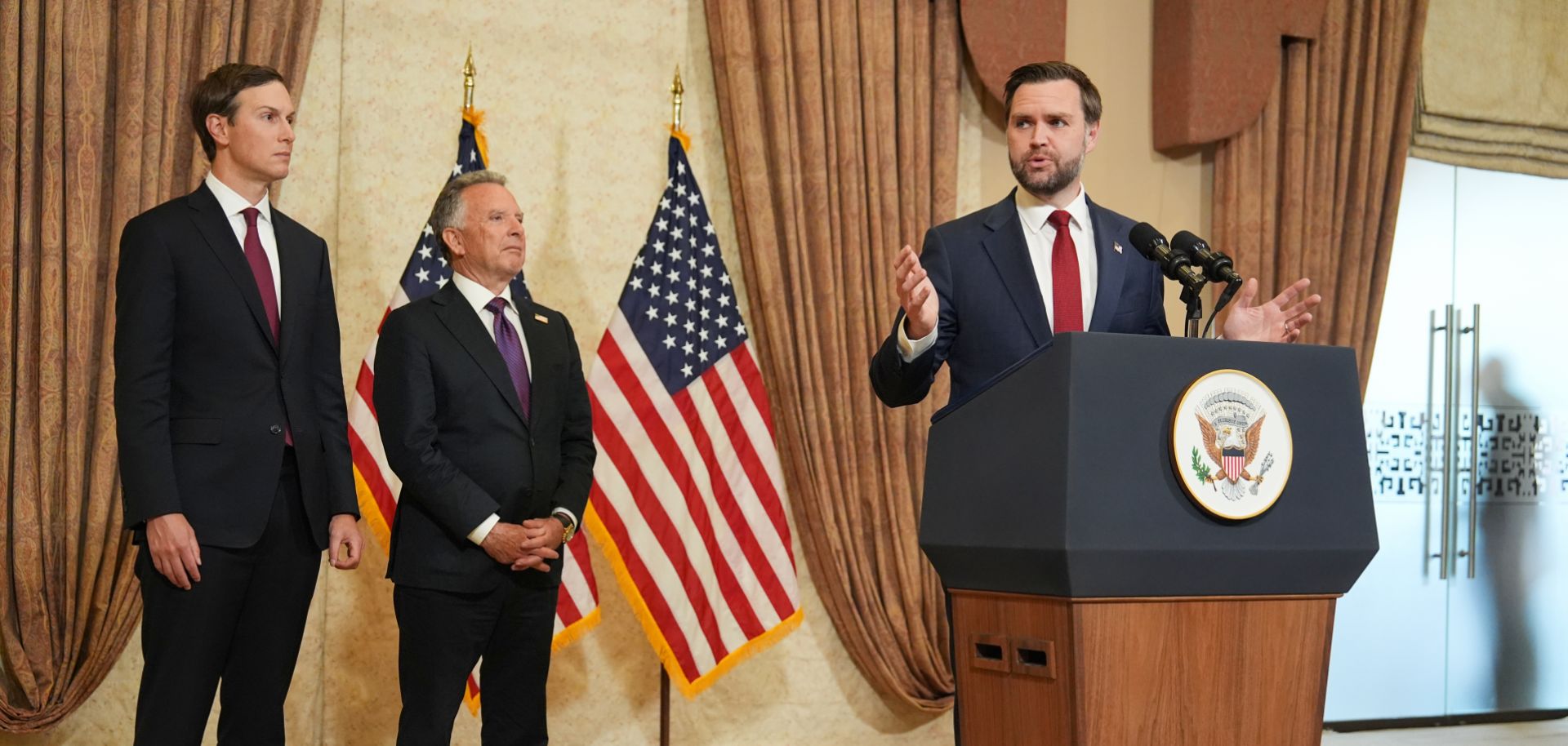
U.S. Vice President JD Vance speaks as special envoys Jared Kushner (L) and Steve Witkoff listen during a news conference after a meeting with representatives from Pakistan and Iran on April 12, 2026, in Islamabad, Pakistan.
(Jacquelyn Martin via Pool/Getty Images)
U.S. Vice President JD Vance speaks as special envoys Jared Kushner (L) and Steve Witkoff listen during a news conference after a meeting with representatives from Pakistan and Iran on April 12, 2026, in Islamabad, Pakistan.

A U.S. naval blockade of the Strait of Hormuz is likely primarily an economic pressure tool rather than an immediate trigger for war, but it will elevate the risk of conflict that further disrupts energy markets and the global economy. Hours after talks between Iran and the United States in Islamabad, Pakistan, over the weekend of April 10-12 concluded without a deal, U.S. President Donald Trump announced via Truth Social that the U.S. Navy would blockade the Strait of Hormuz. The post said all vessels would be blocked from transiting the strait, including those paying tolls to Iran in return for safe passage. U.S. Central Command subsequently clarified that it would prevent vessels of all nations entering or departing Iranian ports and coastal areas, including all Iranian ports on the Arabian Gulf and the Gulf of Oman, from bypassing the strait but would allow ships traveling between non-Iranian ports to transit, with the blockade starting at 10 a.m. Eastern time on April 13. Iran's military command has warned that it will attack Gulf ports in response to the U.S. blockade, stating that maritime security in the Persian Gulf and the Gulf of Oman will no longer be guaranteed if Iranian ports are threatened. Meanwhile, Israel's military has moved to a heightened state of readiness, with preparations underway for a potential resumption of hostilities and contingency planning for the possibility of an Iranian first strike.

  • Oil prices surged sharply following Trump's announcement of a naval blockade on Iran, with Brent crude rising more than 8% to exceed $103 per barrel, reflecting heightened concerns about potential supply disruptions and escalation in the Strait of Hormuz.
  • Following the failure of U.S.-Iran talks, Trump also said he was indifferent to whether Iran returned to negotiations, while reiterating threats to target critical Iranian infrastructure if no agreement is reached. These comments underscore continued openness to escalation alongside pressure tactics. 
  • The maritime intelligence company Lloyd's List Intelligence noted that ships halted attempts to sail toward the Strait of Hormuz on April 13 after Trump's announcement of a naval blockade and Iran's reciprocal threats.
  • Prior to the blockade, Iran had been incrementally asserting control over the Strait of Hormuz by requiring vessels to coordinate transit with its forces, intermittently attacking and intercepting ships, restricting passage and charging transit fees as part of a broader effort to institutionalize control over routing and access.

U.S.-Iran negotiations in Islamabad failed to bridge gaps on core issues, including opening the Strait of Hormuz, the fate of Iran's enriched uranium and Iran's support for regional allies. Following a two-week ceasefire announced on April 7, both sides entered the talks with maximalist demands, each perceiving itself as having gained the upper hand during the conflict, and with fundamentally different interpretations of the basis of negotiations. While the Islamabad talks marked the first direct U.S.-Iran engagement in over 47 years and made progress on several issues, core divergences proved sufficient to derail discussions after 21 hours. The main sticking points reportedly included the fate of Iran's highly enriched uranium, with the United States pushing for destruction or transfer and Iran only offering dilution; Iran's demands to secure postwar control over the Strait of Hormuz, viewing it as a strategic gain; and Iran's rejection of U.S. demands to halt support for regional allies, including Lebanon's Hezbollah and Gaza's Hamas. Beyond the substance of negotiations, mutual distrust remained a critical barrier. Iran is seeking assurances that any agreement will be implemented and not abandoned before making any concessions on uranium and access to the Strait of Hormuz, while the United States is pushing for immediate and verifiable steps from Iran.

  • Iran entered negotiations based on its own 10-point plan, positioning it as the baseline for talks, while the United States approached discussions from its earlier 15-point framework, highlighting a fundamental misalignment from the outset, with each side prioritizing competing demands on nuclear constraints, regional posture and control of the Strait of Hormuz. 

The U.S. blockade will complicate negotiations by hardening Iran's position and increasing the risk of a return to conflict in the coming days or weeks. Washington is pursuing a new form of coercive pressure while weighing whether more military strikes would compel Iran to accede to U.S. demands after more than five weeks of conflict failed to do so. Iran has demonstrated an ability to sustain missile and drone attacks against its foes in the region at a steady pace, reinforcing its perception that it can continue to fight a war, with numerous media reports citing U.S. intelligence estimates that Iran has sufficient stockpiles of weapons to keep fighting for the foreseeable future. At the same time, international and domestic political pressure on Washington is increasing, which may constrain immediate escalation even as Trump signals a willingness to continue the blockade regardless of whether a deal is reached. Meanwhile, Iran views the outcome of the conflict prior to the ceasefire as a strategic win, particularly its ability to disrupt and influence access to the Strait of Hormuz, which makes it unlikely to concede its new role in the strait as part of negotiations. This means the U.S. blockade as a coercive tool is unlikely to shift Iran's position in negotiations or force Tehran to concede on red lines, especially as Iran calculates that the blockade risks disrupting global economies more quickly than its own economy. As a result, the gap between the two sides' positions will likely deepen, increasing the risk of an accident or miscalculation and opening the door to deliberate escalation if either party attacks ships. In parallel, the Trump administration may still opt to resume military operations alongside the blockade, particularly given a demonstrated tolerance for risk and continued Israeli pressure to sustain the campaign. Ongoing U.S. force deployments and reinforcements to the region further support the likelihood that escalation remains possible in the coming days or weeks, even as negotiations continue.

  • On April 12, The Wall Street Journal reported that Trump and his advisers were considering resuming limited military action against Iran in a bid to break the impasse in talks, in addition to blockading the Strait of Hormuz.
  • Israel's ongoing military campaign in Lebanon against Hezbollah will add to the risk of escalation, as Iran has explicitly conditioned negotiations on a ceasefire in Lebanon and tied its broader posture to developments on that front. Continued Israeli operations could therefore trigger Iranian retaliation against Israel, raising the likelihood of ceasefire violations that would cause a resumption of hostilities between Tehran and the United States.
  • The Iran-U.S. Joint Comprehension Plan of Action nuclear deal, from which the first Trump administration withdrew in 2018, took years of negotiations to reach. It therefore stands to reason that a breakthrough in the first round of the current talks was unlikely and that further negotiations without a resumption of war remain plausible.
  • The blockade is designed to strain Iran's economy by restricting its oil exports and revenue over time. However, it also disrupts global energy flows more immediately, driving up oil prices, inflation and shipping costs. As a result, the move creates a race of endurance in which Iran attempts to absorb longer-term economic pressure while the United States and global markets face faster, broader economic consequences. As a result, even if a U.S. blockade ultimately does not result in military action, it would still ripple through global markets and supply chains, especially if it restricts Iranian oil exports, which for much of the conflict have continued to pass through the Strait of Hormuz.

A resumption of war would likely trigger a region-wide military escalation, with further oil price hikes and disruptions to maritime trade across the Strait of Hormuz and, potentially, the Bab el-Mandeb strait. If conflict resumes, it would be more likely to escalate in severity as both sides try to compel the other to back down from their maximalist demands. Renewed U.S. and/or Israeli strikes — particularly against Iranian critical infrastructure, which Trump has explicitly threatened — would almost certainly prompt proportionate Iranian retaliation across the Gulf, targeting energy facilities, power infrastructure and other critical assets. This would likely be accompanied by a resumption and expansion of proxy attacks from Iraq, Yemen and Lebanon, alongside an intensified Israeli campaign against Hezbollah. At the same time, the threat to maritime security would increase significantly, both in the Strait of Hormuz and the Red Sea, where the Houthis could escalate their operations by disrupting the Bab el-Mandeb chokepoint, which they have so far held in reserve as a strategic escalation lever. These dynamics would have immediate economic consequences, most notably upward pressure on oil prices, driven by actual and perceived supply risks. Secondary effects would likely include rising shipping insurance premiums and broader supply chain disruptions, particularly for goods transiting through key chokepoints. The continued movement of U.S. military assets to the region also sustains the possibility of expanded and more escalatory military options, including limited ground operations aimed at securing strategic leverage, either by capturing important Iranian islands or infrastructure or attempting to destroy Iranian nuclear components.

  • Saudi Arabia has restored full pumping capacity on its East-West crude oil pipeline to around 7 million barrels per day, days after assessing damage to its energy infrastructure from attacks during the Iran conflict. The pipeline is Saudi Arabia's key route to bypass the Strait of Hormuz, and the restoration signals a rapid recovery effort aimed at stabilizing exports and maintaining supply continuity. This means in the event of another military flare-up, Iran could strike the pipeline again to further disrupt oil supply.
RANE
SUBSCRIBERS ONLY

Expert analysis when it matters most.

Get access to RANE's decision-grade geopolitical intelligence.