
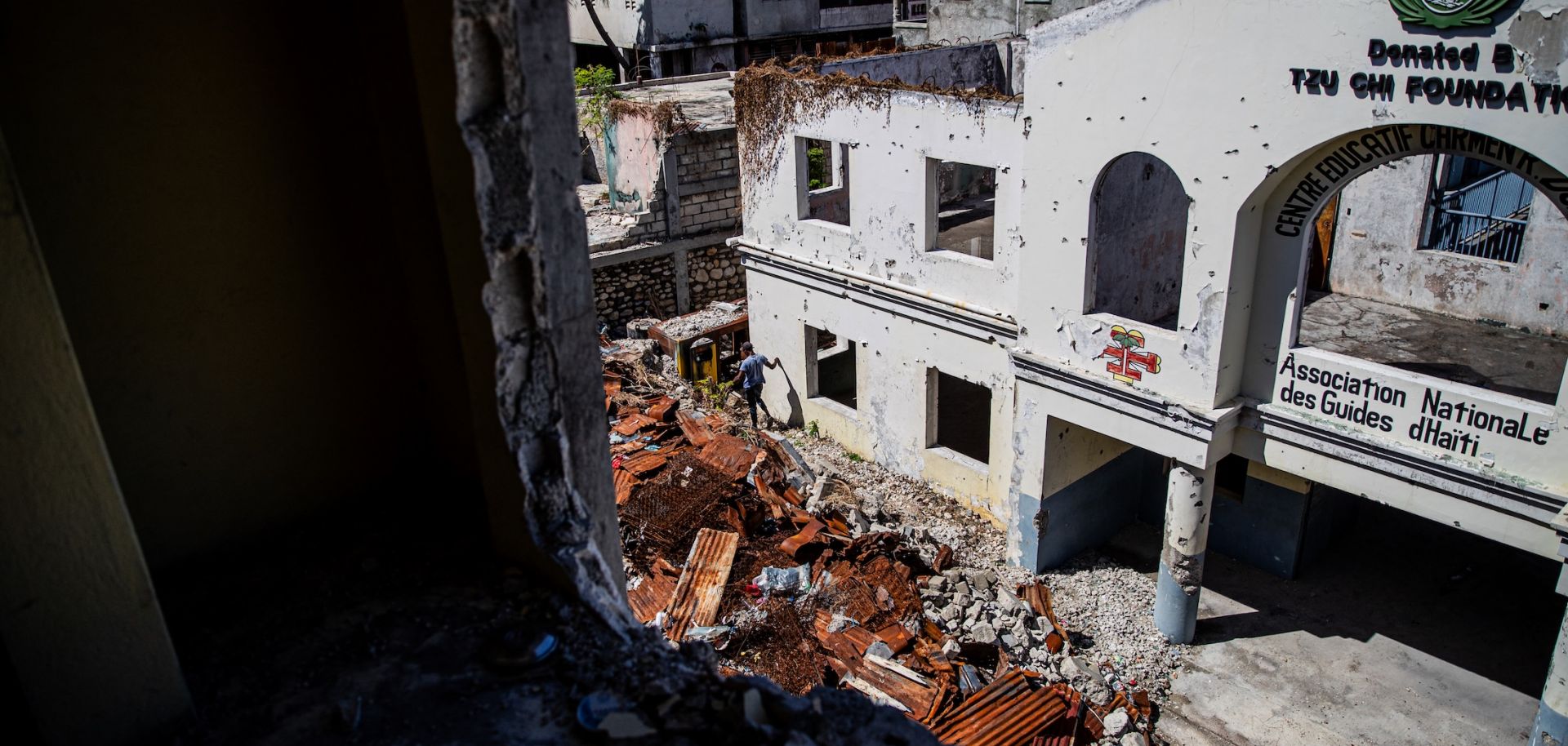
Haiti's extreme insecurity and political instability are highly unlikely to improve ahead of planned elections in August; there is also a significant risk that conditions deteriorate further, collapsing what remains of the Haitian state while worsening regional migration and criminal challenges. On March 29, the Gran Grif group, one of Haiti's most violent gangs, carried out a brutal massacre in Petite-Rivière de l'Artibonite (60 miles north of Port-au-Prince), killing over 70 people, looting homes and displacing thousands of residents. The attack was one of the worst mass killings in Haiti so far in 2026, highlighting the continuation of extreme gang violence in the country, despite the efforts of local authorities and supporting foreign forces. Meanwhile, the Haitian government is in the midst of a yearslong political crisis, following the end of the Transitional Presidential Council's term on Feb. 7, which handed control of the government to Prime Minister Alix Didier Fils-Aime. Fils-Aime says he is working to hold elections on Aug. 30, 2026, with a run-off for the presidency planned for Dec. 6, and newly elected officials taking office in January and February 2027. In March, the Provisional Electoral Council (CEP) approved 282 political parties to participate in the vote, in a major formal step toward holding elections; however, on April 8, the CEP announced that it was postponing voter registration for the elections, which was originally set to begin on April 1, without giving a new date for when it would begin.

- In October 2023, the U.N. Security Council approved the deployment of a Multinational Security Support Mission (MSS) made up of security forces from Kenya, other Caribbean nations and countries around the world. However, the deployment was slow to arrive, reaching only approximately 1,000 personnel out of the mandated 2,500 by mid-2025, and, beyond initial success in regaining control of critical infrastructure, it did not substantially improve security conditions. In October 2025, the U.N. Security Council approved a resolution to transition the MSS into the Gang Suppression Force, which would have more personnel (5,500 forces) and the ability to participate in security operations, rather than merely provide support. However, additional forces associated with this new mission only began arriving in early April, with 800 personnel from Chad expected by April 15, so it will still take months for them to be effectively integrated enough to improve Haiti's security environment. It also remains unclear when all 5,500 personnel will arrive.
- The Transitional Presidential Council (TPC) took power after extreme gang violence in early 2024 forced former Prime Minister Ariel Henry to step down. It was comprised of seven voting members representing top political movements and the private sector, as well as two observing members. The TPC was given the mandate to organize elections and select a new prime minister, but due to severe insecurity, authorities were unable to hold elections as initially planned for November 2025.
- Fils-Aime is a Haitian businessman who ran unsuccessfully for the Senate in 2015 and served as President of the Chamber of Commerce of Haiti from 2011 to 2016. TPC members attempted to remove Fils-Aime from office in January 2026 in an effort to retain control of the government, but failed to finalize the formal process amid a dispute within the council. In a bid to preserve some level of political continuity and legitimacy, the United States pushed for Fils-Aime to take control of the Haitian government, rather than extending the TPC's mandate or forming a smaller governing council.
Though authorities have taken formal steps to hold elections, Haiti is still facing extreme violence in much of the country and popular frustration with the political establishment. Haiti is the most violent country in the Western Hemisphere, with gangs controlling over 90% of Port-au-Prince, and much of the surrounding areas in southern and central Haiti. Gangs such as Gran Grif and Viv Ansanm use extreme violence to assert control over their territory, and clash with both government security forces and local vigilante groups in ways that often cause dozens of civilian casualties, as seen with the March 29 massacre in Artibonite. Materially and numerically outmatched, Haitian security forces have struggled to contain the violence, with many reports indicating that gangs have become more violent and seized more territory over the last year. While U.N.-approved foreign forces have bolstered their capabilities, local authorities remain plagued by corruption, poor professionalism and limited resources. Further complicating the political situation ahead of elections, major criminal leaders, including Viv Ansanm's leader Jimmy Cherizier ("Barbecue"), have demanded that authorities allow them to run for office. Given their deep influence, gangs also almost certainly have sway over some — if not most — of the political groups registered for the ballot. In addition to security issues, the Haitian population is broadly frustrated with the country's governing bodies, previously organizing anti-government protests over insecurity, shortages of basic necessities and the broader economic crisis that has worsened due to the fallout from the Middle East crisis. Haitian political figures constantly face extensive corruption allegations that further frustrate the population; Fils-Aime is already facing criticism for approving controversial multi-million-dollar government contracts that transfer key government operations (including tax collection and border control) to the private sector. Additionally, in March, the Haitian government announced austerity measures that would further roll back already sparse government services. These issues and frustrations have also long fueled political tensions between rival parties, an issue that has previously hindered policy-making and government stability, including within the TPC.
- Reports indicate that Haiti reported over 8,100 murders in 2025 through November, giving the country a homicide rate of approximately 68 per 100,000 people, but this is almost certainly a significant undercount. In comparison, the neighboring Dominican Republic reported a homicide rate of 8.7 per 100,000 people in 2025, while Ecuador, currently the most violent country in South America, reported a homicide rate of 50.9 per 100,000 people.
Regardless of whether elections are held in 2026, deep political instability will persist and likely worsen, opening the door to further state collapse that will deepen insecurity and ripple across the region through outward migration and criminal impunity. Though authorities are in the process of formalizing election preparations for August, significant challenges remain to holding the vote, as evidenced by the delay in voter registration. Chief among these is the dire security situation, which is highly unlikely to substantially improve in the coming months due to the slow arrival of additional foreign troops under the new Gang Suppression Force, the critically poor capabilities of government forces, and gangs' expanding resources and territorial control. Therefore, it is more probable than not that the Fils-Aime government will again delay the election, citing significant insecurity that would prevent most of the population from participating. Still, amid international pressure (particularly from the United States) to restore democratic governance following Haiti's repeated failure to hold elections for nearly a decade, there is a higher chance than in prior years that the government could hold the vote despite these challenges. In such a situation, low voter turnout would likely lead to the election results being widely perceived as illegitimate, which losing candidates would likely exploit to further undermine the vote. Regardless of whether elections are held in 2026, Haitians' growing frustration with the lack of democratic governance and their government's failure to improve security and living conditions will risk triggering mass unrest in the coming months, similar to the anti-government protests seen in 2022 and 2024. Such unrest could lead to a full collapse of the already weakened Haitian government at some point in 2026, if remaining government bodies are dissolved amid public pressure and/or if a major gang exploits the additional chaos to seize control of government facilities or infrastructure. Even without a full state collapse, absent sufficient external assistance, the stage is set for Haitian authorities to slowly lose more territorial control and for humanitarian conditions to worsen. Such a development would compound the existing challenges for the handful of foreign businesses still operating in the country, including those located in northern Haiti that have so far been less affected by gang violence. A worsening of Haiti's insecurity could also prompt greater U.S. intervention, including potential drone strikes on gangs and/or troop deployments. Additionally, a full government collapse would fuel a migration crisis — primarily affecting the Dominican Republic, Cuba, Mexico and the United States — as more Haitians try to flee the gang-ridden country. In a more extreme scenario, in which gangs fully take over Haiti and are not quickly quashed by international forces, Haiti could become a safe haven for criminal groups throughout Latin America, a development that would pose broader regional security threats.
- There is a potential that the Gang Suppression Force will improve conditions in Haiti by the end of 2026 and reduce the risk of state collapse, assuming it includes sufficient personnel and resources to bolster domestic security forces, has an adequate mandate and engages in serious crime-fighting operations. However, this remains a less likely outcome for several reasons, including the ongoing lack of clarity around where forces and funds will come from and when the deployments will arrive. Additionally, it will be extremely politically unpopular for participating countries to allow their armed forces to participate in operations in Haiti that put their lives at risk. These dynamics significantly limited the success of the MSS, and short of sustained U.S. government attention on Haiti that makes it more attractive for participating countries, it is unlikely that international efforts will reach the level needed.