
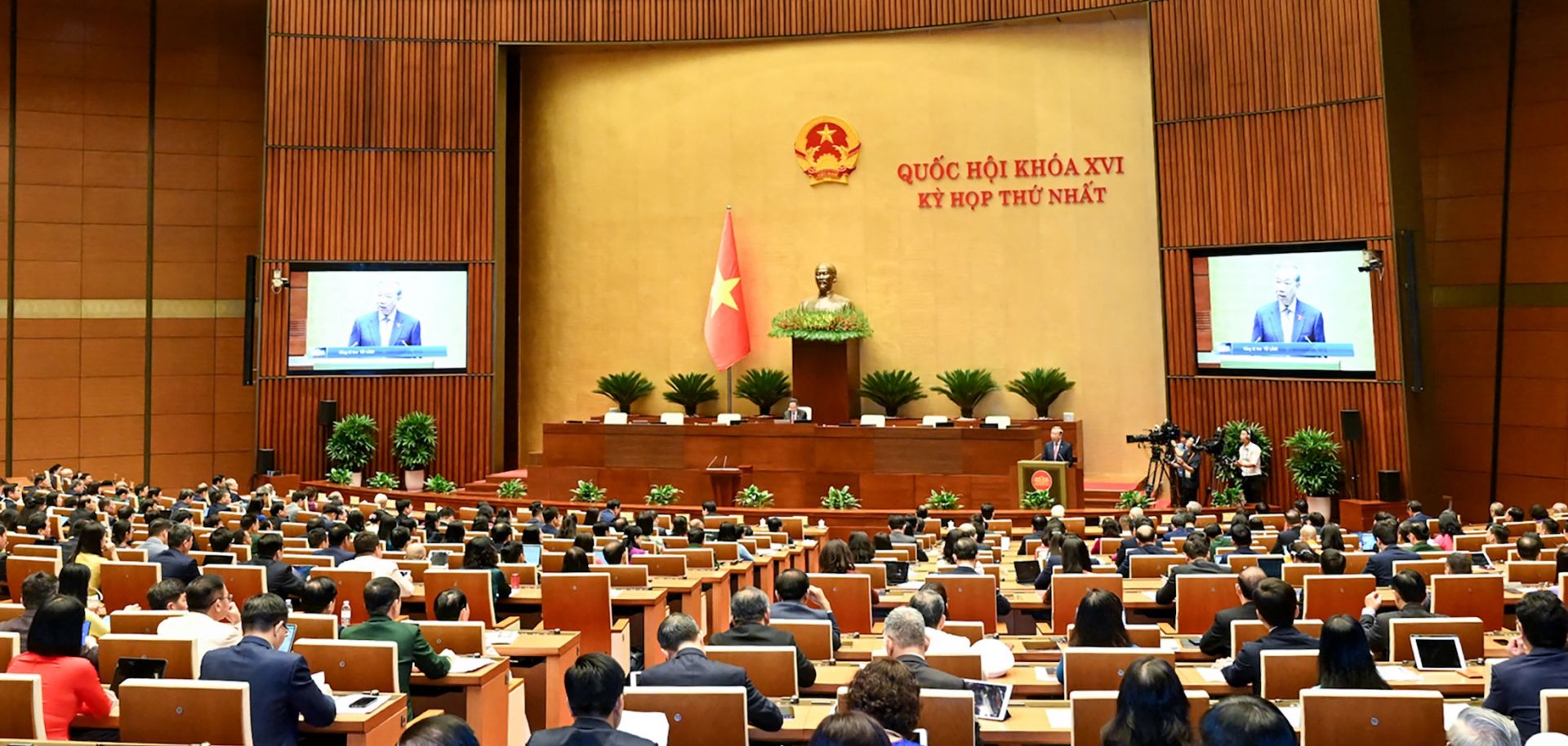
Vietnam's latest leadership appointments merge party and state authority into a single individual, signaling a shift toward more centralized, top-down and security-focused governance to improve policy coordination and execution, albeit with increased risks from reduced institutional checks and implementation distortions. On April 7, Vietnam's National Assembly unanimously elected Communist Party General Secretary To Lam as state president and Party Central Organization Commission head, Le Minh Hung, as prime minister for the 2026-2031 term, completing the top leadership appointments of the new legislative cycle. Lam, Vietnam's de facto top leader, now simultaneously holds the top party position and the presidency, while Hung — a former central bank governor — assumes control of the government. In his inaugural remarks, Lam emphasized maintaining political stability, strengthening national defense and security, and pursuing rapid, sustainable economic development. Hung outlined priorities including institutional reform, administrative streamlining and building a modern government oriented toward services capable of supporting high growth. The appointments also coincide with broader efforts to restructure the state apparatus, improve bureaucratic efficiency and align governance with long-term development goals, including digital transformation and industrial upgrading. No changes to Vietnam's formal political system or constitutional structure were announced during the session, and the transition proceeded without open dissent or competing nominations.

- The vote followed the April 6 reelection of National Assembly Chairman Tran Thanh Man and formalized decisions previously agreed within Party entities, now ratified by the government.
- Lam briefly combined the roles of party chief and president in 2024 following the in-office death of his predecessor Nguyen Phu Trong. Lam held both positions for several months during a transitional period before relinquishing the presidency, effectively establishing a precedent for the dual-role consolidation. His term-long holding of both positions is historic, marking the first sustained combination of the party chief and the presidency since Ho Chi Minh held both roles during the early decades of the modern Vietnamese state.
The leadership transition follows a period of significant personnel turnover in Vietnam's government linked to anti-corruption investigations and internal party discipline campaigns. Vietnam's new leadership configuration reflects both immediate institutional pressures and longer-term structural trends. Over the past decade, an expansive anti-corruption campaign — often referred to as the "blazing furnace" — has removed numerous senior officials, including presidents, ministers, provincial leaders and Politburo members. While economic growth has generally remained strong, these purges have led to administrative capacity gaps and increased bureaucratic caution, particularly with respect to licensing and approvals, resulting in project delays and slower policy implementation. At the same time, leadership turnover at the top has strained Vietnam's traditionally collective leadership model, which distributes authority across the party, state and government to avoid excessive concentration of power. The decision to allow Lam to concurrently hold both the top party position and the presidency marks a departure from this norm and marks a recalibration toward tighter central control (though without a parallel constitutional change, this does not yet represent a permanent structural shift). The leadership transition comes as Vietnam faces a more complex external and domestic environment, including heightened geopolitical competition both regionally and globally, evolving trade dynamics and pressure to sustain high levels of foreign investment and export growth, which is becoming more difficult in the current landscape. Economically, Vietnam has reached a stage where incremental reforms are delivering diminishing returns, increasing pressure for more coordinated policy execution and institutional changes. Against this backdrop, the timing of the leadership consolidation thus indicates a deliberate effort to strengthen decision-making coherence and execution capacity at a moment when both internal governance challenges and external pressures are intensifying.
- In Vietnam's system, the "state" and the "government" are distinct; the state includes institutions such as the presidency and the National Assembly, while the government is the executive branch led by the prime minister.
- Vietnam's anti-corruption campaign has led to numerous high-level resignations and dismissals, including two presidents in just over a year (Nguyen Xuan Phuc in January 2023 and Vo Van Thuong in March 2024) and two deputy prime ministers. Thousands of officials have also been disciplined or prosecuted across the system. Lam led the anti-corruption campaign as minister of public security from its inception in 2016 until his ascent to the presidency in 2024. He used this capacity to sideline potential rivals and pave the way for his eventual rise.
- In recent years, Vietnam has failed to disburse tens of billions of dollars in planned public investment, with ministries and local authorities delaying or avoiding licensing and project approvals amid fear of anti-corruption investigations. This has led to growing investor frustration, with foreign and domestic firms reporting that bureaucratic caution has slowed decision-making across key sectors, including infrastructure and real estate. In response, Vietnam issued a new anti-corruption resolution in March emphasizing "procedural clarity" and "institutional coordination," reflecting leadership concerns that aggressive enforcement has fostered bureaucratic risk aversion and slow approvals in key sectors.
The new leadership structure will likely produce more centralized and coordinated decision-making, with Lam exercising greater direct influence over both political direction and state institutions, while Hung operationalizes Lam's vision and focuses on execution. The leadership consolidation points to a governing model focused on speed, discipline and execution. It also places leaders with deep ties to the security apparatus at the apex of the system: Lam, a former minister of public security and the architect of the ongoing anti-corruption campaign, now oversees both party and state institutions, and his former protege is the top internal security official. This will, in turn, likely increase the role of internal security considerations in both domestic governance and strategic decision-making. Domestically, tighter top-down decision-making could improve policy coherence and reduce delays caused by coordination challenges across ministries and agencies, particularly in areas such as infrastructure development, regulatory reform and industrial policy. However, the concentration of authority also raises the risk of reduced internal debate and fewer institutional checks, meaning policy errors could be implemented more rapidly and at a greater scale before corrective mechanisms take effect. This consolidation of already top-down governance will likely narrow provincial autonomy — with local leaders increasingly operating as implementers of centrally directed policy — while prioritizing discipline and compliance over policy experimentation, which could limit feedback mechanisms within the system. On foreign policy, Vietnam will likely maintain its established strategy of balancing relations among major and middle powers, particularly though not exclusively the United States and China, while continuing to expand economic partnerships and avoid formal alignment. The leadership's focus on stability and economic development suggests continuity, though a more centralized and security-oriented system portends faster but more tightly controlled responses to external shocks. Over the longer term, the durability of this consolidation remains uncertain, as it has not been formalized through constitutional change. However, even a temporary alignment of party and state leadership over a single five-year term could influence policy direction and accelerate implementation, while establishing a precedent for future leadership lineups.
- In 2025, Vietnam implemented its most sweeping administrative overhaul in decades, reducing 63 provincial-level jurisdictions to 34, abolishing the district level entirely, and cutting 60-70% of commune-level jurisdictions while also reducing ministries from 22 to 17. The overhaul reflects a top-down effort to reduce redundant approval layers, streamline governance and accelerate decision-making.
- Lam's new role as president grants him formal command of Vietnam's armed forces as chairman of the National Defense and Security Council, complementing his existing authority over the military through the Communist Party's Central Military Commission. At the same time, Gen. Phan Van Giang was appointed deputy prime minister while retaining his role as minister of national defense and his senior position within the Communist Party's Central Military Commission, marking another historic merger of authority and reflecting a broader pattern of role consolidation across institutions, including the military.
- The consolidation of party and state leadership under Lam parallels elements of centralization seen under Xi Jinping in China, where the top leader simultaneously holds multiple apex roles, potentially providing a directional reference point for Vietnam as its currently more constrained institutional framework evolves.
Economically, Lam's consolidated leadership will likely lead to intensified efforts to remove bureaucratic bottlenecks, attract foreign investment and move up the manufacturing value chain through technology adoption and digital transformation. The effectiveness of this push will depend on whether the new leadership can translate centralized authority into actual administrative reform. Specifically, this will require streamlining approvals for investment projects, land use, construction and infrastructure, while also clarifying legal rules and reducing bureaucratic risk aversion following years of anti-corruption enforcement. In practice, incremental gains in efficiency and investment facilitation are more likely than a rapid structural transformation in Vietnam's economic system, sustaining the country's role in mid-tier manufacturing rather than driving an immediate shift into high-end production. At the same time, ambitious economic growth targets and state-led coordination efforts increase the risk of uneven implementation, inefficient capital allocation and localized bottlenecks, particularly at the provincial level where execution capacity varies. Nonetheless, Vietnam retains strong structural advantages — including entrenched supply chain integration, competitive labor costs, a growing network of trade agreements and sustained foreign investor interest — which will likely underpin continued manufacturing expansion, even if reforms fall short of their most ambitious targets.
- Hung, though a technocrat by training who served as governor of the State Bank of Vietnam from 2016 to 2020, has spent recent years overseeing Party personnel appointments, positioning him as a politically trusted technocratic implementer at a time when Vietnam is filtering out technocrats from top leadership roles more broadly.
- Vietnam's leadership has set ambitious targets of achieving annual GDP growth of around 10% during the 2026-2031 term, significantly above the 6-7% numbers of recent years, underscoring pressure to accelerate reforms and improve policy execution. Nonetheless, growth slowed in the first quarter of 2026, with GDP expanding 7.8% year-on-year, down from 8.5% in the previous quarter, reflecting headwinds even as overall growth remains strong.