
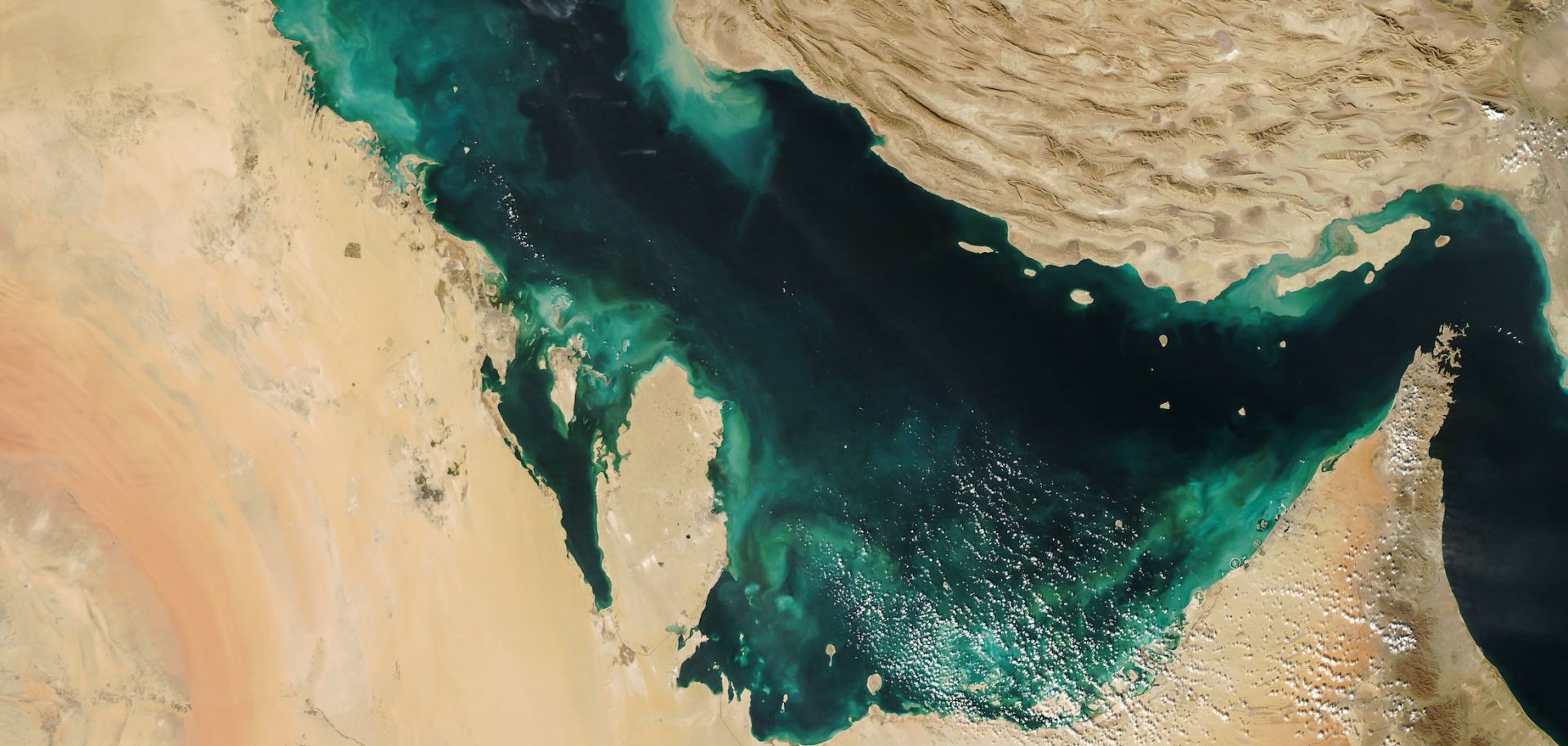
A satellite view of the Persian Gulf, with the Strait of Hormuz chokepoint seen on the right.
(Getty Images)
A satellite view of the Persian Gulf, with the Strait of Hormuz chokepoint seen on the right.

Maritime traffic will likely remain limited through the Strait of Hormuz despite the two-week U.S.-Iran ceasefire. The persistent risk that the agreement will collapse will likely keep shippers cautious, while any negotiated outcome is likely to leave Iran with partial control that expands its economic leverage despite Gulf resistance. On April 7, the United States and Iran accepted a two-week ceasefire just hours ahead of U.S. President Donald Trump's deadline for Iran to fully reopen the strait or face a significant escalation. The ceasefire enables Iran and Oman to charge transit fees on vessels. A spokesperson for Iran's Oil, Gas and Petrochemical Products Exporters' Union said that Iran intends to charge $1 per barrel of oil to be paid in cryptocurrency. Iranian officials have reportedly told mediators that Iran will limit the number of vessels transiting the strait to around a dozen per day and collect fees on them. However, on April 8, Iranian media reported that oil tankers had been stopped from transiting the strait after an Israeli "ceasefire breach," likely a reference to Israel's continued attacks against Hezbollah in Lebanon. On April 9, Iran's deputy foreign minister conditioned the reopening of the strait on an end to U.S. "aggression" and a halt to Israeli attacks on Lebanon; the same day, Israeli Prime Minister Benjamin Netanyahu said that he had ordered direct negotiations with Lebanon on disarming Hezbollah. Even so, the proposal leaves some ambiguity over maritime traffic through the strait to be discussed in further negotiations, though Iran has threatened not to participate in the scheduled April 10 talks if Israel continues to attack Lebanon.

  • The ceasefire came a day after Iran rejected Pakistan's two-phased 45-day ceasefire proposal and instead proposed a 10-point proposal to permanently end the conflict, which included stipulations for Iranian control over the Strait of Hormuz. Initially, Trump said that the proposal was "not good enough," but later, after agreeing to the two-week ceasefire, called it a "workable basis on which to negotiate." The 10-point proposal's stipulations include the reopening of the strait under Iranian control, establishing protocols for ships transiting the strait and enabling Iran and Oman to charge shipping fees on vessels transiting the strait. Iran would then use the funds for reconstruction in an effort to reframe previous demands for U.S. reparations payments.
  • On April 8, Oman's minister of transport said that the kingdom had entered into agreements for the transit of maritime vessels that stipulate no fees would be imposed, indicating that even if Iran collects fees, Oman would not.
  • According to The New York Times, only four ships transited the strait on the first day of the ceasefire, though these did not include oil or liquefied natural gas tankers.

The fragile ceasefire took hold amid Iran's efforts to institutionalize de facto control over the Strait of Hormuz, prompting international resistance. In recent weeks, Iran has taken steps to formalize its control over the strait after effectively closing it following the outbreak of war on Feb. 28. Iran has reached bilateral agreements with some countries to facilitate the transit of vessels and imposed a system of collecting transit fees of up to $2 million for vessels transiting the strait, which it is trying to formalize through parliamentary legislation. Furthermore, Iran is developing protocols to "monitor transit" through the strait, which would further strengthen its control over the chokepoint. Several countries, including the United Kingdom and the United Arab Emirates, have rejected Iranian efforts to control the strait, as it upends the longstanding status quo of unimpeded, free maritime transit. 

  • Around 20% of global oil and liquefied natural gas (LNG) exports pass through the Strait of Hormuz. Kuwait, Bahrain and Qatar are particularly exposed to disruptions in the strait since they have few alternative export routes. Despite some Iranian agreements to allow vessels to transit, Gulf countries seem to be largely excluded from these due to their ties with the United States. On April 6, Iran's Islamic Revolutionary Guard Corps halted two Qatar LNG tankers approaching the strait, indicating that Iran was leveraging its control over the strait to pressure Gulf states.

Although the ceasefire may allow limited maritime traffic through the Strait of Hormuz, many companies will remain wary of transiting due to lingering security concerns and the risk that a collapse in negotiations would further deteriorate the security environment around the strait. Pakistani mediators, as well as China (one of the largest consumers of Gulf oil), will likely pressure Iran to reopen the strait as a confidence-building measure to advance diplomatic efforts, though Iran will likely only do so in a limited manner. With Iran's control over the strait key leverage in negotiations, Tehran is unlikely to fully reopen the strait and return to the pre-war status quo. If Iran allows vessels to pass through the strait, which would be more likely if Israel stopped its attacks on Lebanon, potentially under significant U.S. pressure, growing economic pressures could push some ships — particularly oil and LNG tankers, as well as helium container ships — to resume transit through at still low levels. According to an April 8 Bloomberg report, shipowners have increased requests for insurance coverage to transit the strait after the ceasefire. Even so, many shipping companies will likely remain wary of the persistent security risks. The agreement remains very fragile, and it remains unclear whether Iran will allow ships to transit and, if so, which ones. In addition, further negotiations between the United States and Iran will remain highly contentious due to major gaps between U.S. and Iranian demands, including over uranium enrichment, the ballistic missile program and Iranian oversight over the strait, which risk a breakdown in negotiations and could result in a fully closed strait. U.S. partners in the region, especially the United Arab Emirates, will likely pressure the United States to maintain maximalist demands for the full reopening of the strait to reduce Iran's economic influence over maritime trade in the region. If further negotiations collapse, the United States and Israel will likely resume attacks against Iran, and the strait's security environment will likely deteriorate. In that event, Iran would likely further reduce vessel traffic through the strait, perhaps even closing it entirely. Iran would also prevent Gulf-linked, U.S.-linked or Israeli-linked vessels from transiting and/or expand attacks on vessels in the Persian Gulf to raise the economic cost of the ceasefire collapsing.

  • After Israel conducted additional attacks against Lebanon despite the two-week ceasefire, the Iranian Parliament's National Security and Foreign Policy Committee Spokesperson Ebrahim Rezaei called for maritime shipping in the strait to be halted completely in an April 8 post on X.
  • Israeli Prime Minister Benjamin Netanyahu said that the ceasefire would not include Hezbollah during an April 8 address. However, after calls between Netanyahu, Trump and U.S. envoy to the Middle East Steve Witkoff, Netanyahu announced that he had ordered the start of direct negotiations with Lebanon, indicating that the United States has pressured Israel to curb its attacks on Lebanon and enable space for de-escalation.

A U.S.-Iran compromise on the Strait of Hormuz would likely maintain Iranian control over the strait, which, over time, would facilitate maritime traffic. Though unlikely, if the United States and Iran reach a compromise on issues such as uranium enrichment, Washington may become more open to accepting Iranian control of the strait. In such a case, Iran would likely collect transit fees for vessels crossing the strait. An improved security environment would likely significantly boost maritime traffic over time, since many companies would likely be more willing to pay the transit fees in order to resume operations, especially if there were U.S. guarantees that they would not be sanctioned. However, even if maritime traffic resumes at scale, damage from Iranian attacks against regional infrastructure and production disruptions would still likely result in slower traffic through the strait over the next several months.

In a scenario where Iran maintains control over the Strait of Hormuz, Gulf countries would likely eventually increase pressure on the United States to launch a renewed military operation to reduce Iran's control over the waterway and, by extension, Tehran's leverage over their economies. Iran maintaining control over the strait would give Tehran significant leverage over Gulf economies, which heavily rely on the strait for exports, as Iran would be able to tighten restrictions on specific countries or economic sectors. However, U.S. war weariness and domestic disapproval of major military operations against Iran make a U.S.-led military operation to forcibly reopen the strait less likely over the next several months. In the absence of U.S. participation in a military operation to forcibly reopen the strait, European, Asian and/or Gulf countries would be highly unlikely to try to forcibly reopen the strait themselves, for fear of getting embroiled in a prolonged conflict with Iran that would expend significant resources and manpower. As such, they would likely be forced to accept the new status quo in the near term despite rhetorically rejecting it. Gulf countries would likely pursue alternative export routes to reduce their reliance on exports through the strait, though some, such as Bahrain and Qatar, are geographically constrained in doing so. Although some countries, like the United Arab Emirates, would likely push for a return to the pre-war status quo to reduce Iranian leverage over their economies, they would struggle to secure crucial U.S. buy-in for such an operation. However, if Iran further obstructs maritime trade through the strait, causing more prolonged disruptions to global supply chains, Gulf partners would likely further increase pressure on the United States to participate in a military operation to fully reopen the waterway in the coming months or years. 

  • To address this possibility, European countries have discussed supporting naval convoy operations to secure navigation through the strait and potential mine-clearing efforts. However, they have conditioned participation on a significant de-escalation in the conflict to reduce security risks.
  • Trump said on April 9 that the United States was considering a "joint venture" with Iran to manage the strait, though he did not provide additional details on how the plan would operate. Though such a proposal is unlikely, Trump's comments indicate that he is considering a scenario in which Iran would have some control over the strait.
RANE
SUBSCRIBERS ONLY

Expert analysis when it matters most.

Get access to RANE's decision-grade geopolitical intelligence.