
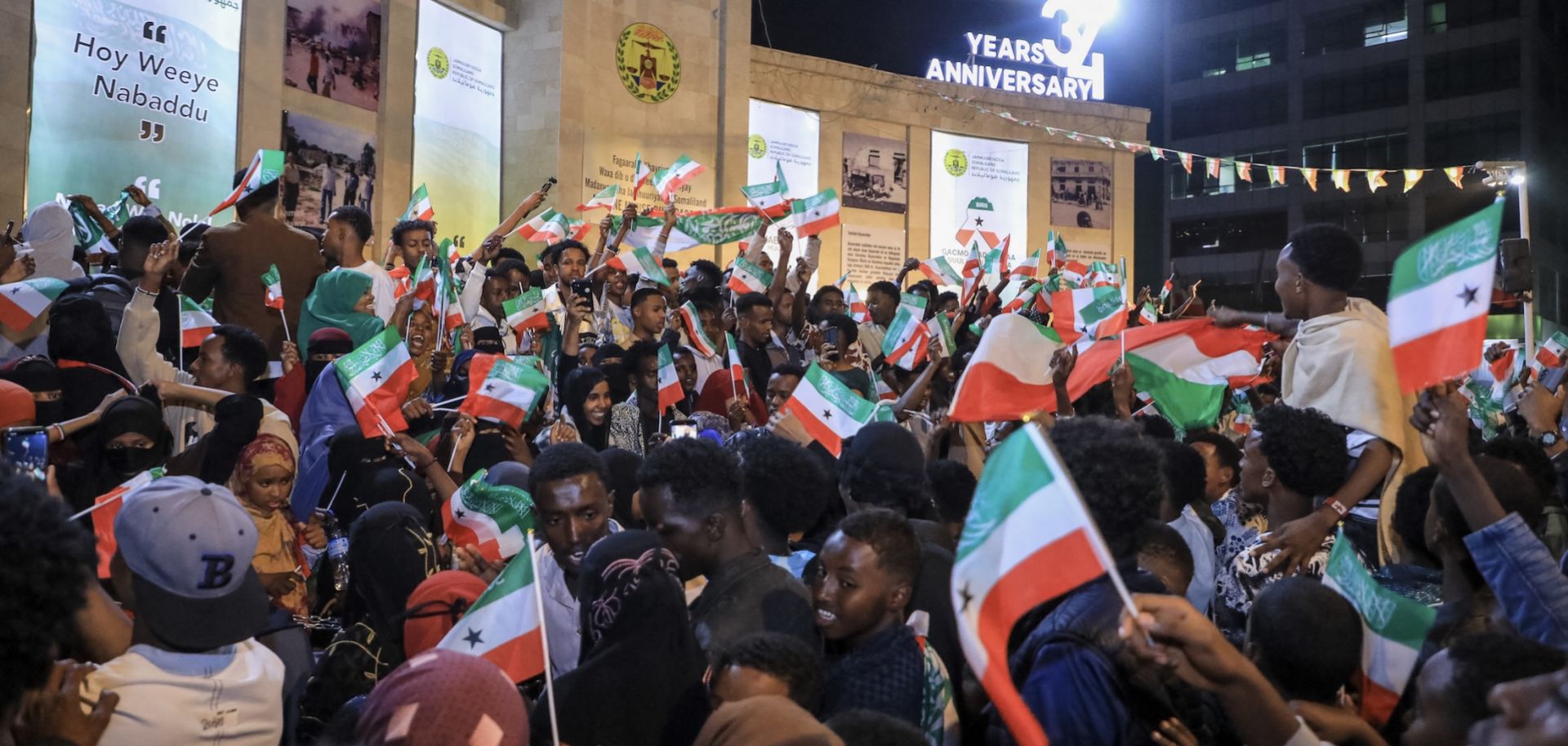
Israel's recognition of Somaliland's independence will likely enable it to eventually secure access to military facilities in the territory, which would raise the likelihood of retaliation from the Houthis. It also increases the likelihood of the United States, Ethiopia and the United Arab Emirates recognizing Somaliland in the coming years and threatens to escalate proxy conflicts in Sudan and Yemen. On Dec. 26, Israeli Prime Minister Benjamin Netanyahu announced Israel's recognition of the independence of Somalia's breakaway region of Somaliland. The move came after Netanyahu signed a declaration of mutual recognition with Somalilander President Abdirahman Mohamed Abdullahi, known as Irro, with Israel pledging to expand cooperation with Somaliland in the field of agriculture, health, technology and the economy. Following the signing ceremony, Netanyahu said that the joint declaration was "in the spirit of the Abraham Accords" and that he would tell U.S. President Donald Trump about Somaliland's readiness to formally join the accords, which have normalized ties between Israel and several Muslim countries. Israel's recognition of the breakaway region's independence was swiftly denounced by Somalia's federal government as a "deliberate attack" on its sovereignty, with many international organizations reiterating their support for Somalia's territorial integrity. Saudi Arabia, Egypt, Turkey and China — among others — denounced Israel's recognition of the breakaway region's independence. Yemen's Houthi rebels warned on Dec. 28 that any Israeli presence in Somaliland would be considered a military target.
- The African Union, Gulf Cooperation Council, East Africa's Intergovernmental Authority on Development and the Organization of Islamic Cooperation issued statements rejecting Israel's recognition of Somaliland. The European Union and East African Community reiterated their support for Somalia's territorial integrity.
- In response to Netanyahu's comments about Somaliland's interest in joining the Abraham Accords, Trump struck a cautious tone, saying that the question was "complex" and that his administration was "working on that right now."
Israel's recognition of Somaliland's independence comes as the breakaway region's efforts to gain international recognition have gained momentum in recent years and as Israel looks to expand operations against Yemen's Houthi rebels. Somaliland declared independence in 1991 following the collapse of former Somali President Siad Barre's regime, but the territory failed to secure recognition from the international community for more than three decades, despite its relative stability, in part due to concerns about boosting secessionist movements across Africa. However, Somaliland's efforts to secure recognition from international partners have enjoyed momentum in recent years, first with the establishment of embassy-level ties with Taiwan in 2020. In January 2024, Ethiopian Prime Minister Abiy Ahmed signed a memorandum of understanding with Irro's predecessor that opened the door to Ethiopian recognition of Somaliland in exchange for landlocked Ethiopia gaining access to Somalilander ports. While the agreement was put on hold following regional backlash and Turkish mediation between Somalia — which strongly opposed the agreement — and Ethiopia, Addis Ababa has not formally scrapped the memorandum of understanding. Meanwhile, support for a recognition of Somaliland has gained support among a growing number of U.S. Republican Party lawmakers, many of whom consider it to be a preferable location for a military base than neighboring Djibouti, which currently houses the main regional U.S. base but is viewed with suspicion because of its ties to China. In August, Trump himself confirmed that his administration was "looking into" recognizing Somaliland. Separately, Israel — which has come under attack from the Iran-backed Houthis since late 2023 — has been seeking to expand its security footprint in the Red Sea to counter the Houthi threat in recent months, after already significantly degrading the capabilities of most other Iranian proxies and allies over the last two years.
- The Houthis began targeting Israeli-linked vessels crossing the Bab el-Mandeb strait in November 2023 in response to Israeli military action in Gaza following Hamas's attack on Israel the previous month. However, Houthi operations also targeted commercial vessels, prompting most shippers to avoid the Red Sea. Houthi attacks began to ease in late 2024 and largely ended after Israel and Hamas signed a peace plan in October 2025.
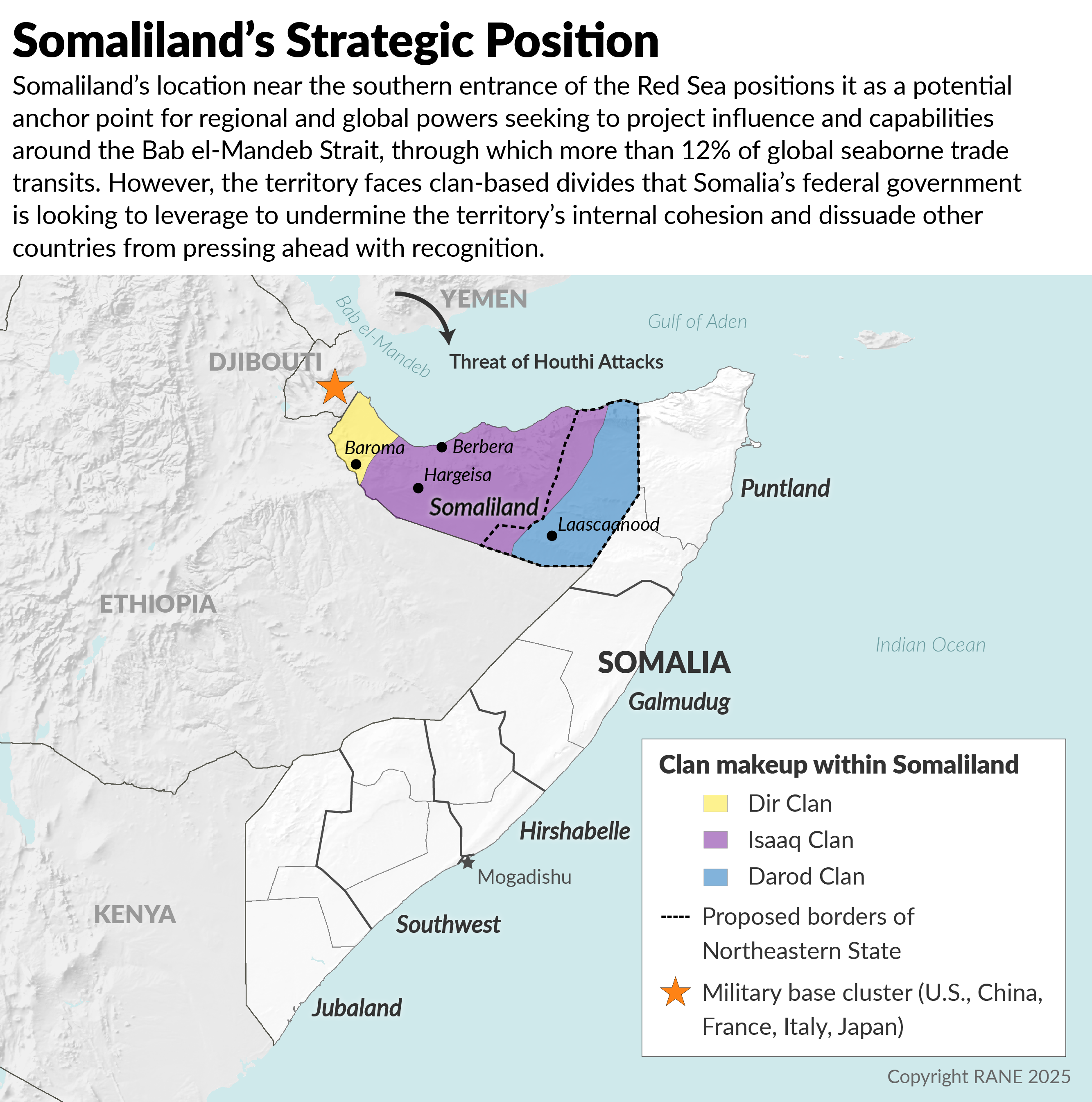
Israel's recognition of Somaliland will likely enable it to eventually secure access to military facilities in the territory, which would raise the risk of Houthi and al Shabaab attacks in Somaliland or against Israeli-linked ships crossing the Bab el-Mandeb strait that could disrupt commercial shipping. Somaliland's strategic location near the southern entrance to the Red Sea means that Israel's recognition of the territory's independence is partly driven by long-term and strategic considerations — including preparing for growing competition with Turkey. However, the Israeli government's more immediate ambition to expand its security footprint in the region to counter the Houthis is likely the leading driver behind the timing of the move. By becoming the first U.N. member to recognize its independence, Israel has gained strong bargaining power over Somaliland. This suggests that Israeli security forces are likely to eventually secure access to military facilities in the territory — even if a formal base is less likely for the foreseeable future. Any Israeli military footprint would likely initially be covert and focus on logistics, expanding intelligence gathering operations in Yemen — and potentially, although less likely in the short term, launching airstrikes — from Somaliland. Given Houthi threats, any such move by Israel would likely prompt the Iran-linked rebels to attack Israeli assets, Israeli-linked facilities or strategic sites in Somaliland using their missile and drone capabilities. The Houthis may also seek to expand their military cooperation with al Qaeda affiliate al Shabaab to target Israeli interests in Somaliland. While the jihadist group's presence in northern Somalia is weak compared to central and southern Somalia, the Houthis may now prove willing to expand their weapon supplies to the group, enabling it to expand its insurgency in the area or conduct targeted operations against strategic sites. Israel nonetheless maintaining a military presence in Somaliland despite these actions could ultimately prompt the Houthis to resume attacks on Israeli-linked ships near Bab el-Mandeb, which could again disrupt maritime trade through the Red Sea.
- The Houthis and al Shabaab have been engaged in small arms smuggling operations across the Gulf of Aden for years. The two groups have expanded cooperation in recent years, including the training of al Shabaab militants in improvised explosive devices, drone adaptation and weapons maintenance. However, al Shabaab's presence in northern Somalia is largely limited to mountainous regions along the Puntland-Somaliland border.
Israel's recognition of Somaliland increases the likelihood of the United Arab Emirates, Ethiopia and the United States following suit in the next few years, but it also paves the way for greater coordination between Saudi Arabia, Egypt and Turkey along the Red Sea corridor against Israel, the United Arab Emirates and Ethiopia, which could escalate proxy conflicts in Sudan and Yemen. Strong international pushback against Israel's recognition of Somaliland will constrain Ethiopia and the United Arab Emirates — the breakaway region's other two close partners — from following suit in the immediate future. Addis Ababa will instead likely favor leveraging Israel's move to pressure Somalia into reengaging in Turkey-brokered talks over maritime access, which have reportedly been frozen since July, by using the threat of Somaliland recognition to pressure Mogadishu. For its part, Abu Dhabi will likely continue its lobbying of the Trump administration to recognize Somaliland — which would provide it diplomatic cover to follow suit. Together with lobbying from Israel on the matter and growing support from Republican lawmakers, this suggests that Trump is growing more likely to recognize Somaliland's independence before the end of his term. However, recognition would trigger strong pushback from Egypt, Saudi Arabia and Turkey, which appear increasingly likely to strengthen their diplomatic coordination along the Red Sea corridor against an emerging Israel-Ethiopia-United Arab Emirates partnership. Even in the absence of an Emirati or Ethiopian recognition of Somaliland in the coming months, Israel's recognition of Somaliland appears likely to escalate competition for political and economic influence in the Red Sea region between Egypt, Saudi Arabia and Turkey — which lean toward the status quo — on the one hand and Israel, Ethiopia and the United Arab Emirates — which lean toward greater revisionism — on the other. In turn, this could escalate ongoing conflicts in Sudan and Yemen in the coming weeks and months. In Yemen, this will raise the likelihood of Riyadh taking further military action against the Abu Dhabi-backed Southern Transitional Council, while in Sudan, Emirati lobbying could prompt Ethiopia to extend support to the paramilitary Rapid Support Forces in the face of the Sudanese Armed Forces' refusal to depart from its maximalist position in ongoing U.S.-backed mediation efforts to deescalate the civil war.
- India's non-reaction to Israel's recognition of Somaliland also suggests that Prime Minister Narendra Modi may be eyeing a recognition of Somaliland in the medium term. India has stepped up its naval patrols against Somali pirates since the end of 2023 and Modi conducted a state visit to Ethiopia in December 2025, signaling strengthening ties with Addis Ababa.
- Saudi, Egyptian and Turkish coordination in the Red Sea may notably include growing cooperation between the three states in supporting the Sudanese Armed Forces as well as expanding economic, diplomatic and logistical support to Eritrea — which faces heightened tensions with Ethiopia. However, this trilateral cooperation could also materialize with fresh Turkish or Saudi investments in Egypt, even though the extent of cooperation will likely be curtailed by Riyadh and Cairo's concerns about Turkey's long-term ambitions in the region.
