
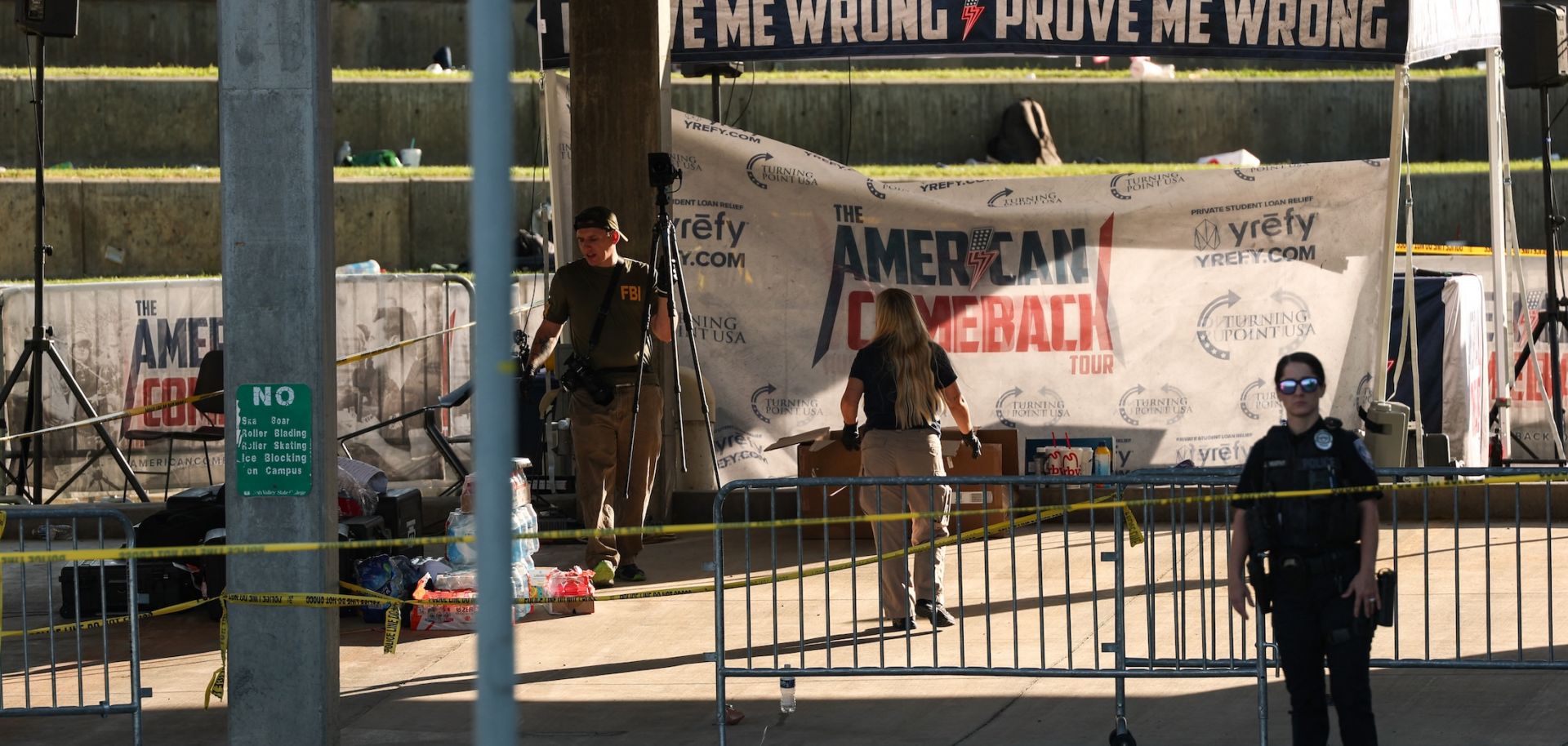
A week after U.S. conservative activist Charlie Kirk was assassinated, the alleged assassin's precise motive remains unclear, despite significant law enforcement investigation and media attention. To be sure, Utah Gov. Spencer Cox has said that Tyler Robinson had an unspecified "leftist ideology" — and authorities' initial legal filings and journalists' inquiries have also provided a few suggestions of Robinson's alleged grievances — but the lack of clarity around Robinson's ideological beliefs that led him to supposedly kill Kirk is conspicuous given the 24/7 news coverage of the attack. What has been publicized about Robinson, based on accounts from his family and friends, paints a more nuanced picture than a mere left-wing radical.
Much like the killing itself, this picture is both surprising and yet simultaneously in line with recent trends. Political violence in the United States and other Western countries is becoming harder to define. Perpetrators' ideologies increasingly appear vague, muddled and at times wholly incongruous. Attackers seem to anchor their acts less in politics and more in violence for its own sake. For security professionals, this will make it harder to detect and counter extremists before they act. For society at large, the trend raises troubling questions about the erosion of shared values, worsening alienation and further political polarization — all of which threaten to hobble the government's response to challenges at home and abroad.
The Extremist 'Salad Bar'
For much of the modern era, categorizing political extremists into groups — far-left, far-right, religious, single-issue or otherwise — has been fairly easy. Within these, further classification was usually fairly straightforward: for instance, far-right extremists more motivated by anti-government beliefs than those who adhered to neo-Nazism. There have always been outliers, but for the most part, attackers' motivations were clear. To be sure, these categories still serve an important purpose in helping authorities allocate resources, track trends in different threats and help make sense of many acts of violence, but their utility has waned.
Beginning in the late 2010s and accelerating in the early 2020s, U.S. security agencies and counterextremism researchers began highlighting a rise in cases in which extremists seemed to lack a clear, singular ideological motivation and instead appeared to take inspiration from multiple ideologies to justify violence. This phenomenon was famously termed the "salad bar of ideologies" by former FBI Director Christopher Wray in September 2020, who used it to describe extremists who pick from different ideologies to justify their main goal, violence. As with the current spate of U.S. political violence, it will be for historians to judge the precise forces behind this shift, but at least three key trends — all of which appear present in Robinson's case — can be identified.
First, violent content remains widely available online. Extremist movements and niche subcultures are ever-evolving, offering a wide variety of entry points for radicalization, ideological justifications and tactical guidance for attacks from which extremists can pick and choose. The proliferation of conspiracy theories, misinformation and deliberate disinformation has meant that people are continually exposed to toxic digital discourse that, especially when repeated in closed online communities, can lower the threshold for some people to commit violence. It has emerged that Robinson was highly active online, including in gaming communities and meme culture — from which he appears to have at least partially radicalized or drawn inspiration for his attack.
Second, growing societal discord — comprising worsening political polarization, falling trust in institutions and declining social cohesion — has increasingly normalized ideas once considered outside the realm of generally acceptable political discourse. These trends have bred not merely intolerance, but zero-sum us versus them narratives. They have led many extremists to combine broader ideological inspiration from extremist movements with more personal grievances. Alongside the spread of divisive and inflammatory political rhetoric that has amplified additional sociopolitical grievances, this combination of grievances can drive some people to believe that violence is necessary and justified, even if the ideological motivations are blurry. These trends appear to have affected Robinson, who apparently was aggrieved with Kirk's controversial rhetoric in general, and specifically with his views on transgender individuals, in part because Robinson was allegedly romantically involved with his roommate, who was transitioning from male to female.
Finally, there has been a rise in lone-actor and small-group extremism in which perpetrators take inspiration from extremist ideologies but plot their attacks without any sort of membership in an established group or even participation in a loose movement. Whereas hierarchical group structures generally enforce ideological cohesion, extremists who operate largely if not entirely on their own are freer to take inspiration from multiple sources. As there is no indication that Robinson received any outside support or that he provided any meaningful warning before his attack, he appears to be very much in alignment with the rise of the lone-actor model of extremism.
Less Political, More Violent
Earlier this year, the FBI coined the term nihilistic violent extremism, or NVE, to describe attackers who lack a clear ideology and prioritize violence as a goal in itself because they are motivated by anger at society, want to accelerate its demise and to gain notoriety for doing so. Even if Robinson may eventually be judged not to fit this precise definition, the number of cases of extremist violence with mixed, unclear and at times contradictory motives that defy traditional categorization is growing.
A recent spate of attacks and disrupted plots in the United States and abroad has been linked to violent online networks known by names like the Order of Nine Angles, The Com, 764 and No Lives Matter. Some recent school shootings — such as one in August at a Minneapolis Roman Catholic school that killed two children — also bear the hallmarks of this trend. In May, an attacker killed himself and injured four other people when he detonated a bomb outside a fertility clinic in Palm Springs, California, in an attack apparently motivated by "anti-natalism," a fringe ideology that defies clear categorization along the extremist spectrum. And while not technically considered an NVE because his attack occurred before the term was implemented, in July 2024, a gunman — whose motives remain unclear, but who appears to have simply wanted to commit violence and gain notoriety — nearly assassinated then-presidential candidate Donald Trump in Butler, Pennsylvania. These are just a small sampling of cases in the United States. Authorities in other Western countries report similar trends.
Troublingly, all signs point to their intensification. Whether called NVEs or otherwise, the forces propelling the rise of attackers with apparent but imprecise political motivations appear set to expand. Among other things, social media companies' rollbacks to content moderation, online movements that glorify violence and encourage competition among participants to promote and conduct attacks, the disruptive impacts of the spread of artificial intelligence across labor markets and society, deepening political polarization, waning trust in government, and further social alienation magnified by disputes over immigration and economic shocks will stoke grievances in ways that increase the likelihood not only of political violence, but especially of violence lacking a clear ideology.
The Impacts of Violence Without a Clear Cause
Most immediately, security services will have a harder time dealing with a growing pool of people at risk of committing violence for ostensible political ends, but without clear ideological motivations. Law enforcement and intelligence agencies generally understand the contours and responses needed to tackle most traditional extremists. But the rise of more ideologically muddled, fluid and at times incoherent attackers will be a new test. With radicalization often occurring fully in private or in niche online communities with unique vocabularies and at times high bars to entry, authorities have fewer means to detect threats in advance. Moreover, strategies tested over years of combating other forms of extremists will not necessarily work against attackers motivated by the ideological salad bar, let alone by violence for its own ends. That many of the people in this mold have been young — at times, in their teens — only adds to this difficulty, as for legal, ethical and practical reasons it can be much harder to monitor minors.
The rise of political violence that is more violent than political will also have broader societal impacts. For one, it not merely illustrates, but also serves to reinforce broader trends toward greater social alienation, political polarization and already fraying senses of common values that bind society together — in this case, propelling forward a vicious cycle. People yearn to make sense of violent incidents. The inability to explain an attacker's motive risks amplifying others' feelings of anger, anxiety or apathy. While abstract concepts that are hard to measure, these undoubtedly have practical consequences, weighing on political participation, community engagement and other things that make for a healthy body politic.
Perhaps the most concerning consequence, however, is that political violence lacking a clear rationale is fodder for political partisans to ascribe their own meaning to attacks, worsening the very trends that help to motivate the violence in the first place. Robinson's motive remains unclear — in fact, many signs suggest he was not an archetypal left-wing radical but rather a generally apolitical but deeply internally conflicted individual motivated more by personal grievances than a broader ideology. But top U.S. officials have wholeheartedly blamed left-wing political beliefs in general for Kirk's assassination, minimized conservatives' responsibility for the current wave of political violence and threatened a sweeping crackdown on left-wing groups, despite Robinson's apparent lack of engagement with any such groups — all of which threatens to polarize the country further. At home, such a response will only stoke the influence of the far left and far right at the expense of the moderate middle, amplifying partisanship and stymieing any hope of collaborative policymaking. Abroad, it will further color how the United States interacts with other countries, something already seen by trade, security and other disputes with governments the Trump administration has accused of promoting "woke" and other left-wing policies.
Tragically, it is not as though a reversion to the historical norm of clearer ideological categorization of political violence would meaningfully reverse these trends. While ideologically amorphous violence is deeply troubling, it still fits into the overall wave of political violence in which the United States finds itself. The precise contours of that wave may shift, but the overall trajectory of more violence is clear for the foreseeable future.
