
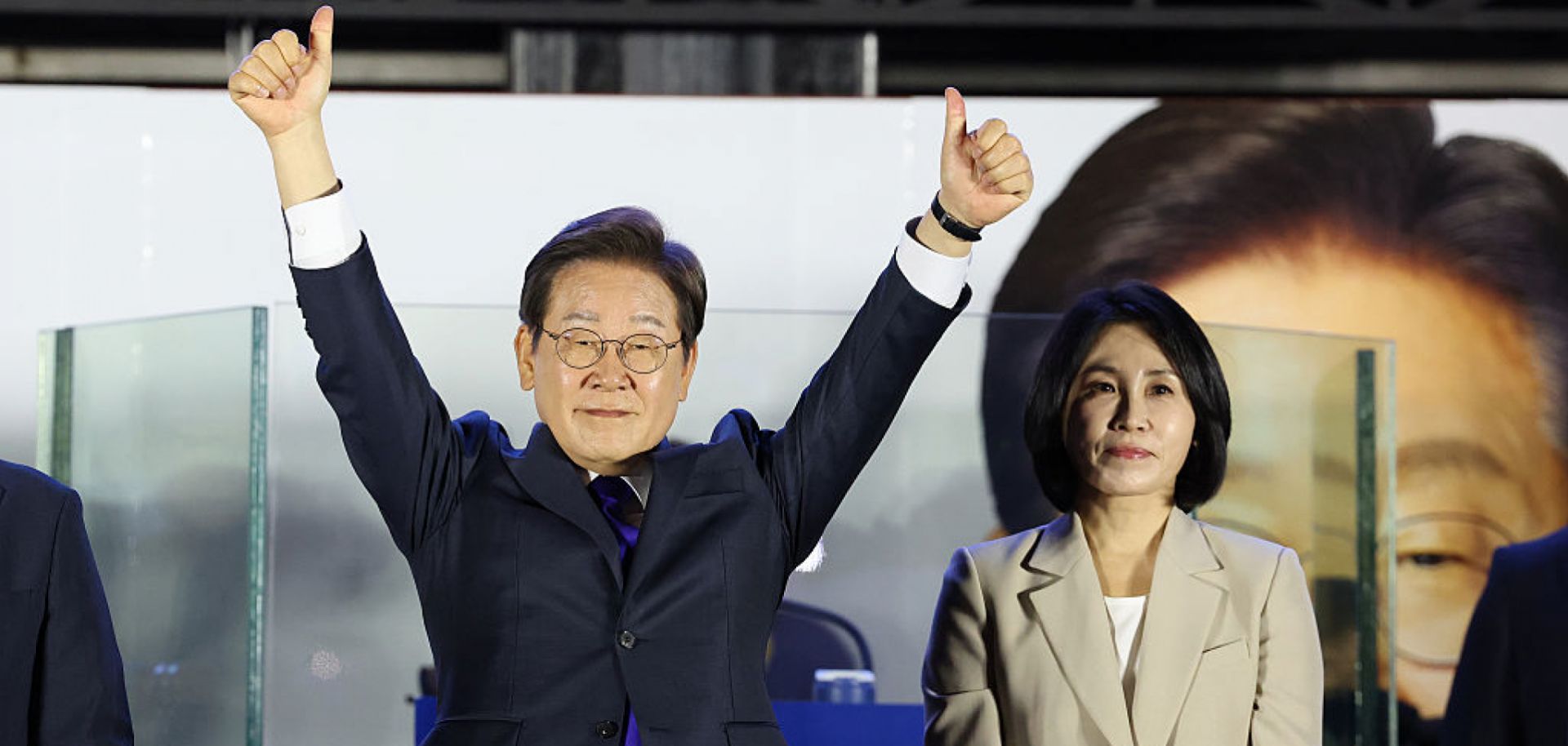
Lee Jae-myung and his wife celebrate his projected victory in South Korea's presidential election on June 4, 2025, in Seoul, South Korea.
(Chung Sung-Jun/Getty Images)
Lee Jae-myung and his wife celebrate his projected victory in South Korea's presidential election on June 4, 2025, in Seoul, South Korea.

South Korea's new president will lessen but not eliminate political instability that has plagued the country since late 2024, pursue pro-labor policies that could raise business costs, and seek to improve ties with China and North Korea, though security ties with the United States may impede the former effort. Early in the morning of June 4, Kim Moon-soo of South Korea's conservative People Power Party (PPP) conceded defeat to Lee Jae-myung of the progressive Democratic Party of Korea (DPK) in the June 3 presidential election. As of 6 a.m. Seoul time, the election results indicate that Lee won with 49.4% of the vote versus Kim's 41.2%, with 100% of votes tallied. Lee will be sworn in as soon as the election commission validates the results, likely within the next 24 hours. Kim's loss is partly attributable to his ardent support for former President Yoon Suk Yeol, whose Dec. 3-4 martial law bid led to his impeachment in April, triggering an early presidential election to be held within 60 days. Since Yoon's failed gambit, Lee has tried to reposition himself as a political foil to what he framed as Yoon's overreach, which struck a chord among South Korean voters, who are highly sensitive to any signs of authoritarianism, given that the country only transitioned from authoritarian to democratic rule in 1987.

  • Supplementing Lee's presidency, his Democratic Party holds 171 of the 300 seats in South Korea's unicameral legislature, the National Assembly, versus the PPP's 107 seats. This gives the DPK a simple majority by itself and, when combined with fellow progressive parties, it has just shy of a supermajority.
  • Voter participation in the June 3 election was 78%, according to the National Election Commission, the highest turnout in any South Korean election since 1997.

Though Lee will pursue reforms aimed at reducing domestic political instability, his own legal issues and reputation for combative politics will prolong such instability, while his efforts to overhaul South Korea's judiciary will raise rule of law concerns. Lee's victory will resolve some of the political instability and market turbulence stemming from Yoon's martial law bid, as Lee will likely pursue at least amendments to the Martial Law Act that his predecessor invoked and at most constitutional reforms to weaken the martial law powers of the president and change presidential term limits from one five-year term to two four-year terms (though the latter will be difficult without opposition support in the legislature). However, Lee's position is not entirely secure, as he faces multiple ongoing court cases pending against him, including those related to alleged election law violations from the 2022 election. These cases could result in punishments (e.g., jail time or large fines) that, by law, disqualify him from the presidency and trigger yet another early presidential election within 60 days. Moreover, as DPK leader, Lee has notoriously pushed through his policy demands above the objections of his enemies (including supporters of the previous DPK leader, former President Moon Jae-in, and PPP lawmakers), earning him the name Dictator Lee among some DPK members. Should Lee maintain this combative leadership style as president, it could stoke PPP-led street protests and intra-DPK party splits, though the latter may take several months or even years to manifest as policy opposition in the National Assembly. In addition, Lee and his DPK have proposed judicial reforms, like expanding the Supreme Court to include more justices (which would benefit the ruling party) and expanding legislative and executive oversight of the Constitutional Court (given the court's recent rejections of DPK efforts to impeach Yoon cabinet officials). These reforms could raise corporate concerns about the rule of law in South Korea if the courts are either stacked in favor of the pro-labor DPK or inhibited by government oversight from ruling on certain cases.

  • During former President Yoon's term, the DPK used its legislative majority to pursue impeachments of several Yoon cabinet members, but most of these were overturned by the Constitutional Court, including the case against Justice Minister Park Sung-jae in April. In May, the Supreme Court voted to overturn a lower court ruling that acquitted Lee of election law violations, sending the case back down to the lower court for reexamination.

Lee will champion labor unions, as well as social spending that raises household incomes but also costs for businesses; additionally, he will seek to expand renewable energy while curbing fossil fuels. Policy-wise, Lee will be a pro-labor president, empowering unions in their negotiations with corporate executives, seeking to raise wages for workers, and potentially raising taxes for businesses while lowering them for lower- and middle-class households. He will also increase social spending to help alleviate cost of living concerns, particularly about housing and food costs. This could involve food and energy subsidies, as well as efforts to expand public housing and potentially curb investment activity in the housing sector. While these and other efforts will benefit workers and households, they will simultaneously raise costs for businesses operating in South Korea that are already threatened by U.S. tariffs. To this end, if Seoul is unable to quickly reach a trade deal with the White House that removes tariffs, Lee will likely pursue a greater economic support package to soften the blow of reduced exports to the United States on South Korean industries and households. Meanwhile, on energy, Lee and his party will seek to expand the use of renewables while curtailing that of fossil fuels; DPK rhetoric also suggests that the Lee administration will be less supportive of nuclear energy compared with the Yoon administration, but given that nuclear power represents a sizable share of South Korea's energy mix, Lee is unlikely to pursue rapid or extensive nuclear curbs.

  • In April, the United States imposed a 26% tariff on all South Korean imports, which was temporarily reduced to 10% until July, as well as a 25% tariff on automobile, steel and aluminum imports, with U.S. President Donald Trump pledging to expand the steel and aluminum tariffs to 50% in late May. Automobile tariffs are a particular concern for Seoul, 
  • given that the United States imported $43 billion worth of South Korean vehicles in 2024, representing 47% of the Asian country's total vehicle exports that year. 
  • According to the International Energy Agency, South Korea's energy mix in 2023 was comprised of 37% oil, 24% coal, 19% natural gas and 17% nuclear.

On foreign policy, Lee's top priority will be securing relief from U.S. tariffs, though he will also seek to improve economic ties with China and diplomatic ties with North Korea. The Trump administration's protectionist trade policy risks severely harming South Korea's economy, which is heavily dependent on exports, including automobiles and various electronics — both of which now face steep U.S. tariffs. This will force Lee to initially prioritize reaching a trade deal with the United States that secures tariff relief. However, he may opt to wait for a better negotiating position, given the current legal uncertainty within the United States over Trump's tariffs, and the general poor progress on other U.S. trading partners' negotiations with the White House. This could see Lee accept either an extension to the current 90-day pause on the U.S. tariffs or a narrow trade deal that involves partial relief (e.g., lower tariffs instead of no tariffs), in the hopes that the mounting U.S. economic and political fallout from the tariffs eventually weaken Trump's resolve to maintain them. Meanwhile, Lee has repeatedly pledged to seek a rebalancing of ties with China. But while he may like to improve economic ties with China amid the current volatility of the U.S. trade partnership, there are few obvious avenues to do so, as bilateral trade is already high, and China recently lifted years-long import restrictions on South Korea (e.g., on K-pop music). South Korea is also limited in the degree to which it can expand its electronics trade with China, given the necessity for Seoul to implement slowly growing U.S. chip restrictions on China. Moreover, South Korea remains heavily reliant on the U.S. military alliance for its security, which means Seoul will likely concede to some of the Trump administration's demands to expand the role of U.S. Forces Korea to better deter China — a move that would likely prompt Chinese economic retaliation against Seoul. Finally, Lee has vowed to reduce friction with North Korea, which will see him pursue better diplomatic ties with Pyongyang and a slow expansion of economic ties. This will reduce the risk of a border clash with North Korea. It also means Lee will be more willing to support U.S. efforts to revive talks between Trump and North Korean leader Kim Jong-un, which could happen in the next year. However, if South Korea is cut out of those talks like it was during Trump's first term, it could fray U.S.-South Korea diplomatic ties and impede future cooperation, including on supply chain security efforts to reduce national security and economic coercion risks from China.

  • The United States has long considered revising the agreement that dictates the scope of work for U.S. Forces Korea, or USFK, which is currently limited to North Korea conflict contingencies. With the Pentagon now focused on China as the primary geopolitical threat to the United States, Washington will likely try to reframe the mission set of USFK to include broader roles (e.g., regional missile defense) that could also pertain to deterring China. Relatedly, U.S. military officials cited in a May 23 report published by The Wall Street Journal claimed that the White House was considering a plan to move 4,500 out of 28,500 troops stationed in South Korea to locations elsewhere in the Indo-Pacific, including Guam. 
RANE
SUBSCRIBERS ONLY

Expert analysis when it matters most.

Get access to RANE's decision-grade geopolitical intelligence.