
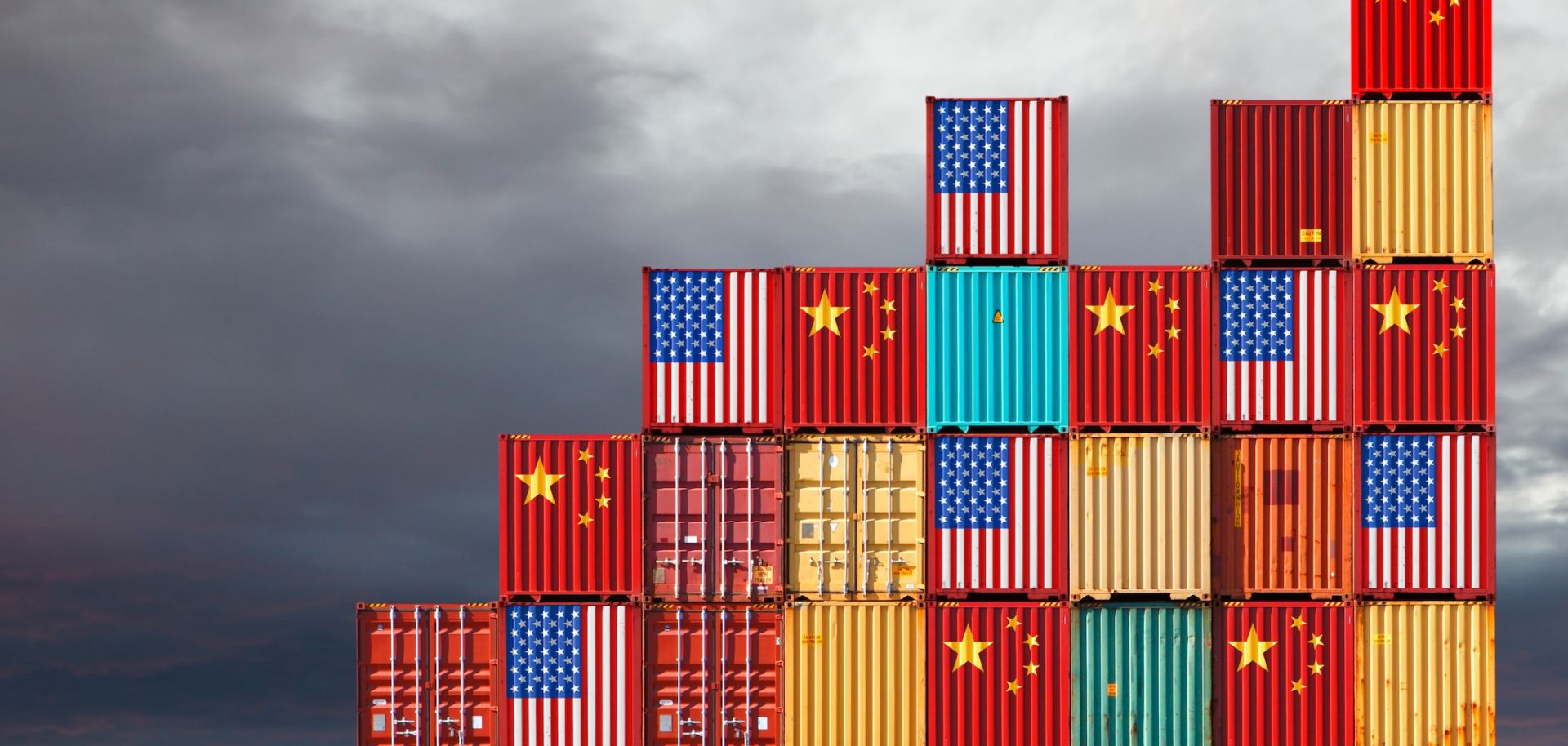
The United States will announce (and in some cases implement) tariffs to pressure its trading partners into trade negotiations, triggering retaliatory threats against the United States and protectionist measures by other countries seeking to shield themselves from goods diverted from the U.S. market. The United States is unlikely to implement a broad 10% to 20% tariff in 2025, but rather to use the threat of large tariffs to drive countries to offer concessions such as promises to buy more U.S. exports or restrict exports of certain goods to the United States. As part of this strategy, the United States may announce a small tariff increase to demonstrate its resolve to implement the large tariffs. Any broad tariffs would likely have large carve-outs for certain goods, like raw materials, or for certain countries, like those with a trade surplus with the United States. The United States is also unlikely to proceed with the 25% tariff threatened on Mexico and Canada, as both Ottawa and Mexico City will work with Washington to address U.S. concerns about immigration and drug flows. As both flows will likely continue regardless, the tariff threat will likely linger through 2025, stifling investor confidence in North America, and particularly in Mexico. The United States is more likely to proceed with new large tariffs on China relatively quickly, with new tariffs on Chinese goods likely to be announced and perhaps implemented in 2025, though the size of — or the goods — targeted by the tariffs remains unclear. In most countries and trading blocs, any U.S. tariffs will trigger retaliatory measures targeting U.S. exports, with agricultural products and U.S. manufactured goods produced in Republican-controlled states bearing the brunt of any retaliation. Large U.S. tariffs on China will also likely eventually cause some other countries to place their own tariffs on some Chinese goods to protect their own markets from an onslaught of cheap Chinese goods previously being sold to the United States.

The U.S. government's tariffs, crackdown on immigration and expansionary fiscal policy will have negative economic and financial impacts on the rest of the world. New U.S. tax cuts and deregulation will support short-term economic growth, but tariffs and a widening fiscal deficit will weigh on the medium- to long-term outlook. An expansionary fiscal policy and higher tariffs will lead to tighter global financial conditions. While higher U.S. growth would normally support economic growth in the rest of the world, higher U.S. tariffs and broader uncertainty about the global economic outlook and the future of international trade will negatively impact the global economy. The negative economic effects will be even more significant in the likely event that the European Union and China retaliate against U.S. protectionist measures. Depending on the size, extent and duration of the U.S. tariffs, the global economic and financial effects could be very adverse. Moreover, a severe U.S. crackdown on immigration, including the deportation of millions of immigrants, would put further upward pressure on a tight U.S. labor market, wages and even inflation. A crackdown on such a scale would also negatively impact the countries of origin of migrants by reducing remittances and adding to unemployment, and would be particularly pronounced in Central America and Mexico.
Ceasefire negotiations between Russia and Ukraine are likely, but any deals to stop hostilities would be fragile while a long-lasting peace agreement to end the war will remain elusive because of disagreements over Western security guarantees for Ukraine. The Trump administration will threaten Moscow with increased sanctions and additional military help for Ukraine while also threatening Kyiv with reduced financial and military support in a bid to pressure both governments to enter ceasefire talks. As Western governments pressure Kyiv to pursue negotiations and foreign support for Kyiv proves insufficient to halt Russian advances amid political, industrial and fiscal constraints, the probability of Ukrainian President Volodymyr Zelensky accepting some of Moscow's demands will increase. Growing questions over the viability of Ukraine's war strategy and the need to lower the mobilization age below 25 (which would spark emigration from the country) will also contribute to domestic pressure on Zelensky. As a result, ceasefire talks are likely in 2025, but while Ukraine is likely to accept making territorial concessions to stop the fighting, the issue of Western security guarantees to prevent future Russian attacks will remain the main obstacle to a more long-lasting peace deal. Western reluctance to offer Ukraine a path toward NATO membership and internal divisions within the West over deploying troops to Ukraine to guarantee a peace deal will delay a long-lasting deal. In any case, if a ceasefire happens in 2025 it would likely only be temporary. Against this backdrop, presidential and parliamentary elections in Ukraine — which should have taken place in 2024 and 2023, respectively — are unlikely unless a ceasefire deal is reached. If the elections happen, Russia will undertake disinformation efforts to try to destabilize Ukraine and influence the outcome.
Israel will engage in wars of attrition in Gaza and Lebanon, where ceasefires are unlikely to end the conflicts. Meanwhile, its progressive annexation of territories in the West Bank will likely result in a violent uprising. Israel will remain in Gaza throughout 2025, building permanent military installations and signaling its intent to restart settlement and remove Palestinians permanently from parts of the strip. This will result in a Hamas-led insurgency and keep alive the drivers of the regional conflict between Israel and Iran. Meanwhile, Israel and Hezbollah will remain in a slow-moving open-ended conflict in Lebanon. Israel will take advantage of U.S. backing to strike Hezbollah and prevent ITS full rearmament in a dynamic that could rapidly escalate back into open war and more Israeli ground maneuvers in southern Lebanon. Israel will also make progress toward the annexation of settlements in the West Bank, announcing plans to absorb territories in a piecemeal fashion (though actual annexations may occur later than 2025). This will make the West Bank increasingly unstable, with the potential for a full-scale uprising emerging in the year.
U.S. tariffs will spur further Chinese economic retaliation, fueling Western decoupling from China and gradually triggering more Chinese stimulus to preserve domestic stability. The United States will impose tariffs early and often on China, while U.S. tech restrictions and sanctions on China will also expand. China will launch retaliatory measures, particularly tariffs and import restrictions — such as on U.S. agricultural and aerospace goods — and export restrictions on critical minerals used in electronics and defense industries. China is also likely to expand its application of seldom-used legal tools, like the Anti-Foreign Sanctions Law and Unreliable Entity List, to target select U.S. companies with market access or procurement restrictions, asset freezes, denial of visas, or business licenses and fines, accelerating Western decoupling from China. Beijing will be somewhat more reserved in wielding these tools against other countries that levy new economic restrictions on China. U.S.-China trade talks could commence, but are unlikely to progress significantly in 2025. Meanwhile, China will likely gradually expand fiscal stimulus proportional to U.S. tariffs, issuing trillions of yuan in sovereign debt to support exporters, stabilize debt risks, and fund investments (e.g., water infrastructure) and consumption (e.g., goods trade-in programs).
Fragile governments in Japan and South Korea will be internally focused, slowing regional security cooperation with the United States. A lingering slush fund scandal will likely see Japan's ruling Liberal Democratic Party lose its majority in July upper house elections, but small opposition parties aligned with the LDP will prevent the collapse of the government. Prime Minister Shigeru Ishiba may resign amid pressure from LDP elders — such as in the event of Cabinet scandals or bungled political funding reforms — but his party replacement would represent policy continuity. These dynamics will see Tokyo internally focused, especially on economic issues like household tax cuts. Though Japan will push security cooperation with the United States, budget committee opposition will limit new defense appropriations, e.g., for new missile platforms, impeding efforts to deter China around Taiwan and the South China Sea. In South Korea, President Yoon Suk Yeol is likely to have his impeachment confirmed by the Constitutional Court in the first half of 2025 following his Dec. 3-4 martial law declaration. With a liberal president likely to succeed the conservative Yoon, security cooperation with the United States and Japan will wane as Seoul seeks to improve economic ties with China and reduce risks of border clashes with North Korea. This may pave the way for a resumption of talks between North Korean leader Kim Jung Un and U.S. President Donald Trump about curbing U.S. sanctions in return for North Korean security assurances, which could yield modest sanctions relief for Pyongyang in 2025. If Yoon's impeachment is not confirmed, however, policymaking will grind to a halt amid political disputes while protests grow larger and more violent as union strikes cause greater industrial disruptions.
Germany's general election will open the door to a more efficient government and a constitutional reform to increase public spending, while Poland's presidential election could streamline decision-making or, if the opposition wins, deepen policy disruptions. Far-right and far-left parties will perform strongly in Germany's general election in February, but mainstream parties will work together to prevent them from entering government. This will complicate postelection coalition-building efforts, leaving Berlin without a fully functional government for months. The new government will likely be a coalition led by the center-right Christian Democratic Union/Christian Social Union alliance alongside one or more junior partners, like the center-left Social Democrats, the Greens or the pro-business Free Democrats. A two-party coalition would provide a stable and efficient decision-making process in Berlin, while a three-party alliance could prove inefficient and internally divided. The new government will prioritize approving the 2025 budget and measures aimed at stimulating Germany's ailing economy — including a reform to constitutional borrowing limits to create additional space for investment in infrastructure, defense and industrial subsidies — while maintaining continuity in foreign and defense policies despite more hawkish support for Ukraine in its war against Russia. In Poland, political turbulence and policy uncertainty will intensify in the run-up to presidential elections in May, with opposition-aligned President Andrzej Duda using his veto powers to disrupt Prime Minister Donald Tusk's agenda, while government efforts to purge opposition allies from public institutions may exacerbate rule of law concerns. Should a government-aligned president win, it would streamline governance by eliminating the presidential veto threat. An opposition win would meanwhile prolong the legislative gridlock, undermining reforms and potentially harming the country's investment climate.
India will implement measures to boost domestic manufacturing, make concessions to the United States to avoid a trade war and seek warmer relations with China, though national security concerns will prevent a major improvement in New Delhi-Beijing relations. The Bharatiya Janata Party's weaker than expected election performance in 2024 has increased its reliance on its National Democratic Alliance political partners, slowing progress on key land and labor reforms due to insufficient parliamentary support, a challenge likely to persist into 2025. Instead, the government will focus on boosting India's domestic manufacturing sector by imposing import restrictions on laptops, tablets and computers to encourage local production. Additionally, the government will offer up to $5 billion in incentives for local and global firms to boost local electronics manufacturing and reduce reliance on China. While these measures will somewhat reduce import dependency and stimulate industry growth, India's underdeveloped infrastructure and regulatory uncertainty will likely limit their effectiveness. India's trade surplus with the United States increases the risk of the White House imposing higher tariffs on Indian goods, which would negatively impact India's export sectors and force New Delhi to retaliate with tariffs on U.S. goods. To avoid a trade war, India may increase purchases of U.S. energy products and defense equipment, aligning with its own needs while supporting U.S. exports. Meanwhile, the United States is likely to push for closer alignment on regional policies, particularly in ensuring a free and open Indo-Pacific, potentially involving greater Indian investment, arms purchases and enhanced maritime cooperation, such as joint naval exercises in the South China Sea. While India will engage in these areas to strengthen its capabilities, it will maintain its broader nonalignment strategy, including efforts to reduce tensions with China on their shared border. Still, India is unlikely to significantly relax restrictions on Chinese investment due to national security concerns and lingering mistrust from the 2020 border skirmish between Indian and Chinese forces. There may be a slight thaw in relations in 2025, however, including the resumption of direct flights and eased visa restrictions for Chinese technicians.
South Africa's coalition government will likely advance reforms to the power and transport sector, but a gradual increase in tensions between the African National Congress and the Democratic Alliance and potential unrest if former President Jacob Zuma is found guilty in a corruption case risks hampering these efforts. South Africa's government will present its first annual budget in February, which is likely to maintain the current pace of fiscal consolidation but is unlikely to accelerate it significantly. The government is also likely to advance reforms to the power and transport sectors, including efforts to secure the participation of private sector operators in South Africa's railways. Disagreements between President Cyril Ramaphosa's African National Congress and the center-right Democratic Alliance could delay reforms. While the coalition government is unlikely to collapse in 2025, potential violence linked to an upcoming corruption trial against Zuma could heighten intracoalition tensions, as the parties may have different approaches to tackling the violence. Internationally, Ramaphosa will leverage South Africa's G20 presidency to persuade U.S. officials to renew the African Growth and Opportunity Act, which provides duty-free access to the U.S. market for more than 30 African countries and expires in September 2025. Many Trump administration officials' critical views on South Africa's foreign policy will hinder these efforts, meaning South Africa could lose access to AGOA even if Congress renews it.
The Mexican government will work pragmatically to mitigate the impact from U.S. tariffs on Mexican goods while pursuing social reforms domestically. President Claudia Sheinbaum's biggest challenge in 2025 will be handling the Mexico-U.S. relationship amid tariff threats in response to immigration and drug trafficking. Although she may resort to tough rhetoric and threaten retaliation, Sheinbaum will work to address U.S. demands, such as by deploying the National Guard to deter migration flows and fight cartels. Mexico is also likely to adopt tighter rules of origin for manufacturing to ease concerns in Washington and Ottawa about the United States-Mexico-Canada Agreement. Domestically, Mexico will approve measures to expand workers' rights and fight gender inequality, including within the private sector. The first election for members of the judiciary — a key aspect of controversial 2024 reforms — will take place by the end of the year. These and other constitutional changes to Mexico's institutions will not reduce the country's attractiveness as an investment destination, especially amid a stronger global push for nearshoring. Mass deportations from the United States could, however, pressure Mexico's economy. Declining remittances and rising unemployment could force Sheinbaum to expand social spending amid a fiscally challenging environment.