
Editor's Note: The following summary is part of the Stratfor Center for Applied Geopolitics' Demographic Decline and Military Manpower report, which can be found here.
Are demographics destiny? Changes underway in population configurations are strikingly unprecedented in human history. Just a few decades ago, the world was concerned with overpopulation, despite this being the more normal trend in human history. Depopulation has not occurred since the Black Death in the 1300s, but now aging and shrinking populations proliferate — forcing governments to grapple with how to address demographic decline.
Since the end of the Cold War, there has been a shift in global demographic patterns. The developed world has seen decreases in marriage and birth rates, leading to slowing, stagnating or even negative population growth. In the developing world, slowing population growth rates still remain far above natural replacement rates. This human imbalance comes amid the redistribution of global power, raising the question of whether the population dynamics will reinforce this trend and lead to a decline in both relative and real power in the Global North amid rising power in the Global South.
National power is a complex concept, encompassing economics, culture, political influence and military capacity, among other factors. Military power, however, is often seen as something more concrete, tangible and thus a node of national power that has a more direct relationship with physical materiel and personnel. The war in Ukraine, which has devolved into a war of attrition, highlights the significance of manpower reserves in warfare, even in the context of assertions that modern warfare is increasingly mechanized and automated with reduced need for overall personnel. While we do not address all aspects of population and warfare, we will look particularly at the way demographic decline — for population growth is the more "common" trend in human history — affects the ability of a nation to assert credible and sustainable military power as a component of total national power.
Demographics and the Military
While many factors contribute to so-called demographic decline, at its core it is the result of decreased birth rates, often correlated with greater urbanization rates, greater female participation in the labor force, and overall increased health and longevity. In the remaining, predominantly less developed countries, the same trend is unfolding despite fertility rates remaining above the replacement level.
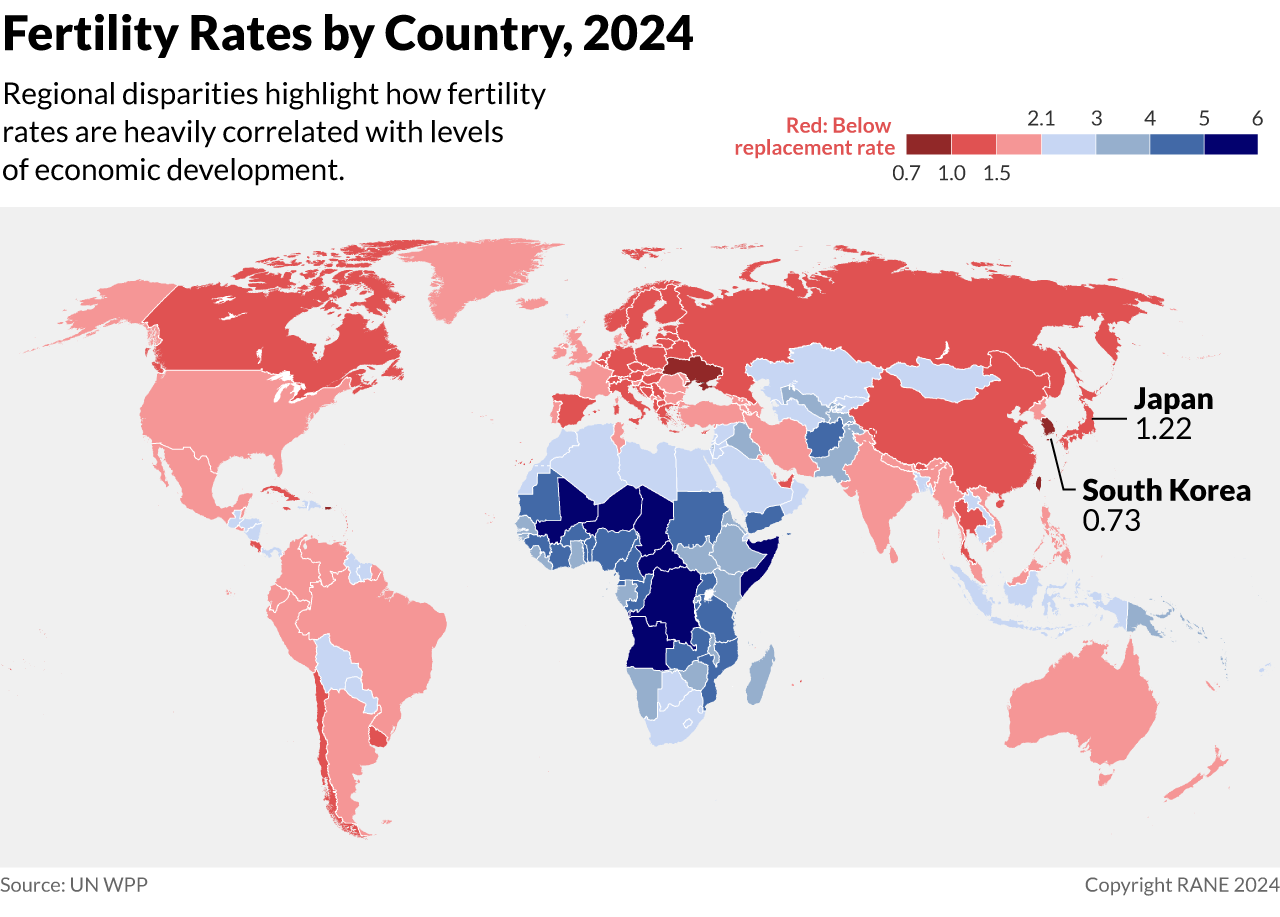
A declining fertility rate predicts that there will be fewer people in consecutive generations, which, when coupled with improved health care and longevity, leads to aging populations. To understand the fiscal burden and sociopolitical stress of a shrinking working-age population, we will use the age-dependency ratio — or the ratio of people who are younger than 15 or older than 64 to the number of people who are between 15 and 64 years old. An increasing age-dependency ratio predicts a slowing of economic growth due to declines in the total labor force and decreased tax revenue from a shrinking workforce, in addition to increased social expenditures for the dependent population.
Taken together, the birth rate and age-dependency ratio offer insights into the total available labor force, of which the military is but one consumer. It also highlights the economic (and in part social) components — how much capacity is there in the economy to support a robust armed forces, how much government revenue is available for the military versus social services, and how society views the military as a viable path when there are smaller families with larger responsibilities.
Military power alone refers to a nation's ability to apply physical force, coercion and deterrence to achieve political and strategic objectives. It encompasses the size, capabilities and readiness of a country's armed forces, as well as its military infrastructure, technology and logistics. Military power, however, is an essential component of geopolitical power and can act as a proxy for projecting a nation's influence on global affairs and achieving its national interests. For any given country, military power is related to its strategic objectives and the capabilities of its adversaries, in addition to the external perception of its doctrine and willingness to fight. While modern domains of warfare — land, maritime, air, cyber and outer space arenas — increasingly emphasize military-industrial capacity, strategy, human capital and unmanned weaponry, a significant need remains for large personnel numbers for conventional warfare.
If any cases best demonstrate the nuanced and complex relationship between demographics and military power, it is Japan and the Republic of Korea. Given the necessarily slow process of population change — which often requires a generation, if not more, for observable differences — it is imperative to start with countries furthest along in such demographic transitions, such as Japan and South Korea. Both countries are confronting the challenge of waning manpower plus shifting perceptions of military threats and growing military ambitions. Moreover, these countries do not rely on significant levels of immigration to supplement waning manpower, giving them greater relevance in light of current demographic trends.
South Korea
Once defined by economic and population boom, South Korea is currently projected to experience a significant population decline due to it having one of the highest aging rates and lowest total birth rates in the world. By 2050, elderly people (defined as more than 65) are expected to make up nearly 40% of the population. Currently, the birth rate is around 0.72 children per woman, a figure expected to remain well below half of the replacement level (2.1) for the next few decades. Additionally, the age-dependency ratio is rising, which will put increasing pressure on the working-age population to support dependents and retirees through taxes, health care and social security contributions. This could strain South Korea's public finances and reduce economic growth, as well as deprive the military of manpower and funding.
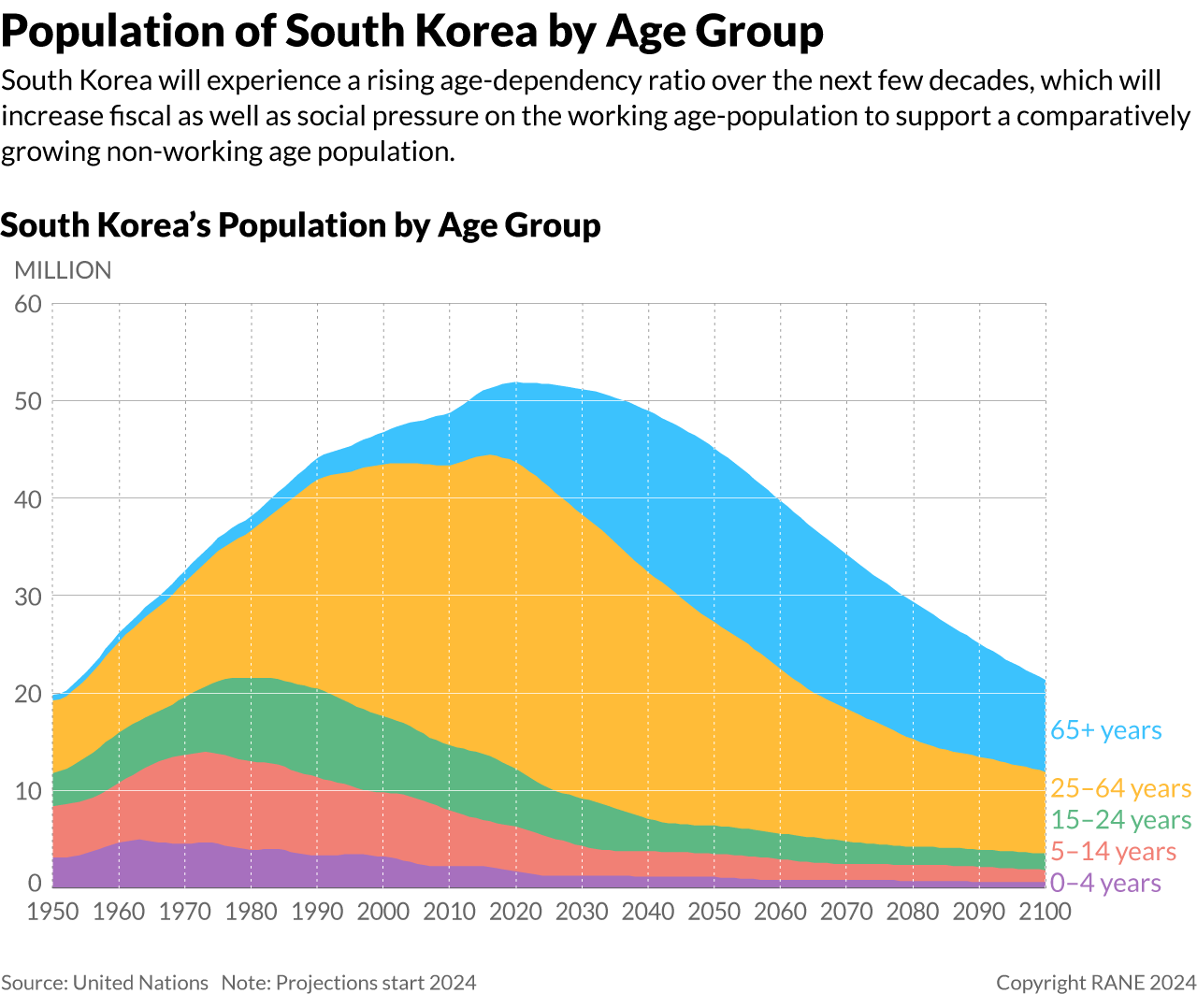
While South Korea views maintaining a sufficient fighting force as a critical priority due to the land border it shares with its hostile neighbor, it is unlikely to maintain current troop levels without major policy reforms. Declining fertility rates indicate that South Korea's pool of eligible recruits will continue to decline over the next few decades, something identified as a national security threat because of its implications for the conscription system. To maintain current personnel strength, the military needs to enlist or conscript about 200,000 new troops per year. To put the sustainability of this requirement in perspective, in 2023, South Korea saw 236,000 births (an 8% decrease from the previous year) with about half being male. By 2035, the total number of males reaching the age of 18 will be less than 200,000, which means that downsizing the military will be inevitable short of major policy reforms.
To combat direct demographic effects on the size of its military force, South Korea has attempted to widen the military recruitment pool while simultaneously trying to keep its troops in the force longer. This has included increasing the capacity for women in the armed forces, albeit only on a volunteer basis. The move has seen limited success, with female participation in the military growing from 6% to 9% in recent years. Another policy attempted is the increase of military salaries and additional funding for improved health care services, housing allowances and educational support. Similar programs in the past have led to slight increases in retention and reenlistment, yet it is somewhat unclear if these programs are cost-effective and have more than just a marginal effect. Until these incentive programs can meaningfully address social and economic factors relating to the high cost of living and the competitive job market, their effectiveness is limited at current funding levels.
Beyond such efforts to increase force size and rapidly growing strains on South Korea's conscription system, the military is increasingly turning to technology to augment its forces and increase its efficiency across the various warfare domains. South Korea has more than doubled research and development spending as a percentage of GDP since 2000 to mitigate the effects of demographic decline on the private and public sectors. Specific R&D initiatives include the Defense Innovation 4.0 project, unveiled in 2023, which plans to use advanced technology to better deal with North Korea's expanding multidomain threat — primarily missile and nuclear technology — and offset the decline in the recruiting pool for military service. The project aims to integrate AI into its weapons systems, improve automated and unmanned capabilities; innovate military structure and training; and expand capabilities in the cyber, space and electromagnetic domains.
Given an array of ongoing challenges — a declining workforce, slowing growth, aging population, escalating North Korean threats and increasing Chinese military assertiveness — achieving an economic and political miracle akin to the rapid development seen in the 1960s appears impossible. There are steps that South Korea is likely to take, however, to contend with these challenges.
Over the next decade, South Korea will seek to strengthen its security primarily through strengthening alliances with the United States, Japan, and Europe. Coordination with these countries is likely to include greater participation in joint military exercises, sharing of intelligence, and the build-up of supply chains that directly support large-scale military operations, expanding on South Korea's successful aid to its partners in the Ukraine War.
Beyond weapons procurement, South Korea's military is likely to benefit from increased U.S. attention to the peninsula due to its geostrategic position near North Korea, China and Russia. South Korea's current willingness to play a more overt role in the U.S. regional defense posture has put stress on its relations with China, something Seoul currently appears to consider an acceptable cost in exchange for greater influence in its security relations with the United States.
For a more domestic solution, South Korea's most tenable method to construct military power with shrinking armed forces can be through building up its defense industrial sector. Strengthening its domestic arms manufacturers would help alleviate political constraints on increased military funding, since growing industries have the potential for numerous economic benefits such as greater tax revenue and employment opportunities.
By 2035, efforts will likely be focused on building up ground forces with technology that intentionally reduces personnel numbers while increasing firepower and lethality, and the R&D budget will likely continue to grow to facilitate this. If South Korea can gain greater security independence and self-reliance through technological advancement that transforms the armed forces from the tactical to strategic level, it may be able to buffer its own strategic interests against any shifts in U.S. priorities.
Ultimately, South Korea finds itself facing an inevitable downsizing of its military due to demographic constraints that will primarily arise in the 2030s. Even with greater funding to incentivize recruitment and retention in the armed forces, demographic projections dictate that South Korea will be unable to rely on manpower alone to maintain military power. Due to its reliance on personnel-heavy ground forces, this presents a significant problem for the South Korean government. Additionally, the economic environment will limit financial solutions to the manpower shortage as stagnating growth and a tighter fiscal budget become key governing issues. While promising as a long-term solution, technology is unlikely to be innovated and produced at the scale required within less than a decade to offset personnel losses. Therefore, we project that South Korea will look to the geopolitical arena to strengthen alliances within the next decade to maintain its security posture via external military power.
Japan
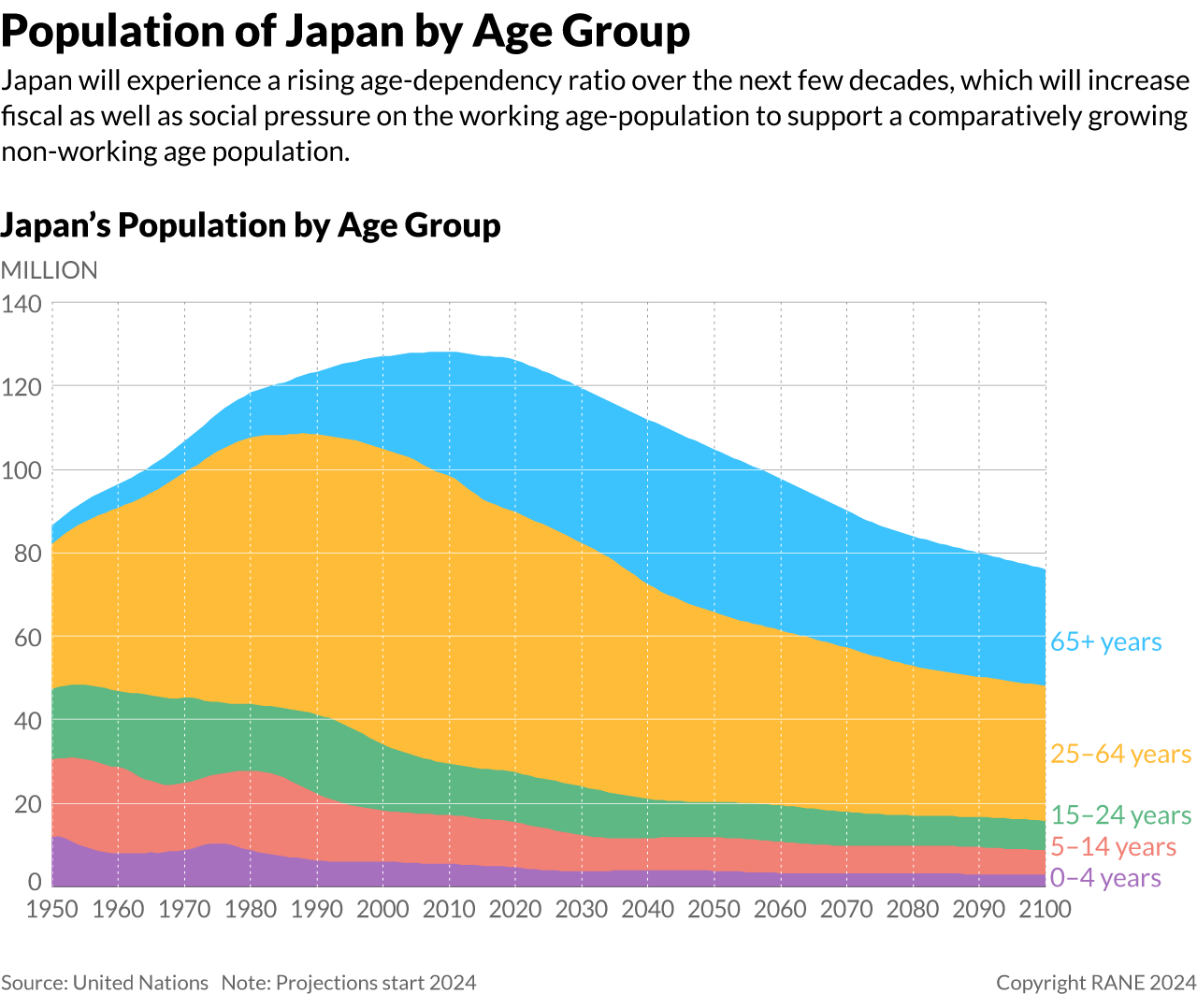
Japan's demographic decline has been decades in the making. Unlike most G7 countries that enjoyed 20 years of postwar baby boom, Japan's lasted a mere three years. The extent of its low birth rates meant that the Japanese working-age population began declining in 1996 and the total population began decreasing in 2008, leaving an older and smaller population overall. Meanwhile, immigration to replace the Japanese working-age population has not occurred. Any meaningful policy shift would not be able to provide demographic relief in less than at least a generation. Tokyo's Institute of Population and Social Security Research's most recently revised forecast postulates a population decline of 30% by 2070, at which time 40% of the population will be people 65 and older (e.g., nonworking by common benchmarks). Japan is seen as the "demographic policy laboratory" as much of the Global North faces population plateaus or decline.
The Japan Self-Defense Forces — a euphemism for the Japanese armed forces — has, since its inception in 1954, mirrored these weak demographics. In part, this reflects the Japanese Constitution, which under Article 9 relegated "land, sea, and air forces, as well as other war potential" to U.S. manpower, instead prioritizing economic development. For much of this time, therefore, demographic issues have had little bearing on Japanese security. This has meant that commensurate to its economic size, Japan's military has historically been smaller and less operationally adept than that of its comparative peers.
Japan's Cold War strategy has been put to the test in post-Cold War Asia as Northeast Asia becomes an increasingly contested region, led by threats from North Korea in the 1990s, and more recently by a surge in Chinese assertiveness. Distant wars, including in Ukraine and the Middle East, have meanwhile affected Japan's perceptions of the likelihood of conflict. Together, such perceptions reinforce Tokyo's embrace of the Self-Defense Forces as a tool for pursuing its foreign policy objectives.
A squeezed working-age population and rising age-dependency ratio affect Japan's ability to reconfigure its military capabilities in multiple ways.
From a purely numerical view, and given a volunteer force that does not measure yearly cohorts like South Korea does its conscripts, Japanese demographics will not affect military size directly in the short or long term. Staffing shortages that do affect the Self-Defense Forces, which has failed to meet recruitment targets annually since 2013, apparently have more to do with social willingness and economics.
Rather, the secondary and tertiary economic issues that arise from Japan's demographics are more pertinent to military size and power. Weaker economic growth, stiffer competition for human resources, pension cuts and rising taxes to accommodate age-dependency ratios plus competition for the military budget will make recruitment harder and more expensive, and in the longer-term require budgetary compromises that may affect nonpersonnel related ambitions to expand the Self-Defense Forces.
The Self-Defense Forces has pursued policies to reverse perceptions of the military, make it a more reliable path to sustained economic benefit and reconstruct the military to adapt to low native manpower. First, Japan has prioritized an expansion into multilayered security cooperation via both multilateral and bilateral forums beyond those with the United States. Under newly elected Liberal Democratic Party President Shigeru Ishiba, who favors more independence from the United States in foreign policy, the current trajectory to diversify bilateral partnerships is highly likely to proliferate. Second, the Self-Defense Forces is combatting secondary and tertiary demographic effects by increasing salaries, spousal benefits, education subsidies, and the remodeling and refurbishing of Self-Defense Force housing to make the military a more viable career path. These changes are unlikely to substantially change recruitment prospects unless the Self-Defense Forces begin offering better economic benefits that can compete with private sector benefits. Last, Japan is addressing personnel shortages by redefining "military-age population" beyond young men, raising age limits for recruits, and integrating women and elderly service members. Reservists are an additional population base increasingly likely to be tapped.
In addition, there has been a budgetary and conceptual shift to modes of substituting or enhancing manpower via technology. Of course, the necessity for technology is also critical to Japan's military power projection as warfare becomes more high-tech, but a low manpower high-tech military also reflects necessity in the face of population constraints. Moreover, technology has long been Japan's comparative advantage. It also serves Japan’s strategy as a maritime power that requires fewer boots on the ground in conflict.
Already, Japan has a strong private sector that will make a shift to military tech easier. Dual use of the private-sector population and their services to support the Self-Defense Forces is a highly viable option to use a high-capital and comparatively larger nonmilitary population that will serve to maximize the potential of a shrinking working-age population in both private and public sectors. Merging public and private sectors will occur via both contracting — although this remains expensive — as well as with greater research cooperation reminiscent of the U.S. Defense Innovation Unit, which serves to incorporate experts from academia and private sectors in defense planning and research.
Lessons
Considering a direct relationship between population size and military power is alarmist and overly simplistic, even in highly unique demographic cases. Japan is facing the most extreme demographic loss in the developed world but with limited direct effect on its ability to gain personnel, let alone function as a military. Even in this advanced demographic case, it would take decades for a direct numerical relationship to materialize. In South Korea, we see a stronger relationship between the recruitment pool and military power, given its military is built on conscription. If South Korea had not constructed its armed forces in this manner but rather prioritized cultivating an all-volunteer, professional military force with enough buy-in from enlisted personnel, officers and noncommissioned officers due to its being a competitive economic option and career choice, it is unclear that it would have had a personnel shortage by 2035. A purely numerical view is thus an initial foil, but overly simplistic when considering such complex domains of national power.
Size can constrain or enable military power, however, according to several factors, including the military domains of a state, perceived security threats, external support, the level of human capital, political willingness, and secondary and tertiary economic and sociocultural effects of a smaller and older population. The Japanese case has, for instance, shown us that as a maritime nation, it is better able to distribute its human resources and rely on fewer men than South Korea as land power. Such analysis must be applied relatively: Taiwan is at no benefit from its maritime military domain (unlike Japan) given its key aggressor is mainland China with a total and military population incomparably larger. For the same reason, South Korea places a greater emphasis on being a primary responder to threats and a greater need for indigenous deterrence measures, including military hardware and even nuclear arms. Thus, while South Korea and Japan are not necessarily at risk of a relative power loss from aging and declining populations, the likelihood of military power loss as a function of size increases without effective policy attunement and management of demographic shifts in line with the above variables.
While these variables have more room for substitution and policy maneuvers, secondary and tertiary economic effects of demographic decline on the military domain are the factors that most will consistently and increasingly constrain military power in demographic decline. Both Japan and South Korea — and increasingly other countries — will need to contend with inevitable rises of social welfare spending and related tax rises or pension cuts that infringe on the ability to maintain let alone grow militaries.
The premier policy shift in both cases has centered on high-tech, low-manpower militaries. A tactical and strategic substitute of physical personnel is accentuated by the speed of its innovation in contrast to the slow process of demographic change. Alongside more immediate benefits to military power, tech can be more malleably constructed to the military domain and security threats of a state, be a major area of cooperation with allies, enhance and benefit from high human capital, and weaken the effects of low human willingness to fight — all while benefiting economies via increasing labor force productivity that may otherwise be more stressed by growing age-dependency ratios. Tech thus interacts with population variables to constrain military power.
Duplicating Japan's and South Korea's adjustment to a strong military with fewer personnel than they would like would prove difficult elsewhere around the globe. Europe provides an apt comparison. Moreover, despite technologies' promise and "substitutability," it will, too, remain a limited solution and must coexist with a stronger manpower base. The introduction of, and transition to, new technologies can also prove labor-intensive. As the ongoing Russia-Ukraine War reminds us, trench warfare remains a central pillar of conflict despite the high-tech capacities of both Ukraine and Russia. Unlike techno-utopian forecasts of tech replacing human potential, militaries globally cannot neglect their manpower issues. After all, well-trained and -cared for troops with high morale are a prerequisite for any well-performing military force.
Though Japan and South Korea present an extreme demographic outlook and have sociocultural, political, economic and security nuances that deserve consideration, they set the blueprint for how the military must contend with stiff competition for human resources, a reconceptualization of manpower and replacement potential of physical personnel. This study thus reiterates that demographic decline is not a diametrically negative development but rather a difficult new context in which militaries can still find ways to thrive. While population size can act as a constraint of military power, it will not be deterministic as manpower in the 21st century will be increasingly constructed at the intersection of low force size and high technological capacity.
