
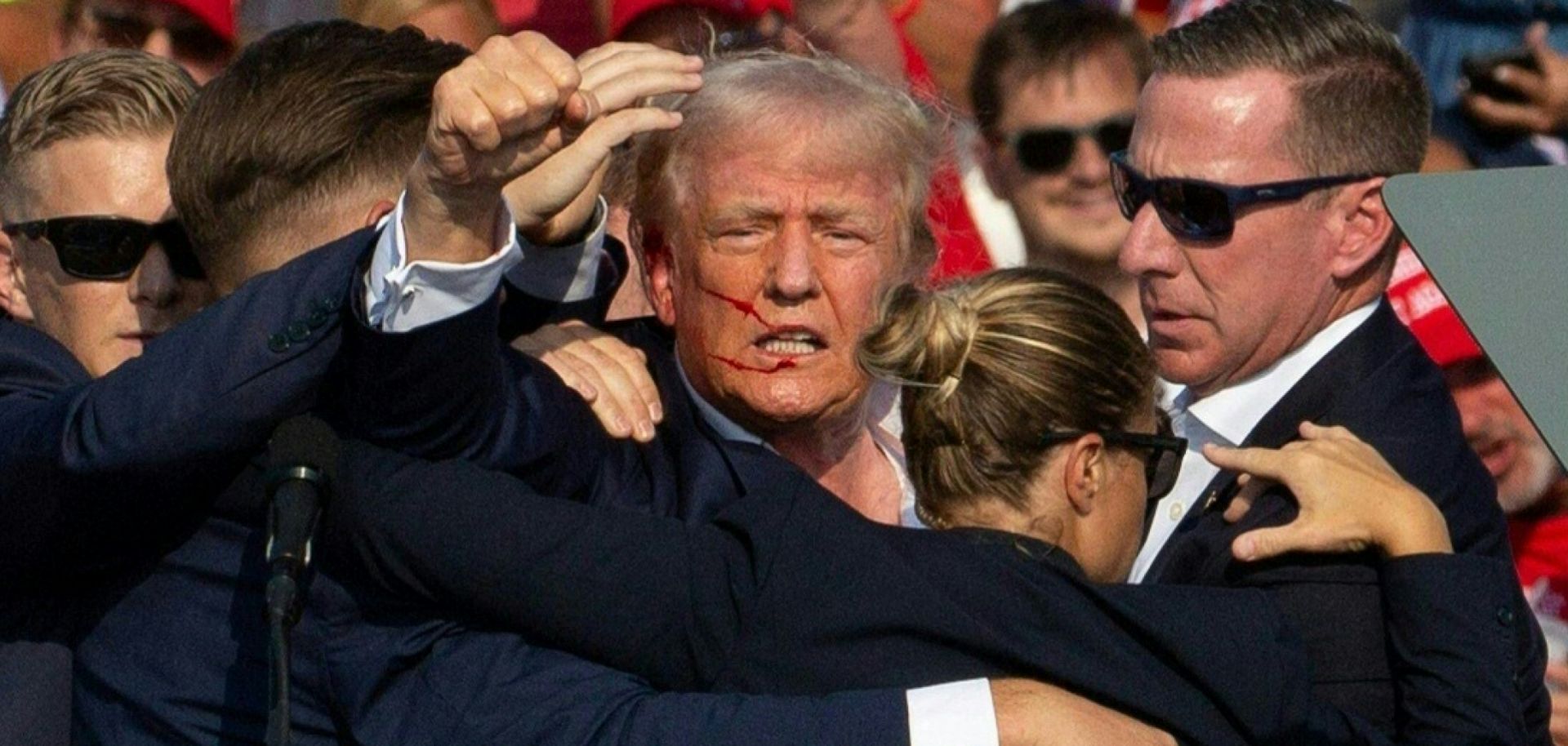
A gunman fired shots at former President Donald Trump during a campaign rally on July 13 in Butler, Pennsylvania, with one bullet hitting Trump's ear. The attacker fired an estimated five to seven shots before Secret Service agents blocked Trump and led him off the stage and into an armed escort. According to the Butler County district attorney, a Secret Service member shot and killed an individual believed to be the shooter, who was positioned on the rooftop of a manufacturing facility over 130 yards from the rally and located out of the perimeter of the venue where attendees were checked for weapons. The attacker killed an audience member and critically injured two others. Footage showed blood on the former president's face as left the rally facilities, though a campaign spokesperson later issued a statement that Trump was "fine" and was being checked at a local medical facility. In the hours after the shooting, the FBI identified the shooter as 20-year-old Thomas Matthew Crooks of Bethel Park, Pennsylvania; as of July 14, the motive for the attack remained unclear, though authorities have said they are investigating it as an assassination attempt. Little is known about the shooter. Pennsylvania voter records indicate that he was registered to vote as a Republican, but federal campaign finance reports indicate he donated $15 to a liberal voter turnout group in 2021, and images indicate he was wearing a T-shirt for a YouTube channel called Demolition Ranch, which showcases firearms. The shooting came two days before the start of the Republican National Convention on July 15-18, during which Trump is set to officially become the Republican Party nominee for president.
The attack on Trump came amid elevated political tensions ahead of the Nov. 5 U.S. presidential election, which have included violent rhetoric, albeit few actual incidents of violence so far this year. Political tensions are elevated across the United States ahead of the November elections amid right-wing frustration with the Biden administration and legal cases against Trump plus left-wing opposition to Trump's possible return to office. Tensions recently increased following Trump's May 31 conviction on 34 felony charges in the New York hush money trial and the July 1 Supreme Court ruling that the president is immune from prosecution for actions exercising the "core powers" of the presidency. Misinformation and disinformation have further contributed to political tensions, with conspiracy theories surrounding both Trump and President Joe Biden circulating on social media. Some of the escalatory rhetoric has come from the candidates themselves, with Trump previously calling on supporters to "guard the vote" in a December 2023 statement and Biden saying that Trump poses a threat to U.S. democracy. Some prominent Republicans, including possible Trump vice presidential pick J.D. Vance, have blamed the assassination attempt on Biden. Despite these elevated tensions, few instances of political violence have occurred in the first half of 2024; over the last decade, violent incidents targeting political figures have occurred occasionally.
- In the past two weeks, focus on Project 2025, a package of controversial right-wing policy proposals, has also received increased attention and backlash and has resulted in Trump trying to distance himself from the package.
- Recent politically motivated violent incidents include an incident in August 2022 in which an armed man attempted to breach the FBI's field office in Cincinnati before police officers shot and killed him; the attack appeared to be in response to the FBI raid on Trump's Mar-a-Lago Club in Palm Beach, Florida, a few days before. In October of that same year, a far-right conspiracy theorist attacked the husband of then-House Speaker Nancy Pelosi at the couple's home in San Francisco, seriously injuring him.
The assassination attempt will increase the risk of demonstrations and politically motivated attacks in the near term, particularly amid spreading conspiracy theories regarding the incident, with threats likely to persist through the election cycle. Regardless of the motive for the shooting, the assassination attempt will contribute to already-elevated political tensions and create the risk of demonstrations over the next few weeks. In particular, right-wing groups will likely organize demonstrations in support of former President Trump, especially in the vicinity of the RNC at the Fiserv Forum arena in downtown Milwaukee. Right-wing demonstrations may also occur in major cities over the next week, including Los Angeles, New York and Washington. If events draw hundreds or thousands of people, they will create localized transportation disruptions and travel delays. Left-wing groups could also organize counterprotests, though this risk is significantly lower in the immediate future given that most left-wing groups will be hesitant to organize anti-Trump events in the immediate aftermath of the attack. If counterprotests do occur, they will risk triggering clashes and pose safety risks to protest participants and bystanders. In addition, there is the risk that the assassination attempt will incite attacks by actors on both sides of the political spectrum. Likely attack targets include political events (including demonstrations and campaign rallies), government buildings, entertainment venues, and popular public areas such as squares and major thoroughfares. Attacks could include shootings, vehicle rammings, or bombings, creating further safety risks. Meanwhile, misinformation or disinformation surrounding the assassination attempt is already spreading, and uncertainty regarding the shooter's political views will likely fuel conspiracy theories on both sides of the political spectrum. Demonstrating this concern, individuals have already speculated on social media that the shooting was a false flag operation intended to boost support for Trump, while others have speculated that the so-called Deep State attempted to assassinate Trump. Such conspiracy theories will risk exacerbating the threat of targeted politically motivated attacks in the next week. Though these risks are likely to be particularly pronounced over the coming days, they will likely remain elevated over the coming months ahead of the presidential election. Risks of violence are likely to escalate in the immediate run-up to the vote, on Election Day (including toward election facilities) and following the announcement of the election results.
- Demonstrating efforts to lower tensions following the attack, virtually all prominent Democrats condemned the attack and political violence more broadly shortly after reports of the event emerged, and the Biden campaign also quickly paused communications and took down its ads.
- Since the 2021 attack on the U.S. Capitol, right-wing groups have typically been unable to attract high participation for demonstrations, but the assassination attempt may draw higher attendance.
- Authorities will likely increase security at the RNC, political rallies and other demonstrations in the coming weeks, creating additional transportation disruptions and other logistical challenges in the vicinity of events. The New York Police Department has already bolstered security at Trump Tower and other prominent locations around New York following the attack.
