
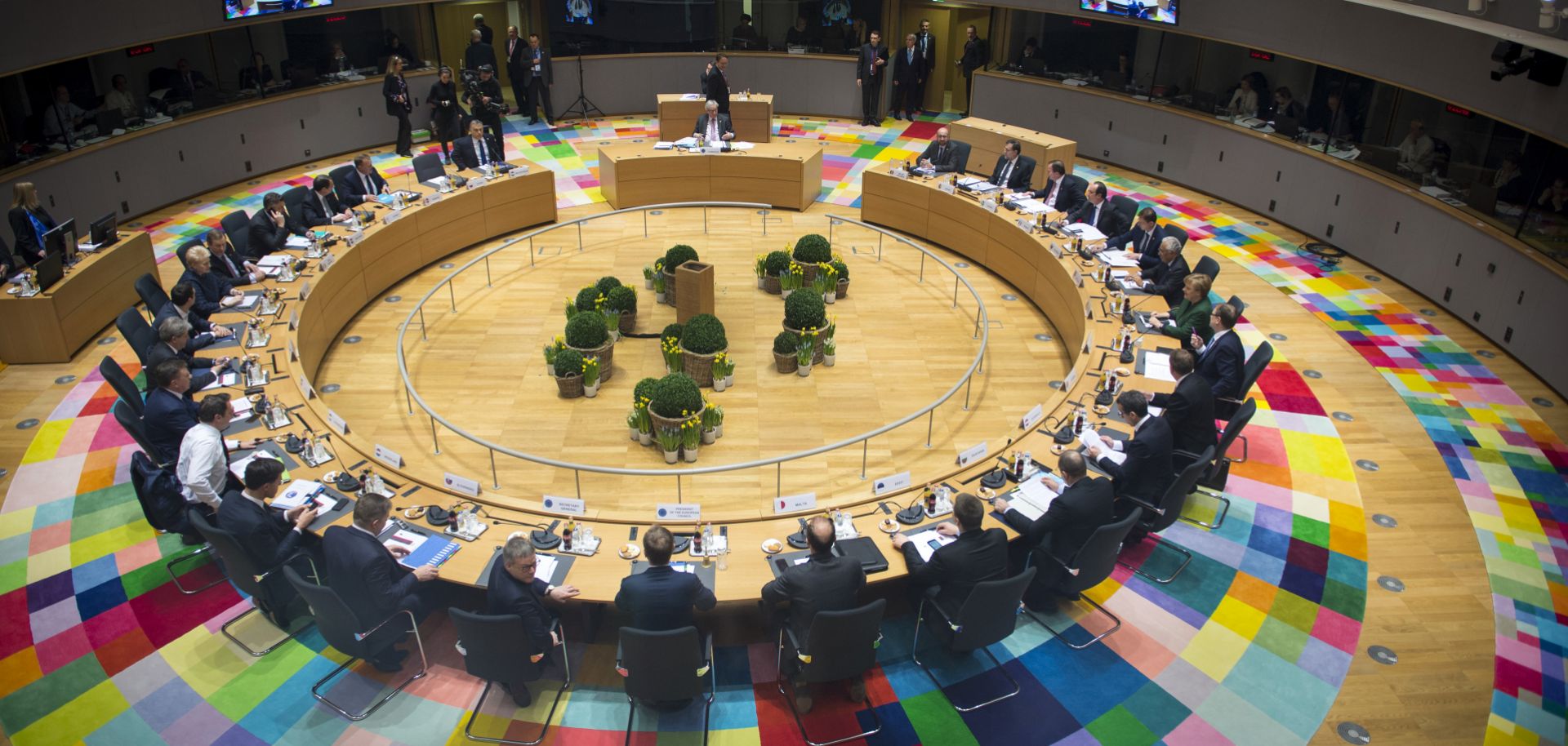
The Council of the European Union, the bloc’s main decision-making body, holds a meeting in Brussels, Belgium, in 2017.
Despite a new proposal to eliminate the use of unanimity to make the European Union's foreign policy more efficient, resistance from small member states means that the bloc is unlikely to introduce such a drastic change in the short to medium term. On May 22, Spanish Foreign Minister Jose Manuel Albares announced that during his country's six-month presidency of the European Union (which begins on July 1), Madrid will promote a change of the bloc's voting rules on foreign policy, security and enlargement to use qualified majority voting instead of unanimity. Later on May 22, the governments of Poland and Hungary rejected the Spanish proposal and said they were in conversations with like-minded governments to preserve the use of unanimity.
- The European Union uses qualified majority voting to make most of its policy decisions (in which support from 15 of the 27 EU member states representing 65% of the bloc's population is needed to approve legislation). But there are still some strategic areas where unanimous support from all of the bloc's 27 members is required to pass policies. These areas include the bloc's Common Foreign and Security Policy (which includes the Common Security and Defence Policy), the accession of new EU member states, social security or social protection, and taxation.
- On May 22, Hungarian Foreign Minister Peter Szijjarto said that the ''member states who want to keep unanimity and the possibility to defend their national interests in Brussels decision-making, they want to have close cooperation.'' That same day, Polish Foreign Minister Zbigniew Rau tweeted that ''Poland will never support the idea of moving away from unanimity to qualified majority voting in the common foreign and security policy.''
While the European Union has discussed the problems related to unanimity for years, the war in Ukraine has reignited the debate over the efficiency of the bloc's process for foreign policy decisions. The potential replacement of unanimity with qualified majority voting has been a source of intense debate in the European Union for over a decade. Supporters of unanimity argue that the system prevents large EU member states from imposing their foreign policy decisions on smaller EU member states, which see their veto power as a way to protect their national interests. The supporters of qualified majority voting, on the other hand, argue that unanimity prevents the European Union from acting in a quick and efficient manner, because rebel member states often use their veto power to block decisions that the vast majority of the bloc supports. The war in Ukraine has made this issue particularly visible, as every round of sanctions against Russia has been plagued with intense horse-trading and veto threats from member states, in many cases for reasons not directly connected to the issue under discussion. Against this backdrop, in early May, nine EU member states (Germany, France, Italy, Spain, Belgium, Finland, Luxembourg, the Netherlands and Slovenia) launched the so-called ''friends of the qualified majority'' group to promote the issue.
- According to the European Parliament, between 2016 and 2022 there were at least ''30 individual vetoes, threats of vetoes or delays'' in EU foreign and security policy. Since the start of the war in Ukraine in February 2022, most rounds of EU sanctions against Russia involved weeks of horse-trading and veto threats that in some cases resulted in a toning down of the sanctions. In May 2022, for example, Hungary received an exemption from the EU embargo on Russian oil after Budapest threatened to veto the entire sanctions package. In January 2023, Hungary said it would veto any EU sanctions against Russia's nuclear energy sector. While the issue is still on the table, the European Union has so far not imposed such sanctions.
The debate over unanimity will become more intense during the second half of the year, but a substantial reform of EU voting mechanisms is unlikely because of resistance from smaller member states. As the rotating president of the European Union, Spain will have the power to introduce this issue on the bloc's legislative agenda during the second half of the year, which means that the topic will be under discussion starting in July. However, Spain will not have any special powers or influence in the debate, which means that the bloc's traditional divisions on the issue will re-emerge and likely prevent significant reform. There are two main ways to change voting rules in the European Union. The first is to reform the bloc's treaty, to change the policy areas that currently mandate unanimity voting. The European Union is unlikely to try this option because reforming the treaty is a process that can take years, and would also open the door to member states proposing reforms that go beyond the issue of voting rules. The second option is to use the so-called ''passerelle clauses'' of the EU treaty, a mechanism that allows the bloc to change EU voting rules without a formal reform of the treaty. Spain and its allies are more likely to promote this course of action because it limits the scope of the reforms under discussion. However, both options require unanimous support from the 27 member states, which means that Poland, Hungary and any other member states opposed to the reform will have veto power. This means that Warsaw, Budapest and others will either veto the reforms, or push to water them down to the point where the changes are irrelevant.
- According to the Spanish government, Madrid will seek to offer reassurances to reluctant member states that their national interests will be protected if unanimity is scrapped. However, Madrid has not offered any details on how it plans to achieve this. In line with EU history, the possibility of a very nuanced reform (which includes clauses that still give some degree of veto power to individual member states) cannot be ruled out. Such an outcome would not immediately solve the bloc's unanimity problems but could serve as a prelude to deeper reforms in the long term.
In the low probability case that the European Union manages to introduce a meaningful reform in its voting mechanism, it would result in much faster approval of policies, such as sanctions on third countries and the incorporation of new EU member states. If the European Union is able to overcome its internal divisions and unanimity is scrapped, the result would be a more streamlined decision-making process on foreign policy, security and enlargement. For example, new packages of sanctions against countries like Russia would no longer involve the long, tense, horse-trading-heavy negotiations that define the existing process. Using qualified majority voting for enlargement would also increase the probability of candidate countries (such as Serbia, Albania and North Macedonia) eventually entering the European Union — something that many countries in Western Europe currently oppose. Finally, such a reform would also open the door to the eventual elimination of unanimity in other policy areas, such as taxation, that don't seem to be included in Spain's current plan. However, large member states like Germany, France and Italy will likely remain very influential even under the new rules, as Brussels is unlikely to make any decisions that Berlin, Paris or Rome adamantly oppose. This means that a more streamlined decision-making process would reduce, but not completely eliminate, the politicking behind strategic EU decisions.
