

A hand holds a virtual circuitry-inspired display that represents ChatGPT.
Since its release on Nov. 30, 2022, an artificial intelligence (AI) chatbot called ChatGPT has taken the world by storm with its ability to provide in-depth answers to a variety of questions and seemingly hold meaningful conversations. ChatGPT's resounding success has pushed U.S. software and internet services company Microsoft to expand investment in the technology's developer, U.S. AI research and deployment company OpenAI, as well as integrate the chatbot with its Bing search engine. Since then, U.S. technology company Google, Chinese internet company Baidu and U.S. social media platform Facebook have accelerated their own plans to develop chatbots and other generative AI tools, lest they be left behind.
The seeming leaps and bounds that ChatGPT represents in the field of AI are refueling age-old fears about the impact of new technologies on the job market, fears that date back perhaps most memorably to the early 19th-century Luddite movement. After England's Sir Richard Arkwright developed and spread the use of new textile machines in the late 18th century, a faction of violent textile workers began destroying these machines out of the belief that they would steal workers' jobs and leave them unemployed. Ultimately, textile machines did cause many workers to lose their jobs, but the Industrial Revolution created millions more in industries that didn't previously exist. As AI continues to develop, the global job market will likely set out on a similar revolutionary trajectory.
ChatGPT Is Just the Beginning
OpenAI trained ChatGPT to understand natural language by using a deep learning algorithm called a large language model (LLM), which developers fed mass volumes of written text in order to teach it the structure of and relationships between words. Following ChatGPT's LLM training, it could generate written responses to users' questions. Notably, a professor at the University of Pennsylvania's Wharton School of business asked ChatGPT to write responses to an exam taken by students pursuing their master's degrees and said that its responses would be given a B- or a B if submitted by a student. ChatGPT can also create outlines for papers, summarize text, write haikus and screenplays, and countless other things. None of this column was written using ChatGPT, except for the title, though writers will have to make this clarification more often in the future.
In recent weeks, I have tested out writing articles, summarizing information and pestering my colleagues with ChatGPT's results as I gauge its usefulness and utility. It is far from perfect. ChatGPT's knowledge of current events only goes through 2021, and its ability to perform mathematical operations and arithmetic is rudimentary at best. It is also prone to "hallucinations" when the answers it gives contain untrue facts, sources and information. Despite these initial shortcomings, I am convinced that my profession — and likely yours — has been changed forever.
OpenAI released ChatGPT's current LLM, GPT-3.5, in 2022 and trained it on text scraped from the internet that required more than 800 GB to store and some 175 billion parameters. Its successor, GPT-4, is expected to be released later in 2023 and was trained on more than 170 trillion parameters. These upgrades will increase the sophistication of the AI tools' responses to users' questions and presumably the accuracy of the information that it provides, leading to fewer hallucinations. Once GPT-4 is rolled out, many of those already exploring what ChatGPT, GPT-3.5 and other related tools can do for their industries will quickly do the same for GPT-4 — as well as all of the other chatbots and LLMs that OpenAI's competitors release.
ChatGPT Puts White Collar Workers In Its Crosshairs
What makes ChatGPT and other generative AI technologies so important is that they have the potential to perform a wide range of cognitive and non-routine tasks. In previous analyses, RANE has used the informal task model developed by professors David Autor and Frank Levy of the Massachusetts Institute of Technology and Richard Murnane of Harvard University to frame how automation and computerization can affect jobs. In their model, tasks are classified as routine or non-routine and as cognitive or manual. Routine manual tasks have long been the easiest to automate through robotics and have had a major impact on manufacturing lines globally for the better part of at least three decades. AI and digital technologies have also been able to replicate many routine cognitive tasks, such as accounting and clerical tasks. Non-routine tasks — especially non-routine cognitive tasks (such as writing fiction or coding) — have long been viewed as the most difficult tasks to automate.
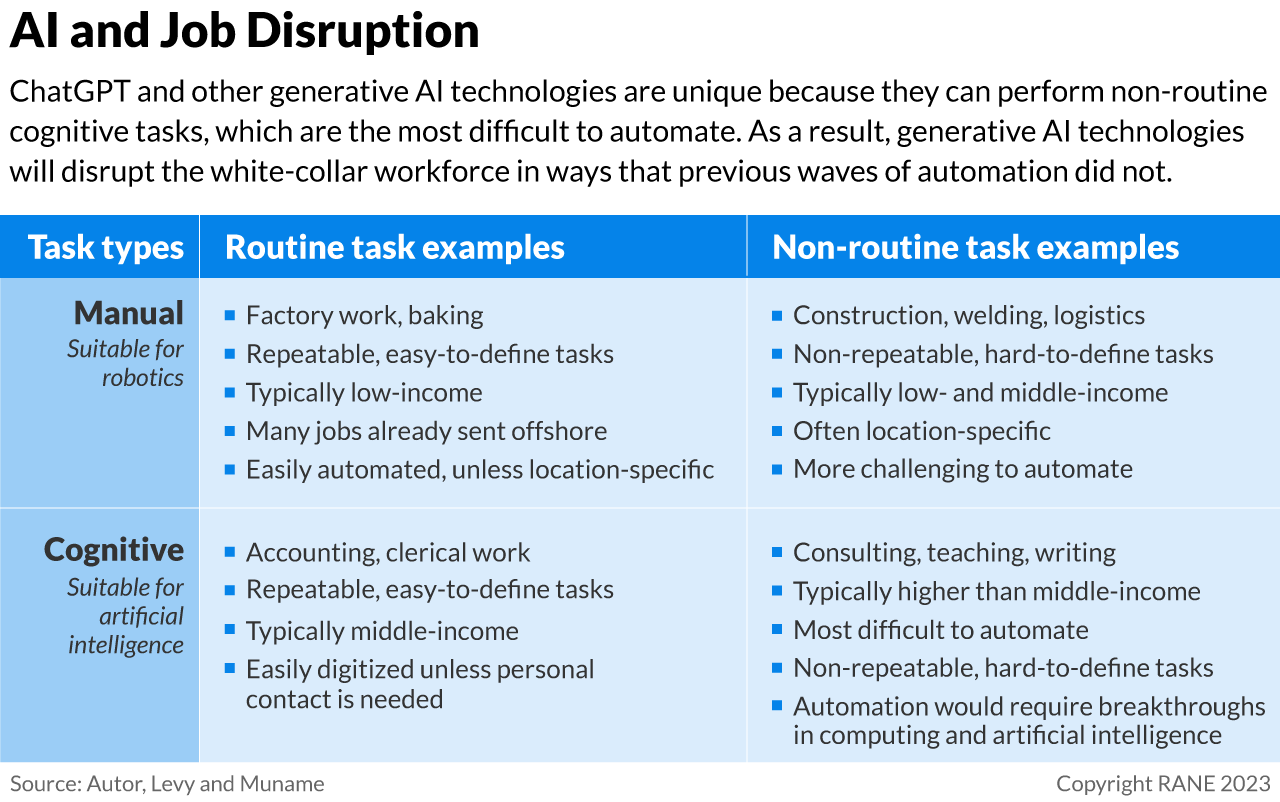
ChatGPT's and other generative AI's abilities to carry out non-routine tasks are demonstrating that AI can now perform cognitive tasks — many of which are performed by highly paid workers — previously reserved for humans. Compared with previous waves of automation, this development may disrupt more white-collar, highly educated and knowledge-focused jobs, as tasks previously performed by writers, editors, teachers, coders and many more professions may now be automated. This also may only be the starting point for chatbots, as it is not hard to imagine ChatGPT or a similar tool being more directly integrated into our email inboxes or linked to a voice assistant that pulls information directly from the internet, as Microsoft's Bing has done with ChatGPT.
Historically, innovative technologies like ChatGPT typically do not have a large macro-impact on employment levels, and there are countless academic studies showing that fears about automation's impact on employment are often overblown. Indeed, ChatGPT and other innovative technologies typically help create jobs and industries that simply did not exist beforehand (as virtually everyone reading this column is likely working in an industry that did not exist 100 years ago). ChatGPT and generative AI are also subject to a large degree of spurious results that in many industries will require human oversight, much like how humans still oversee the industrial shop floor. Moreover, in jobs where tasks are primarily cognitive, workers are likely to adapt and use AI tools to help automate less complicated cognitive tasks that free up their ability to focus on more important and complex tasks. For example, while ChatGPT may be able to write a halfway decent outline for a paper, many writers will then take up the pen to address more complicated material. In general, ChatGPT and other generative AI tools are likely to complement jobs people have, not replace them all.
Nevertheless, job dislocation and job displacement are likely to be a challenge that modern society and governments must address. In recent years, RANE has carried out a number of scenario planning exercises for the global geopolitical system, and one of them, which I like to call "Automation Disaster," focuses on how technology may change so rapidly that society and governments cannot keep up with a rapidly changing job market. In this scenario, Western societies face a significant crisis due to widespread structural unemployment that leads discouraged workers to aim violence at corporations, governments and other socioeconomic classes. Even if that extreme future does not come to pass, the following side effects could still occur.
- Wider Wealth and Income Inequality Gap: Numerous academic studies have shown that growing automation often leads to higher income and wealth inequality, as highly-skilled workers are more likely than lower-skilled workers to be able to take advantage of the new technology while continuing to perform tasks that cannot be automated. Tools like ChatGPT appear likely to have a similar effect. And in a paper published in the peer-reviewed journal Econometrica in November 2022, economists Benjamin Moll, Lukasz Rachel and Pascual Restrepo argue that new technologies also tend to benefit the owners of capital since they usually own and develop the technology in question. It is likely that this phenomenon will continue with ChatGPT, especially since leading technology firms (like Microsoft) are primarily developing these technologies.
- Erosion of Middle-Skilled Jobs: In a 2022 study, economists Daron Acemoglu and Jonas Loebbing found that "further automation pushes workers into tasks at the lower and upper ends of the task distribution." In other words, wage, labor and employment inequality is likely to occur because automation will force middle-skilled workers down the employment ladder to compete with less skilled (and presumably less well-compensated) workers, while highly skilled (and better compensated) workers will continue to carry out highly complex tasks.
- High Frictional Unemployment: A 2020 study by Acemoglu and Restrepo found that since 1987, industries that increased automation were no longer replacing jobs displaced by automation with other jobs. Frictional employment, which occurs when workers are searching for a new job, subsequently increased, and this pattern will likely continue in industries most affected by generative AI tools like ChatGPT. Additionally, a 2019 study by economists James Bessen, Maarten Goos, Anna Salomons and Wiljan van den Berge found that highly-skilled workers who lost higher-paying jobs due to automation found new employment more quickly than less-skilled workers who lost lower-paying jobs, even when they previously worked at the same firm. This study demonstrates that automation-driven frictional unemployment is often longer for lower-skilled workers, who are generally less able to adapt to a changing job market.
- Changes in Higher Education: The potential impact of generative AI tools, ChatGPT and other related technologies on the job market is also likely to affect people's attitudes toward certain subjects in higher learning. ChatGPT may significantly reduce the number of jobs available for entry-level work at law firms, editing and writing positions, and many customer service and sales positions, reducing the potential wages for students getting degrees in areas less suited for a changing job market. As a result, students may shift their attention away from these subjects in favor of other industries.
- Loss of Innovation: ChatGPT and other generative AI tools may impact people's critical thinking skills in the long term, particularly among younger generations of society that become dependent on the technology. Ultimately, these implications remain unclear, but a decline in workers' critical thinking skills could result in less human-led innovation.
No Society Will Be Immune
The seismic societal shift created by ChatGPT and generative AI will be felt in every corner of the world, though the exact impact will vary by country and region. In the United States, these tools will likely serve as yet another catalyst to further political and social polarization by exacerbating many of the societal challenges that the country has already been dealing with for decades — namely, wage inequality, wealth gaps and labor strife. Globalization and technological advancements have concentrated economic opportunities and political influence along America's coasts and away from its industrial- and manufacturing-heavy heartland — fueling political divisiveness, unrest and calls for more protectionist policies. This shift has arguably left the United States focused inward on domestic crises, even as it tries to retain its status as the world's main superpower. But compared with China and European powers, the United States is still better positioned to handle the impending economic disruptions brought on by ChatGPT and other generative AI technologies. The U.S. labor market, for one, is more flexible than the labor markets in many European and Asian countries, which will probably make it easier for U.S. workers that lose their job to find another one. U.S. technology companies and U.S. investors are also the ones spearheading the development of generative AI tools, giving the United States another advantage in preparing for and shaping this next stage of the technological revolution.
In Europe, a fractured regulatory environment and largely protective labor markets will continue to impede labor mobility. On one hand, this is likely to "save" some jobs, as labor unions, rigid labor market rules and other regulatory burdens will make it more difficult for workers to be laid off as AI enters the workplace. But it remains to be seen whether those same rigid labor rules will impede European companies' ability to quickly adopt AI technology, which could eventually affect their global competitiveness. Europe will also move to put into place more robust policies around worker training in order to deal with potentially more job friction (as will other governments around the world). Some European countries have been able to withstand some of the largest impacts of automation by using vocational training programs to enable workers to quickly move into different industries and also help lower-educated workers gain the necessary skills to find higher-skilled jobs. However, it remains unclear whether such training programs would work in a system where AI and automation increasingly perform middle-skilled tasks — leaving human workers to perform only high- or low-skilled tasks, which many vocational programs may be less suited to teach. Regardless, European political polarization and labor inequality could exacerbate societal divisions that are enabling more anti-establishment parties to gain traction, as well as increasing polarization between the Mediterranean and Northern Europe over economic policy and Eastern and Western Europe over wealth disparity. And rising inequality and the loss of middle-income jobs would only reinforce calls for a universal basic income, which is increasingly becoming an important piece of center-left parties' agenda in Europe. Moreover, the likely dominance of U.S. technology firms in the ChatGPT and generative AI revolution will lead to an even more hostile regulatory environment for U.S. technology companies in Europe.
In Asia, while some countries are positioned to quickly adopt AI technologies, they are unlikely to see the same level of success as Western countries. While China has garnered a reputation for being nearly as advanced as the United States in artificial intelligence, the country's leading technology companies appear to be scrambling to quickly catch up with ChatGPT. Beijing will likely use any generative AI tools that Chinese companies develop to help foster the Communist Party, but such tools are also likely to create polarization that undermines China's overall economic rebalancing strategy. While China's innovation hubs, such as Shenzhen, Shanghai and Beijing, have a high degree of skill specialization and labor flexibility that enable many workers to adapt to changing demands, the rest of China's economy has a more rigid labor market, and empirical evidence has found that, compared with the United States, many Chinese cities have been less resilient to automation in the past when it comes to jobs. It is likely that this pattern will continue. Nevertheless, in China and Japan, as well as other aging countries demographically (such as Germany), generative AI and ChatGPT can help mask and offset some of the impacts of demographic decline. Prior to ChatGPT, automation for robotics had been viewed as a way to relieve some of the demands for healthcare workers and physical assistants by utilizing technology to help patients, and now the emergence of ChatGPT and generative AI may be used for cognitive work with the elderly, such as for entertainment and to increase wellbeing.
The impact of generative AI and ChatGPT on developing countries is less clear, but they could negatively impact countries that export online knowledge and services in a globalized economy. Already, ChatGPT's ability to write and fix code is causing some to question the long-term impact on South Asia's software engineers and programmers. India and other South Asian countries are trying to move up the value chain through the development of an information technology industry as opposed to solely manufacturing, a strategy that contributed to the growth of China, South Korea and Taiwan decades before. However, the growth of robotics and automation has made this route less profitable, and it is possible that automation due to generative AI will make South Asia's trajectory toward digital services even more difficult.
