
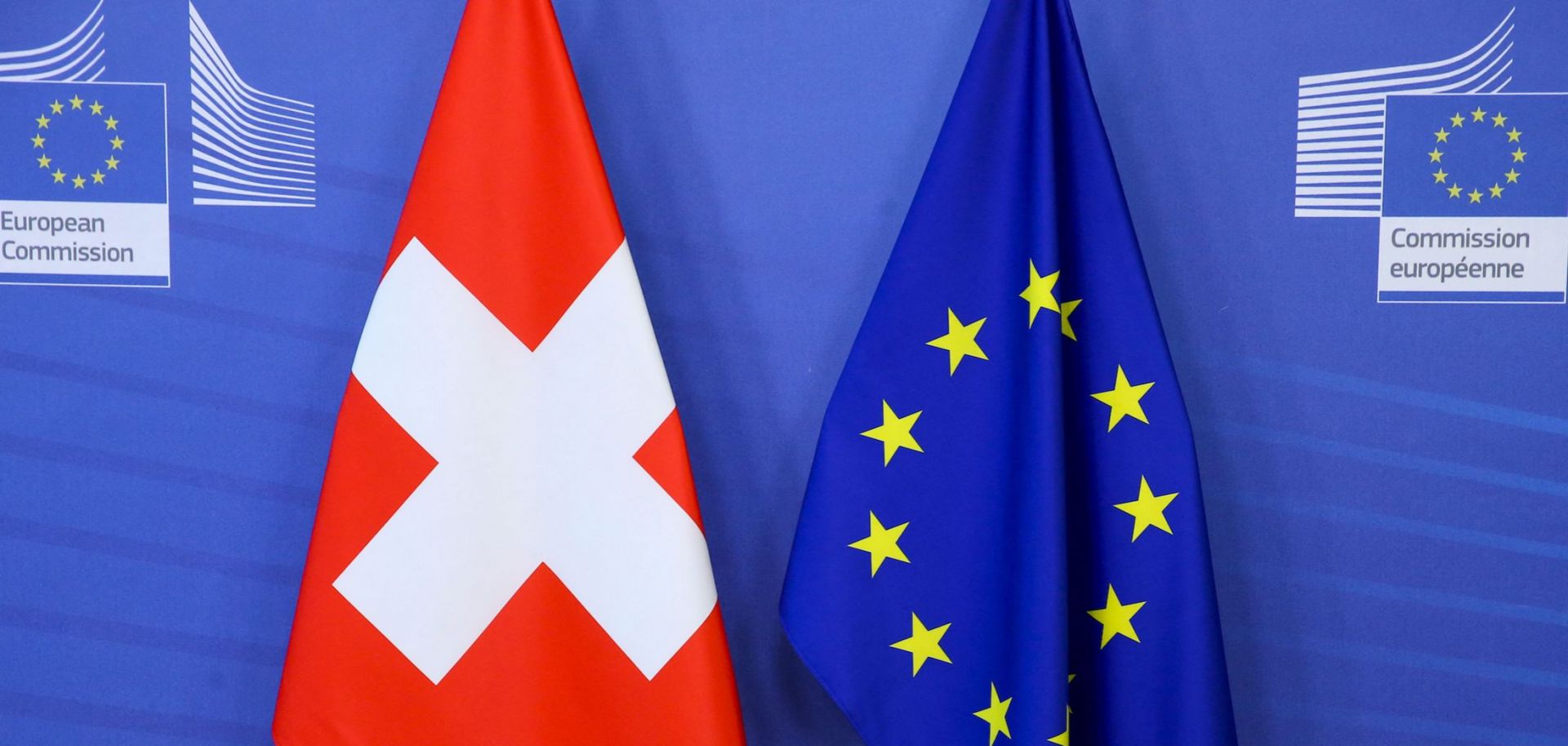
Switzerland's national flag (left) is pictured next to the EU flag at the European Commission building in Brussels, Belgium.
Switzerland’s decision not to update its partnership agreement with the European Union will create bilateral trade disruptions in the future as the existing deals expire or become outdated. Still, Bern and Brussels could eventually return to the negotiating table. Switzerland on May 26 put an end to talks with the European Union over a deal to update and upgrade their economic partnership. The Swiss government said that the deal would go against the country’s interests, but urged the European Union to preserve their existing ties. Under Switzerland’s political system, any deal would have to be ratified in a referendum. Right-wing parties are critical of the deal while polls suggest that voters could reject it, which probably influenced the Swiss government’s decision to end the negotiation.
- EU-Switzerland economic ties are regulated by more than 100 different bilateral treaties signed since the 1970s.
- The negotiations between Switzerland and the European Union over an Institutional Framework Agreement (InstA) began in 2014. If approved, the deal would have replaced the existing bilateral agreements with a comprehensive, updated legal framework.
- The InstA was supposed to include areas such as immigration, the mutual recognition of industrial standards, a longer list of agricultural products, state aid, medical devices, civil aviation and transport. On issues such as immigration, wages and accepting EU law, Switzerland felt that the deal would undermine its national sovereignty.
While the failure to approve the InstA will not significantly undermine Swiss-EU trade in the immediate term, Swiss and EU exporters now face higher uncertainty about the future of the bilateral relationship. While the InstA talks were scrapped, the existing deals between the European Union and Switzerland are still in place. But as technology advances, new products are created and regulations change, the increasingly obsolete arrangements between the European Union and Switzerland could hamper trade. In addition, some of the bilateral agreements have expiration dates and will require renegotiation, for which good political ties between the European Union and Switzerland will be essential. For example, a mutual recognition agreement for medical devices expired on May 26, which means that it will be harder for manufacturers in the sector to trade in the future. The InstA would also have granted Switzerland better market access for agricultural products such as meat and dairy.
- On May 26, the European Commission said it “regrets” Switzerland’s decision to end the negotiations and said that “privileged access to the single market must mean abiding by the same rules and obligations." The same day, Swissmem, which represents mechanical and electrical engineering companies, said that “the period of great uncertainty in relation to the most important sales market has been going on for far too long.”
- Growing tensions between the European Union and Switzerland have already strained the bilateral economic relationship. In 2019, Swiss stock markets lost their rights to serve EU customers after Bern and Brussels failed to reach an agreement on the issue.
The economic ties between the European Union and Switzerland are so tight that new negotiations are probable in the future, meaning the uncertainty could be only temporary. The European Union is Switzerland's main trading partner, while Switzerland is the European Union's fourth-largest trading partner. Switzerland’s exports of chemicals, pharmaceutical and medical products, machinery, instruments and watches to the European Union are central to the country’s economic well-being. Many EU countries rely on Swiss commercial services as well. These close trade ties suggest that, despite the current tensions, Bern and Brussels will remain interested in preserving, and potentially increasing, their economic relationship in the future.
- In a May 26 statement, the Swiss government said that it is “in the shared interest of Switzerland and the European Union” to “safeguard their well-established cooperation and to systematically maintain the agreements already in force.”
- The Swiss government also said it “wishes to launch a political dialogue with the European Union on continued cooperation” and that it has tasked the Federal Department of Justice and Police “to consider how autonomous amendments to Swiss legislation might contribute to the stabilization of Swiss–EU relations.”
