
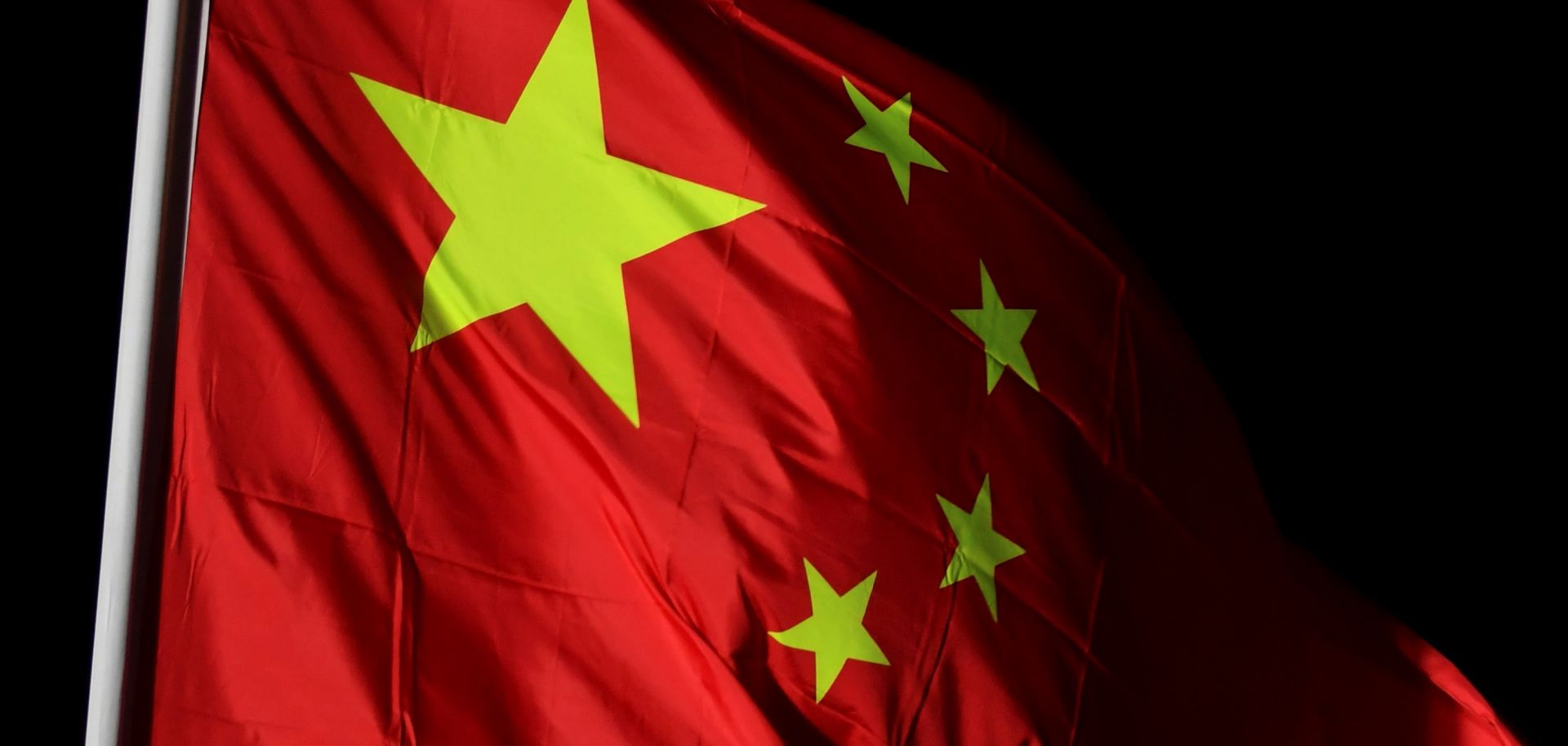
The flag of mainland China.
Editor's Note: As the prospect of renewed international travel returns over the course of 2021, companies and individuals find themselves at a potential inflection point when it comes to travel to China. The decision on whether to return comes amid increasing tensions between China, the United States and U.S. allies — and the associated threat of arbitrary detention of individuals for political reasons. While arbitrary detention of foreigners in China remains rare, the potential impacts are dire, and particularly for people involved in noncommercial, politically sensitive activity who are at higher risk of detention. There are limits, however, to how far China will go, and Beijing has demonstrated a preference for far less inflammatory tactics in its response to international political pressure. In the first of this two-part series, we will examine recent cases of Chinese arbitrary detention and consider Beijing's rationale for this activity. We will then evaluate whether there is something of a U.S. exception to this threat, and outline key considerations when planning travel to China.
The Biden administration announced at the end of April that it will start easing restrictions on Chinese students entering the United States over the course of the summer as universities tentatively prepare to go back in person this fall. China officially welcomed the move and has committed to easing restrictions on travelers who are fully vaccinated against COVID-19. Beijing hopes to return international travel to pre-pandemic levels by early 2022. But even if the disruptions caused by the global pandemic eventually fade away, a completely different set of disruptions is increasing concerns regarding travel to China.
Rethinking Post-Pandemic Travel to China
Anecdotal evidence suggests that American academics, nongovernmental organization workers, media professionals, business executives and consultants have become warier of traveling to China than they were before the pandemic due to deteriorating relations between Washington and Beijing. They also cite the passage of Hong Kong's National Security Law in summer 2020 as giving rise to concerns regarding travel to the historically more Western-friendly semiautonomous region. A Bloomberg article from December 2020 and a CNN article from March 2021 both cited concerns over travel to China from people who traveled there on a regular basis before the pandemic. They noted that, statistically, the threat was low given the large number of foreigners who traveled to China and the small number who were arrested on apparent political grounds. Even so, the consequences of detention in China are high. Those who have been detained previously have lost years of their life in a Chinese prison cell, cut off from their friends, family and livelihood. Granted, the evidence for a greater reluctance to travel to China so far is anecdotal and represents the concerns of a few dozen people rather than a randomized survey of the approximately 145 million people who traveled to China in 2019. But the concerns are nevertheless warranted, since even if international travel in 2021 looks more like it did in 2019 than during the pandemic, the same cannot be said about the U.S.-China relationship.
Travel to China was already accumulating risks before the pandemic made it impossible. Travelers presumably took notice in 2019 of the high-profile arrests of two Canadian nationals at the end of 2018. Chinese authorities detained Michael Kovrig and Michael Spavor on Dec. 10, 2018, without explanation or evidence. The timing of the detentions, just nine days after Canada arrested Huawei CFO and Chinese national Meng Wanzhou, gave rise to speculation that China was using them as pawns to retaliate for Canada's arrest of Meng. As the three cases progressed, more evidence supported the speculation: China officially charged Kovrig and Spavor with espionage in June 2020, about three weeks after a Canadian judge ruled that Meng's extradition case could proceed. Through not-so-subtle messaging, China appeared to be signaling to Canada that Kovrig and Spavor could expect the same treatment Meng receives. Shortly thereafter, Canadian Prime Minister Justin Trudeau referred to the affair as "hostage diplomacy," suggesting that China was trying to coerce Canada into releasing Meng.
While the pandemic and its associated restrictions on movement have eclipsed other concerns over travel, the issues fueling those concerns have persisted, and will continue long after the pandemic has ended. On the political level, despite U.S. President Joe Biden's easing of restrictions on Chinese students and general commitments to a coherent China policy, the new U.S. presidential administration has indicated that it will continue the Trump administration's overall hawkish approach. This ensures that more episodes of political, diplomatic and economic disputes will threaten to inflame tensions, potentially leading to threats and rash policy announcements as each side tries to emphasize its point. Such episodes, like the recent criticisms of China's human rights record in Xinjiang and resulting threats against companies responding to those concerns, tend to escalate anxieties over potential Chinese retaliation against foreign companies and personnel operating in China.
The Rationale for Politically Sensitive Arrests
In order to better assess the threat, it is important to understand the factors motivating the high-profile arrests outlined above. International relations theorist Stephen Walt has laid out four primary motivations behind the practice of detaining foreigners.
- The Face-Value Argument: When countries arrest foreigners, they are simply following their own local rules and are not engaging in political conspiracies. We should take at face value authorities' justifications that they cannot provide evidence of crimes implicating national security because that evidence must remain secret due its sensitive nature. The timing of arrests and nationality of the suspects are not connected to larger political goals and any links are either coincidence or the product of foreign governments seeking to undermine national sovereignty. For example, drug trafficking is a crime in China as elsewhere, so China is perfectly justified in arresting foreign nationals accused of the offense. Capital punishment is a common sentence for drug traffickers in China, so foreign nationals would not be exempt.
- Difference of Opinion: Countries define criminal, espionage and national security threats differently and have every right to do so. Other countries have very different political systems, and do not necessarily have the same level of tolerance for dissent, potentially elevating things seemingly as routine as gossiping over rumors about state leaders to the level of national security threat. Foreigners tacitly accept local laws by choosing to travel to a given destination, becoming subject to them just as anyone else there. For example, distributing books negatively portraying Chinese leaders in China is illegal and, regardless of freedoms to do so elsewhere, so a foreign national distributing such material in China would be criminally liable.
- Political Leverage: Countries arrest foreign nationals in order to gain negotiating leverage with other countries. Any charges against the detained individuals are grossly exaggerated or simply made up. Authorities can use foreign prisoners as bargaining chips for policy changes or the release of their own nationals detained abroad. For example, Canadian nationals Kevin and Julia Garratt were freed in 2016 after two years in custody on espionage charges following Canadian Prime Minister Justin Trudeau's inaugural visit to China, suggesting that political considerations outweighed the formal legal process.
- Nationalism/Internal Power Struggles: Foreign governments are not monoliths and national leaders may be negotiating with local leaders with differences of opinion as strong as those held by foreign rivals. Hard-liners can pressure more moderate political leaders by making arrests, forcing leaders to accept the arrests or risk looking weak or unsupportive of local leaders. Since local authorities are ultimately the ones who tend to make arrests, this is a way for them to acquire leverage over typically more powerful national leaders. There are no explicit examples of this in China, where national authorities tend to exercise greater control over local issues, but recent leaks show that Iranian Foreign Minister Mohammad Zarif griped about the Iranian Revolutionary Guard Corps usurping foreign relations through overly aggressive actions. Zarif did not explicitly mention detentions, but the IRGC has been most proactive on that front.
I would add a fifth to this list.
- Unequal Treatment Based on Ethnic Identity: Countries do not always treat foreign visitors equally and more authoritarian countries are especially likely to prioritize a visitor's ethnic background over the national citizenship stated in his/her passport. When it comes to detaining foreigners, countries like China and Iran have overwhelmingly detained foreign citizens of Chinese or Iranian descent, respectively. China, for example, does not recognize dual citizenship and has used any kind of legal ties to China (including relatives) as leverage against foreign passport holders of Chinese descent.
China is by no means alone in its practice of hostage diplomacy. Iran, North Korea (and even Western countries) have detained foreign nationals or used the detention of foreign nationals as bargaining chips to negotiate with rival countries. The threat of hostage diplomacy associated with China is greater, however, because far more foreigners travel there than to Iran or North Korea. Furthermore, China's tendency not to publish evidence supporting detentions and charges against foreigners makes it more difficult to distinguish legally justified detentions from politically motivated ones, creating greater uncertainty.
Next: The limitations of the practice, those most likely affected by it and other tools Beijing has to pressure foreign commercial and political interests.
