
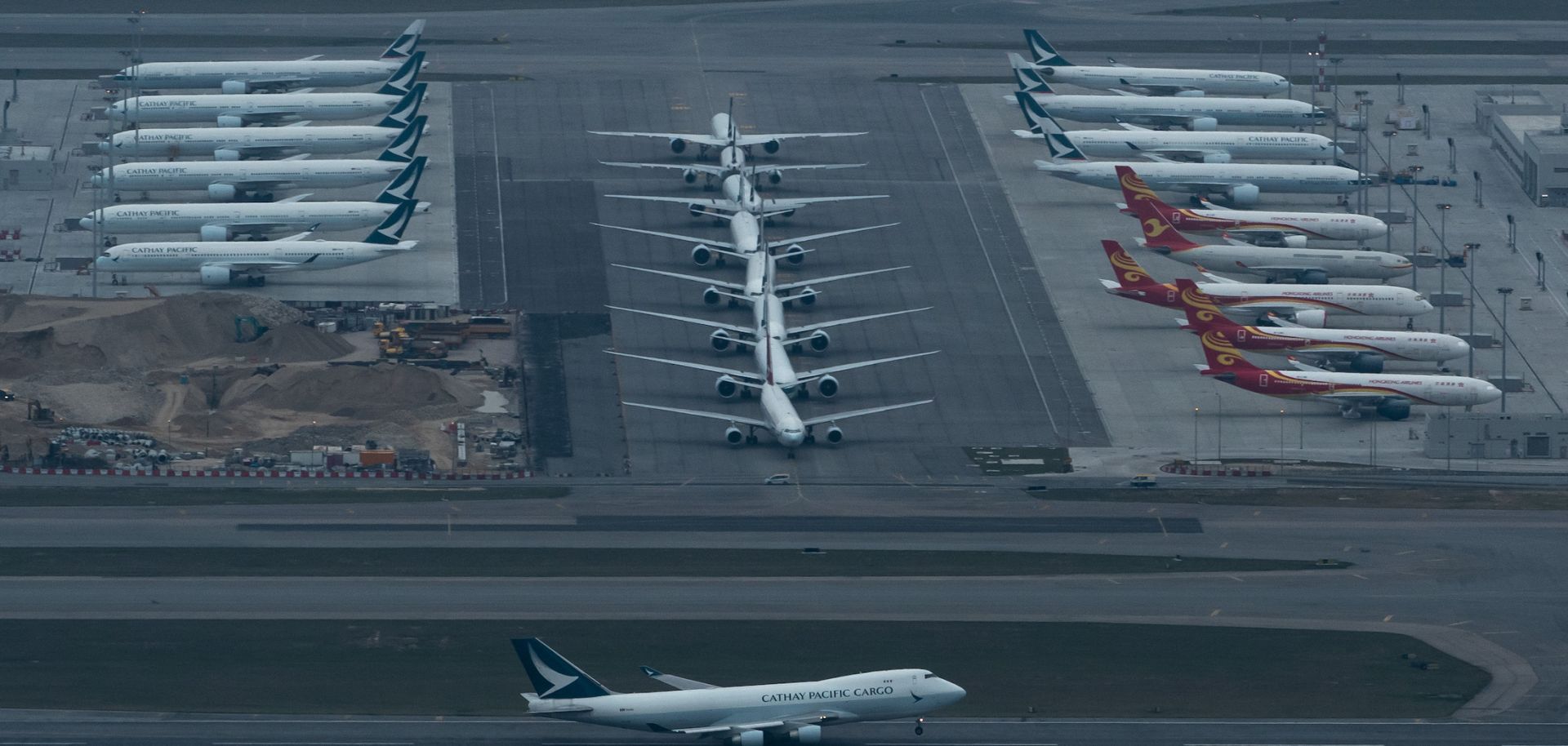
A Cathay Pacific aircraft takes off on a runway as others park at Hong Kong International Airport on March 6, 2020.
Editor's Note: This security-focused assessment is one of many such analyses found at Stratfor Threat Lens, a unique protective intelligence product designed with corporate security leaders in mind. Threat Lens enables industry professionals and organizations to anticipate, identify, measure and mitigate emerging threats to people, assets and intellectual property the world over. Threat Lens is the only unified solution that analyzes and forecasts security risk from a holistic perspective, bringing all the most relevant global insights into a single, interactive threat dashboard.
Ambiguities in Hong Kong's new immigration law may empower officials to prevent individuals from leaving the city even though authorities are unlikely to deploy mainland-style "exit bans" targeting foreigners. On April 28, Hong Kong's Legislative Council approved the long-awaited Immigration (Amendment) Bill 2020, which will come into effect Aug. 1, the Financial Times reported. This new law will require airlines and other transportation providers to provide passenger and crew member information to immigration officials before flights depart to allow for quicker passenger clearance but also to enhance immigration enforcement, including to prevent a passenger from boarding.
- With the enabling provisions now passed, the Hong Kong Security Bureau will next assemble subsidiary legislation providing details of the law, potentially before it enters force in August, which will once again go before the Legislative Council.
- First floated in 2018, the Security Bureau argues these measures are necessary to bring Hong Kong into compliance with changes in the International Civil Aviation Organization's Convention on International Civil Aviation, which now requires an Advance Passenger Information (API) system. The United States, EU member states, Canada, Australia and 60 other countries already have such a system.
Hong Kong pro-democracy forces and the Hong Kong Bar Association are concerned that the law's ambiguity may empower authorities to deploy targeted "exit bans" that could prevent Hong Kongers and foreigners from leaving the region at will. As with the Hong Kong extradition law that sparked 2019 protests, their concerns are rooted not in the precise provisions of the law, but in its ambiguities.
- Specifically, the law leaves it unclear whether the new API system would apply to passengers both entering and leaving Hong Kong. Much will now depend on whether the Security Bureau's follow-up provisions limit the scope of the legislation to only cover entry into Hong Kong, which is much less controversial given that it would not leave Hong Kongers or foreign residents stuck in the city under a travel ban and would more clearly apply to control of inbound immigration.
- Hong Kong officials, however, say such specificity is unnecessary given that Hong Kong residents have the right to enter and exit Hong Kong under the city's miniconstitution, the Hong Kong Basic Law. They also defend the changes as necessary to stem the arrival of refugees and asylum seekers to the city, which they criticize as wasteful of public resources.
For foreign businesses operating in Hong Kong, the law's ambiguity raises the risk that Hong Kong authorities could use the measures to prevent travelers or foreign residents that have run afoul of the government from leaving or entering the city. Authorities in mainland China have frequently used these tactics to compel U.S. and other travelers to participate in government investigations.
- In January 2019, the U.S. State Department warned travelers of the risk that Chinese authorities will prevent them from exiting the country without prior warning of a travel ban. Australia and Canada issued similar travel advisories.
- A May 2020 AP study examined 10 instances of mainland "exit bans" on Chinese as well as dual-nation U.S., Australian and Canadian citizens. It found that in most cases these were used to compel Chinese dual citizens to face prosecution, often by threatening dual citizens' relatives with "exit bans" as a means of compelling return.
- Already Hong Kong authorities have reportedly used visa delays and other bureaucratic hurdles to target Western journalists in the city, although this has been on a limited basis and largely meant to deter journalists from reporting adverse to Hong Kong or mainland government interests.
Hong Kong authorities are unlikely in the short term to impose "exit bans" as they — and officials in Beijing — have a strong interest in maintaining the city as a getaway for foreign capital into the mainland and as a regional business hub, although the risk will increase over time if Hong Kong's economic prominence within China wanes.
- Hong Kong and Chinese authorities have refrained from deploying the tough new National Security Law broadly against foreign businesses, allowing them to comply, for example, with Western sanctions.
- Additionally, Hong Kong already has legislation in place that allows courts to block foreigners from leaving the country in cases of business disputes. In contrast to the tightly controlled mainland judicial system, which leaves no room to appeal travel restrictions, Hong Kong's continued robust rule of law provides a check on the unrestrained application of immigration controls.
Officials are more likely in the near term to use the law to more proactively prevent the flight of Hong Kongers who may be involved in political activities that authorities interpret as running counter to Hong Kong or mainland interests.
- The new immigration laws may serve to augment already-sweeping government powers to monitor the movement of Hong Kongers by requiring transportation companies to more proactively report on their passengers, thereby enabling more rapid interdiction.
- Beijing and Hong Kong are interested in keeping dissidents inside the city to allow time for prosecution and to limit the growth of an overseas political exile community that could provide a critical global voice on Hong Kong political issues out of mainland and Hong Kong authorities' reach.
- As with protections on businesses, however, the implementation of travel bans on Hong Kongers will itself be partly limited by the city's rule of law that could allow anyone subject to such potential "exit bans" due process to challenge the measures.
