
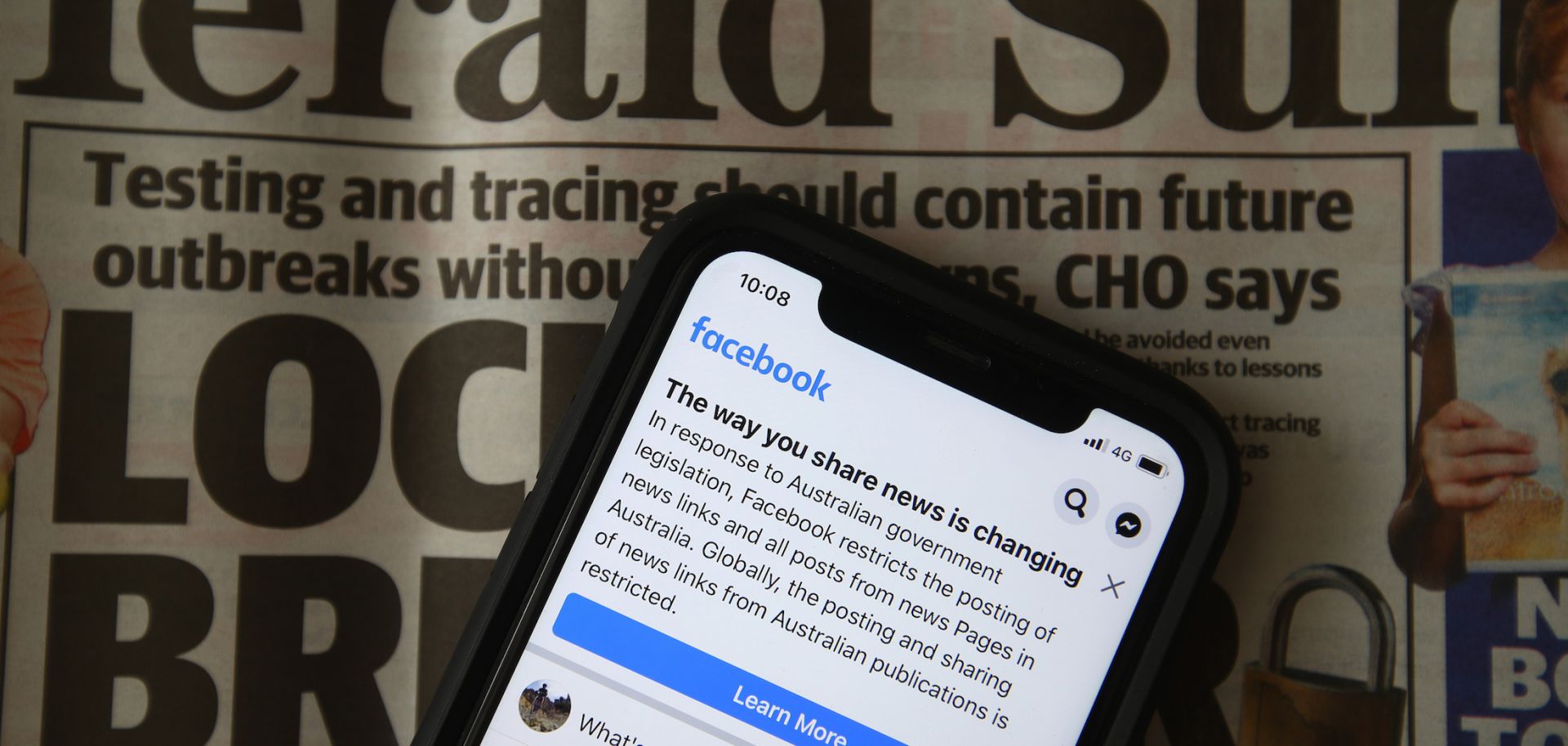
In this photo illustration, a message is seen on Facebook mobile on Feb. 18, 2021, in Melbourne, Australia.
Australia's proposed media code requiring Facebook and Google to pay for content from Australian media companies has prompted Facebook to pull some services as a message to Australia's government that it has overstepped the line. Early Feb. 18, Facebook made the surprise decision to block the newsfeed on its platform in Australia and block access to Australian news pages for users worldwide. At the same time, Facebook inadvertently disabled a raft of pages, including those relaying government public health information and those displaying weather warnings, along with several run by charities and politicians. Facebook called the last move accidental, and restored many late in the day, blaming the mix-up on a lack of clarity in Australia's definition of news content.
- Facebook's move came in response to Australia's proposed News Media and Digital Platforms Mandatory Bargaining Code, which would require Facebook and Google to negotiate with Australian media companies over news content and require arbitration if no agreement is reached.
- Australia's News Media and Digital Platforms Mandatory Bargaining Code passed the lower house on Feb. 17 and is now headed to the Senate, where it is likely to pass next week. It was formally introduced in parliament in December 2020, with potential implementation by mid-2021.
- Australian Prime Minister Scott Morrison said his government would not be intimidated and called the move "arrogant and disappointing," slamming Facebook for cutting off essential information on health and emergency services.
Facebook's move is meant to show the Australian government that its earlier threat to pull news services was not empty, with the company seeking to demonstrate the impact of such legislation on social media access and associated revenue for Australian companies. Facebook leadership may believe its strategy could compel lawmakers to soften the legislation and build up leverage over Australian publishers to strike favorable deals with the company. The strategy, however, risks sparking a political backlash against the platform in Australia.
- With Australian nationwide elections potentially looming between August 2021 and May 2022, Australia's ruling Liberal-National coalition may be more unwilling to back down on the planned legislation in the face of such high-profile pressure much as it has doubled down on its hard-line China policy in the face of Chinese economic pressure.
- Facebook may succeed, however, in incentivizing some alterations of the bill when the Senate considers it. It is unclear whether Facebook’s move to block news in Australia will be permanent. Australian Treasurer Josh Frydenberg said he had a constructive conversation with the company on Feb. 18, building on talks earlier in the week that he had characterized as yielding progress.
- While Google has also threatened to cut some services, it has since opted for a softer approach, negotiating one-on-one with major Australian media companies ahead of time in hopes of avoiding mandatory arbitration, striking (among others) a deal with News Corp. on Feb. 17.
