
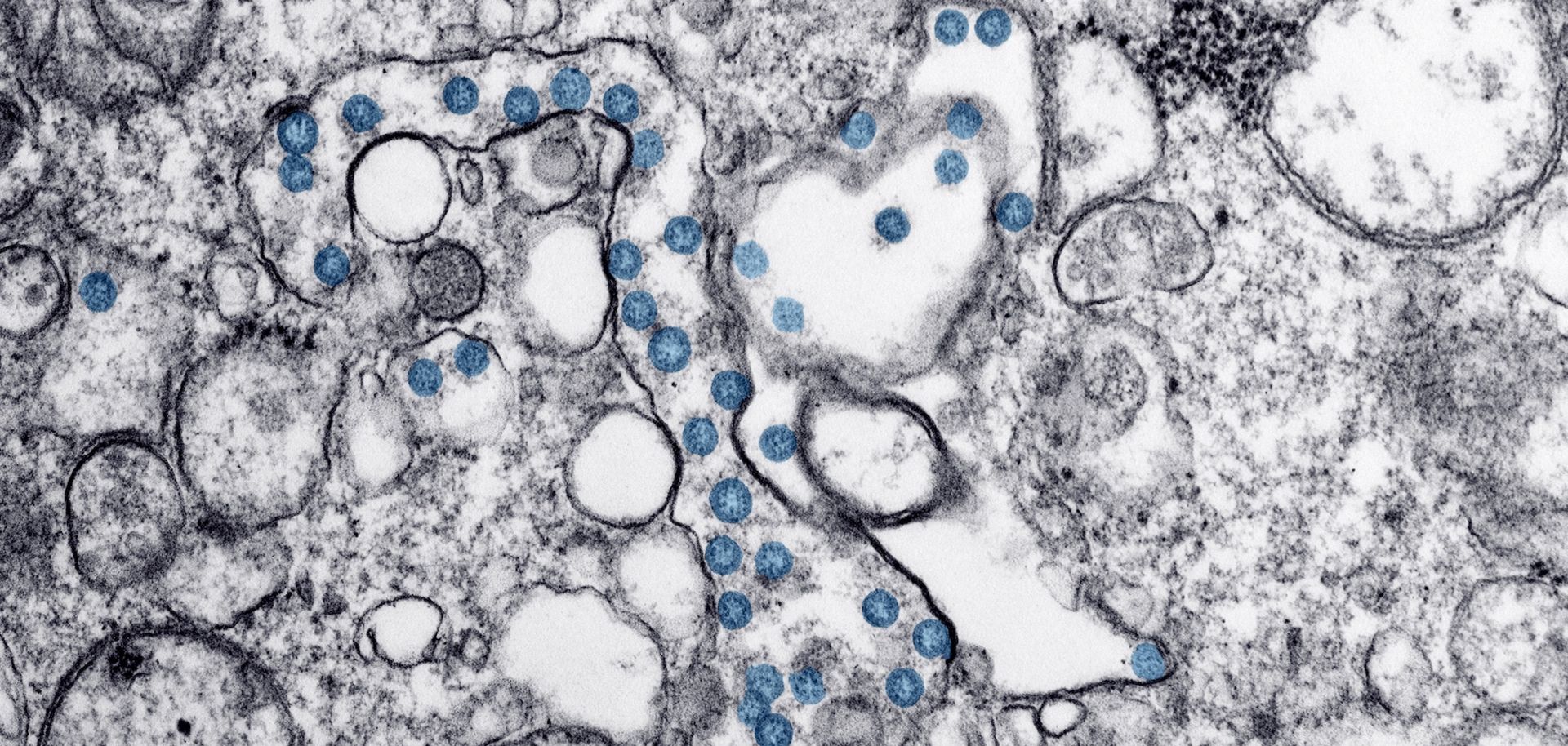
A transmission electron microscopic image of an isolate from a COVID-19 case in March 2020.
A mutation of the virus that causes COVID-19 is compounding struggles with pandemic management in the United Kingdom and upending travel and critical imports from the European Union, highlighting the broader question of the impact of mutations on COVID-19 transmission and the efficacy of new vaccines. Over the weekend, the European Union and other countries imposed stringent travel restrictions on travel and trade with the United Kingdom. While these measures will prove temporary, similar restrictions on other countries may occur elsewhere as cases associated with mutations become more prevalent. Even as vaccination campaigns begin, questions will persist regarding how mutated viruses will shape infection numbers and possibly treatment, leading to greater uncertainty and caution as the world crawls toward a recovery.
- A new variant of the SARS-CoV-2, the virus that causes COVID-19, dubbed B.1.1.7 was detected for the first time in September in the United Kingdom. Health officials reviewing data Dec. 8 recognized the emergence of new hot spots and the mutant strain has now become a dominant strain in both London and Kent, according to Science.
- The strain contains 17 new mutations, impacting the virus' ability to bind to and infect cells, and also enabling it to evade some of the body's immune response.
- Previously, the virus had been mutating at a steady rate of one to two new mutations per month. The unprecedented number of mutations within this new strain suggest it probably arose in an immunocompromised patient with a chronic case of COVID-19.
- The key mutations have been seen previously in other variations of the virus, but never all together.
- Early data suggests that the new variation of the virus may be up to 70% more infectious than previous strains.
- Without a notable change in the hospitalization rate, however, early indications are that the severity of the new strain is not substantially different.
- The variation presents differently in PCR tests, meaning that exhaustive sequencing will not be necessary to track the variation's path.
EU governments temporarily banned all flights to and from the United Kingdom in an attempt to mitigate the spread of the new strain of the virus in the Continent. While the European Commission has recommended that restrictions on essential travel should be lifted, restrictions on business- and leisure-related travel will probably remain in place for a longer period (potentially weeks), which would further damage the already-battered tourism and hospitality industries.
- The French government said Dec. 21 that the reopening of its border would happen hand in hand with the increase of testing for truck drivers.
- Supermarket chains in the United Kingdom warned that the availability of some products, such as fresh vegetables, could be at risk if imports aren't resumed quickly. In addition to flights, train service connecting the United Kingdom with France, Belgium and the Netherlands has also been suspended.
- More than two dozen countries, including many European countries, Canada, Argentina, India and Israel, have suspended inbound travel from the United Kingdom.
The high frequency of mutations in many viruses and the previous emergence of multiple strains of SARS-CoV-2 suggest that travel restrictions may delay, but won't necessarily prevent, the spread of the new variant. Pandemic management policy will quickly shift to the question of whether newly approved vaccines remain effective against mutated strains. Governments in continental Europe may be forced to tighten lockdown measures in the coming days, which will negatively impact economic activity. There will likely be similar approaches as it becomes clear in the coming weeks where other outbreaks of this new strain occur. This means that governments in continental Europe may be forced to tighten their lockdown measures in the coming days even as they begin vaccine campaigns, which will negatively impact economic activity.
- The new variant of the virus has already been detected in Australia, the Netherlands and Belgium. Given that its first detection was in September, we will likely see other pockets of this strain emerge around the world.
- Another completely distinct mutated variant has been detected in South Africa, and Pretoria's recent struggles in controlling the outbreak are being linked to the new mutation.
More data is needed to determine the impacts these new mutations will have on overall efficacy; vaccines with emergency authorization will continue to be administered, and early data indicates that they are likely to remain effective. Recently approved vaccines were tested on multiple variants during development. Current theory on the new set of mutations, however, suggests that health officials could change treatment protocols or review and even adjust the controversial prioritization for vaccination target groups. With staggered vaccine rollouts and increased uncertainty, businesses and communities should expect these punctuated disruptions to occur throughout 2021 as more information is gathered in this rapidly evolving situation.
- The unknown patient of origin possibly received convalescent plasma and other experimental treatments; should further evidence emerge that the combination of immunosuppression and these treatments contributed to the virus' opportunity to mutate, treatment protocols could be reevaluated.
- The United Kingdom became among the first developed nations to authorize the use of the Pfizer-BioNTech vaccine earlier in December and has begun vaccinating all vulnerable populations.
- The United States has approved the Pfizer and Moderna vaccines for emergency use and has begun vaccination for health care workers and nursing home residents.
- The European Medicines Agency on Dec. 21 authorized the vaccine developed by BioNTech and Pfizer, and many EU governments will start vaccinating their populations Dec. 27.
